
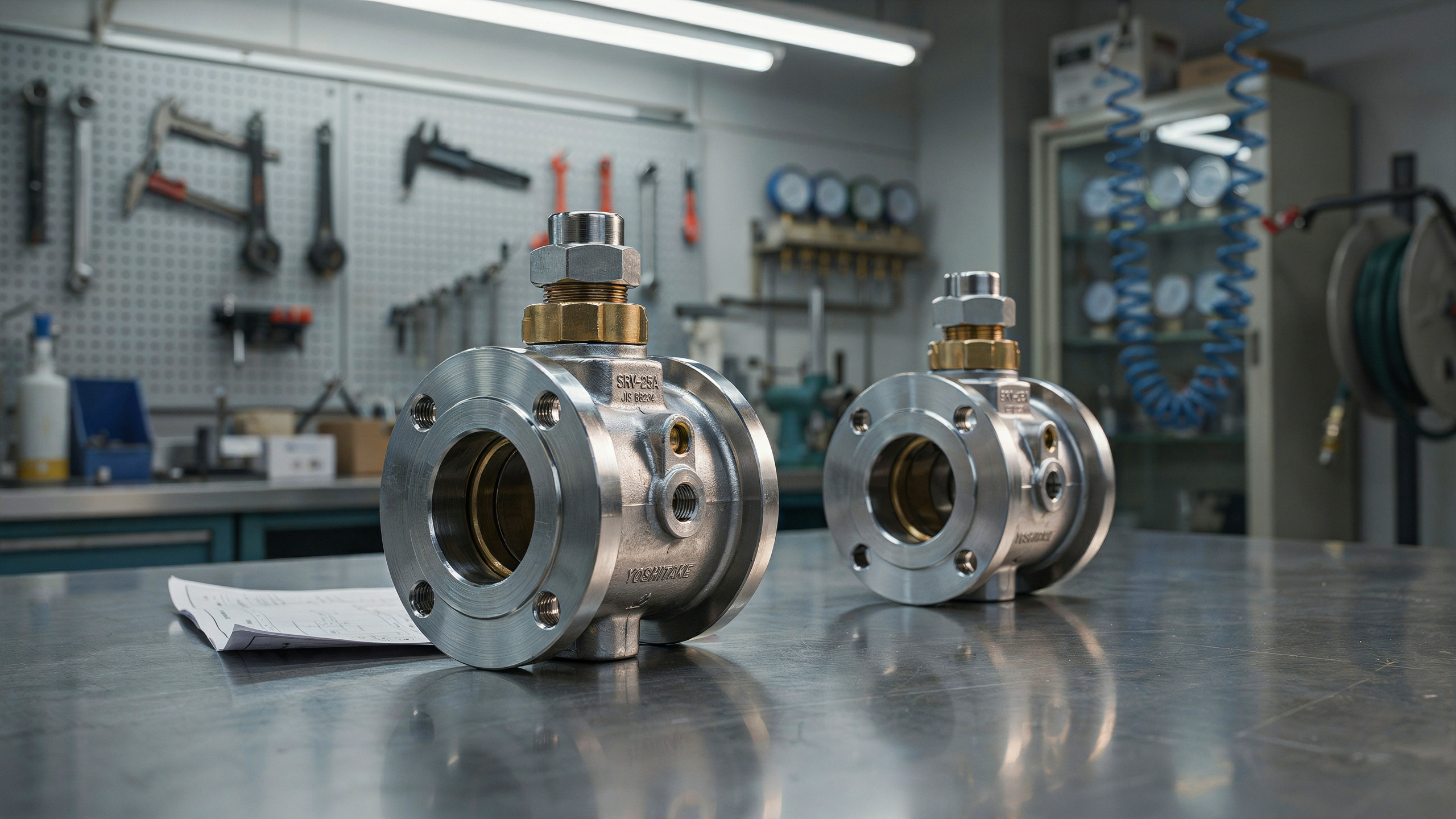
Why Are Yoshitake Safety Valves Trusted on the Plant Floor? Selection Points Based on Precision and Long Service Life
Yoshitake safety valves are “field-grade” valves that combine precise pressure setting with high corrosion resistance and durability. Compared with general-purpose products in the same class, they are chosen for their low leakage risk and stable long-term operation. The combination of finely segmented pressure ranges, SCS14A-equivalent stainless steel, and a sealed structure makes them well suited to equipment you don’t want to shut down for 5 to 10 years at a time—and that’s their biggest defining feature.
Key Points of This Article
This article organizes why Yoshitake safety valves are chosen in the field—not just by spec sheets covering materials and structure, but through the hands-on sense of real selection and inspection work. If you’re unsure whether to put Yoshitake products on your shortlist, keeping these three points in mind will make the decision easier.
- You’ll understand what’s really behind Yoshitake’s “precision machining,” “corrosion resistance,” and “safety”
- You’ll get a concrete picture of common selection mistakes and how Yoshitake differs from other makers’ general-purpose products
- You’ll have a clear yardstick for when you should “consult right away”
Today’s Recap: 3 Key Takeaways
- Finely segmented pressure ranges and precision finishing produce stable set (popping) pressure
- The use of stainless steels such as SCS14A reduces corrosion-driven trouble
- A sealed structure and proper O-ring selection keep leakage risk and maintenance frequency down
The Bottom Line
- In one sentence, Yoshitake safety valves are pro-grade valves chosen for “precision and long service life.”
- What matters most is determining whether the “set-pressure accuracy,” “seat material,” and “sealed structure” match your own equipment conditions.
- To avoid mistakes, don’t choose on price alone—sort out the four factors of fluid, pressure range, corrosion factors, and inspection cycle before putting Yoshitake products on the list.
Three Reasons Yoshitake Safety Valves Are “Trusted in the Field”
Precision Machining and Finely Segmented Pressure Ranges Stabilize the “Popping Point”
Yoshitake’s flagship AL-150 series segments pressure ranges finely and uses advanced ultra-precision finishing, which stabilizes the set (popping) pressure of the safety valve. For a safety valve, the lifeline is “at what pressure it reliably opens and over what range it reseats.” When that’s vague, the field is forced to build in an excessive safety margin.
In fact, when I once helped select piping equipment for a chemical plant, there was a line where we switched from another maker’s product to Yoshitake’s AL-150. Before that, a line set at 0.6 MPa would “open sometimes and not others” depending on the season and load fluctuations, and operators had to fine-tune operation while keeping an eye on the pressure gauge. After switching to the AL-150, the popping pressure came in almost exactly as intended, and the moments where operators had to rely on a “weird gut feel” dropped sharply.
A common assumption is, “Safety valves are standardized products, so any maker’s is the same, right?” To be honest, when you only look at catalogs, the nominal bore, connection, and pressure range look nearly identical across makers, so it’s understandable to think that way. But the more a maker like Yoshitake finely segments pressure ranges and refines the spring-and-seat combination, the higher the repeatability on actual equipment—and the smaller the “set pressure ± α” tends to be.
As a voice from the field, I once heard this from a boiler-equipment manager:
“With the old valve, every inspection ended with ‘well, this is about right.’ After switching to Yoshitake, I get the feeling of ‘ah, it opened exactly as set.’ The numbers feel trustworthy.”
That sense of “trustworthy numbers” is a pretty important point for anyone carrying responsibility for operation.
Corrosion Resistance and Durability from SCS14A and All-Stainless Construction
In the Yoshitake AL-150 series, SCS14A (equivalent to SUS316) is used for the valve body and seat, raising resistance to corrosion. Furthermore, on models explicitly described as “all-stainless,” such as the AL-31, the design assumes long-term use in corrosive environments.
Beyond water and steam—on lines carrying chemicals or oil content, and on outdoor piping exposed to the elements—iron-based materials can develop red rust or pitting in 3 to 5 years. In fact, at a food plant where I accompanied an inspection, another maker’s cast-iron-body / stainless-seat safety valve had corroded around the flange in its seventh year, with “frayed” red rust spreading beneath the paint. The Yoshitake stainless-body safety valve used on the expansion side of the same line showed almost no body corrosion even at five years after installation, and the judgment was that it could be reused after simply cleaning the seat contact face.
It depends on the case, but even if the statutory inspection cycle for boilers and pressure vessels is once every 1 to 2 years, the total lifecycle cost changes considerably depending on whether you replace “the valve itself” every 3 years or keep it running for 8 to 10 years. To be honest, when you look only at initial cost, a cheaper general-purpose safety valve can look more attractive in the moment. But with a design like Yoshitake’s that “lasts a long time” through highly corrosion-resistant materials and a simple structure, once you include the labor of replacement, shutdown, and inspection, the cost tends to reverse when viewed over a 5- to 10-year span.
Low Leakage Risk Through a Sealed Structure and O-Ring Use
Yoshitake safety valves adopt a sealed (closed) structure, with a design that suppresses external fluid leakage. The AL-150 series is explicitly stated to have “no external leakage thanks to its sealed structure,” and the AL-140T and AL-150T use an O-ring at the valve disc seat to raise airtightness and sealing performance.
O-ring material needs to be changed according to the fluid, and the optimal material varies with chemical type, oil type, and temperature conditions. A common pattern is deciding “the standard one is fine,” and later having the O-ring swell or harden and leak. On this point, Yoshitake’s support information clearly states that “O-ring material change can be considered depending on the fluid,” so the product is built on the premise of material selection at the design stage.
As a voice from the field, a manager using the AL-140T on a compressor air line shared this:
“The safety valve we used before had a habit of slowly bleeding pressure when shut down, so the tank was often at zero before we started the compressor first thing in the morning. After switching to Yoshitake’s sealed type, the tank pressure is still mostly there the next morning, and the startup time got noticeably shorter.”
It’s only a change on the order of “the morning startup got easier,” but for a site that feels it every single day, that ties directly to a sense of trust.
When You Should Choose Yoshitake—Seen Through Comparison with Other Makers
Sorting Out the Differences from General-Purpose Products (Performance, Durability, Maintainability)
When comparing Yoshitake with other makers’ general-purpose safety valves, the key points fall broadly into three: “pressure-setting accuracy,” “material / corrosion resistance,” and “maintainability.” The following summarizes general tendencies as a rough image (figures are illustrative examples of representative ranges).
| Item | Yoshitake safety valve (e.g., AL-150) | Typical general-purpose safety valve |
|---|---|---|
| Pressure ranges | Finely segmented; can be set in fine steps such as 0.05–1.3 MPa | Covers a wide pressure range in one band |
| Material (body / disc) | SCS14A (SUS316 equivalent) and all-stainless models available | Cast iron + stainless seat, etc. |
| Structure | Sealed structure, explicitly stated as no external leakage | Many are open type or semi-sealed |
| Airtightness | Models with O-ring seat available; emphasis on airtightness | Mostly metal-to-metal, with larger allowable leakage |
| Applications | Widely adopted for boilers, pressure vessels, instrumentation, etc. | Mainly for general-purpose equipment |
| Maintainability | Simple structure + clearly specified parts | Disassembly/adjustment can be complex on some models |
On a project I was involved in, a line that started with a “cheap general-purpose product for now” exceeded the allowable leakage at its third-year periodic inspection, while only the Yoshitake-side line added at the same time stayed within spec. At that point we standardized the existing lines on Yoshitake as well, with the reasoning that “for the next five years we want to avoid worrying about valve unit-to-unit variation.”
Common Failure Patterns (Price, Over-Spec, Selection Mistakes)
The common failures in choosing safety valves boil down to these three:
- Judging on price alone and not considering corrosion-resistance or airtightness requirements
- Choosing over-spec materials or pressure ranges, so only the cost balloons
- Leaving fluid conditions or temperature ranges vague and ending up with the wrong O-ring or sealing material
To be honest, some sites drop Yoshitake from consideration based only on the image of “Yoshitake = expensive.” But for equipment like boilers and pressure vessels, where a once-in-a-while accident can become a matter of corporate trust, it’s also a fact that a difference of a few thousand to a few tens of thousands of yen per year can determine whether you can “sleep soundly.”
On the other hand, whether you need to install Yoshitake’s top grade on every line is not something I’d assert. It depends on the case, but for “auxiliary lines with low corrosivity and short annual operating hours,” a general-purpose valve plus periodic replacement can sometimes come out cheaper in total cost. That’s exactly why a perspective of deciding “where to spend on cost and where to compromise” by looking at the equipment as a whole is important.
What Kind of Site Should Make Yoshitake the First Choice
Putting together my own experience and what I’ve heard from site managers, the situations where you should make Yoshitake the “first choice” are sites where conditions like these come together:
- Equipment where the impact of a “once-in-a-while” accident is large, such as steam boilers and various pressure vessels
- Lines in food, pharmaceuticals, chemicals, and the like, where corrosion or leakage directly affects product quality
- Equipment where you want to minimize human monitoring as much as possible, such as unattended nighttime operation
- Locations where frequent replacement is difficult due to piping or installation-space constraints
Conversely, for equipment where risk and cost aren’t that high—such as an “auxiliary tank for a compressor that only runs during the day” or a “low-pressure clean-water line”—it’s realistic to compare several candidates including Yoshitake and decide while weighing the cost balance.
“How much loss per hour does this line cause if it stops?” “In an emergency, how much is protected automatically, and where does the human eye take over?”
If you decide the grade of the safety valve while writing out questions like these on paper, it becomes easier to break out of the vague judgment of “Yoshitake is expensive, so let’s just skip it.”
Frequently Asked Questions (FAQ)
Q1: About what percentage longer do Yoshitake safety valves last than other makers’?
A1: There is no published “X% longer life” figure, but thanks to the use of SCS14A and all-stainless construction, corrosion-driven trouble clearly tends to occur less than with typical cast-iron-based products. In practical terms, they are often chosen at sites that want to “take a line previously replaced every 3 years and run it over a 5- to 10-year span.”
Q2: Should I choose the AL-150 or the AL-31?
A2: The AL-150 is a sealed type using SCS14A with excellent corrosion resistance and is widely used for general pressure equipment such as boilers. The AL-31 is all-stainless and places even more emphasis on corrosion resistance and durability, so it suits lines in strongly corrosive environments or equipment intended for long-term use.
Q3: What number should be the top priority in selecting a safety valve?
A3: The top priority is the “set pressure (popping pressure)” and the “applicable pressure range.” Next, the rule of thumb is to decide on material selection (SCS14A or all-stainless, O-ring material, etc.) based on temperature, fluid type, and corrosion factors.
Q4: Can Yoshitake safety valves be used for fluids other than steam?
A4: Yes. General-purpose-type safety valves that handle water, oil, air, non-hazardous fluids, and the like are also in the lineup. However, since each fluid has suitable and unsuitable O-ring materials and structures, you need to choose while checking the specification sheet.
Q5: What are the benefits of a sealed structure?
A5: A sealed structure suppresses external fluid leakage, contributing to safety and reduced environmental risk. In particular, for fluids involving gas, steam, or odor, whether or not the valve is a sealed type ties directly to the safety of the surrounding environment and workers.
Q6: Where can I buy Yoshitake safety valves?
A6: Yoshitake products can be purchased through industrial-equipment trading companies and online stores (such as MonotaRO). Since the usual approach is to order by specifying the model and set pressure, it goes smoothly if you organize the specifications in advance.
Q7: When switching an existing valve to Yoshitake, what should I check first?
A7: The first step is to note, one by one, the existing nominal bore, set pressure, fluid, temperature, and connection standard (flange standard / thread standard). Next, writing out the problems occurring with the existing valve (corrosion, leakage, unstable popping, etc.) makes it easier to match against Yoshitake’s recommended model.
Q8: Is there any point in being conscious of differences between makers?
A8: Yes, there is. Summarizing catalog information is easy, but first-hand information such as “how it held up after years of use” and “under what conditions it failed” is hard to capture. The more a maker like Yoshitake clearly emphasizes differences in material and structure, the more the “gap” tends to show in long-term operation—so selection from a field perspective will remain important going forward.
Summary
- Yoshitake safety valves are designed to raise “popping stability” through finely segmented pressure ranges and ultra-precision finishing.
- By using SCS14A and all-stainless materials, they make it easier to suppress trouble from corrosion and long-term use.
- Through a sealed structure and O-ring use, they have a strength in reducing external leakage and leak risk.
- Initial cost can be higher than other makers’ general-purpose products, but considering 5- to 10-year lifecycle cost and safety, in many cases they end up the “more economical” choice.
- It’s important to identify the equipment that should make Yoshitake the first choice from the perspective of “how much trouble it causes if this line stops” and “how much corrosion or leakage risk you can tolerate.”
If you’re unsure, start by putting a Yoshitake safety valve on the shortlist for even just your “line you least want to stop,” organize the existing conditions and issues, and then consult a trading company or the maker’s technical staff.