
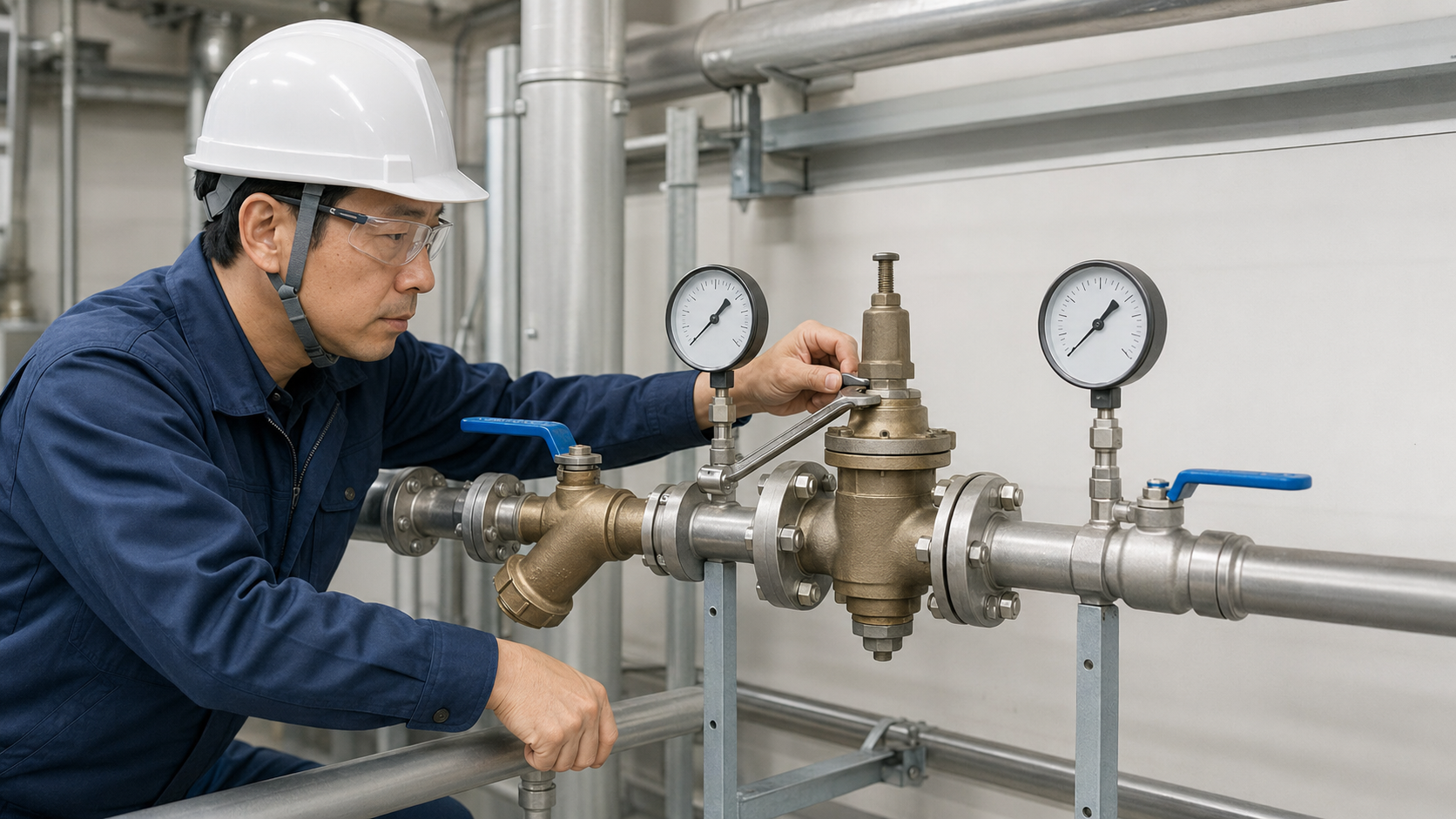
To select a pressure reducing valve correctly, the process is to first confirm four points—”type of fluid, inlet (primary side) pressure, outlet (secondary side) pressure, and required flow rate”—and only then consider the bore size, materials, and reduction ratio, in that order. This article first organizes the selection procedure, then explains the possible causes and countermeasures when the secondary-side pressure fails to stabilize after selection, along with the points to check in the field. In many cases where the secondary pressure does not stabilize, one of the selection conditions is off, or there is a reason related to the installation or operating conditions. Let us check each item one by one, following the procedure.
Key Points of This Article
- The starting point for selecting a pressure reducing valve is to first confirm four points: the type of fluid, the primary-side pressure, the secondary-side pressure, and the required flow rate.
- When the reduction ratio is large, consider two-stage pressure reduction; when the range of used flow rate is wide, consider parallel installation.
- When the secondary pressure does not stabilize, check in order for foreign matter trapped in the valve, deviations in flow conditions, the installation location, and so on.
Procedure for Selecting a Pressure Reducing Valve
Selection is not about “choosing one good valve,” but about confirming, in order, the specifications that match the conditions of the equipment. Proceeding in the following order leads to a selection with no excess or shortfall.
First, Confirm the Four Conditions
The first things to confirm are four points: the type of fluid, the primary-side pressure, the secondary-side pressure, and the required flow rate.
For the fluid, the suitable structure and materials change depending on whether it is steam, water, air, oil, and so on. For the primary-side pressure, confirm the maximum and minimum of the supplied pressure and its range of fluctuation. The secondary-side pressure is the working pressure required by the equipment side. For the required flow rate, it is important to confirm not only the maximum but also the minimum operating condition. This is because if the minimum flow rate is too small, it can become a cause of the hunting (fine up-and-down fluctuation of the pressure) described later.
Only once these four points are determined can you narrow down the bore size, connection type, body material, spring range, and so on. Conversely, if you select based on bore size alone while these remain vague, it tends to become a cause of unstable secondary pressure.
Consider the Configuration According to the Reduction Ratio and Flow Range
When the difference between the primary pressure and the secondary pressure is large (the reduction ratio is large), reducing the pressure all at once with a single valve can make control difficult to stabilize. In such cases, consider a configuration that uses two-stage pressure reduction, arranging two valves in series to drop the pressure in stages.
Also, on a line where the used flow rate varies widely from minimum to maximum, a single valve can make it difficult to stabilize on the low-flow side. In this case, installing pressure reducing valves of different bore sizes in parallel and sharing the load according to the flow rate makes it easier to stabilize over a wide range. In either case, since it depends on the conditions, make the judgment based on the actual ranges of the primary pressure, secondary pressure, and flow rate.
Confirm the Installation Layout
The stability of a pressure reducing valve also changes depending on where it is placed. On a steam line, for example, the pressure and flow are apt to be disturbed immediately after the boiler outlet, so rather than mounting the valve directly there, installing it after passing through a header or just before the equipment to be used tends to stabilize more easily.
In addition, providing a strainer on the primary side to protect the valve seat from foreign matter, securing appropriate straight-pipe sections before and after, and providing pressure gauges at positions where the pressure can be checked are also prerequisites for stable operation.
Causes and Countermeasures When the Secondary-Side Pressure Does Not Stabilize
Even when you believe you have selected correctly, problems can occur in which the secondary pressure fluctuates up and down, or stays higher (or lower) than the setting and does not return. Since there is not always a single cause, check the following points in order.
Common Causes and Countermeasures
Foreign matter or scale becoming trapped is one of the representative causes. When foreign matter is caught in the valve seat, the valve cannot close fully, and the secondary pressure becomes difficult to reduce. Inspect and clean the strainer for clogging and the interior of the valve.
Deviations in flow conditions are also frequently seen. If the actual used flow rate is smaller than the selected range, hunting—in which the pressure fluctuates finely up and down—is apt to occur; conversely, if it is excessive, the secondary pressure may drop. Reconfirm the minimum and maximum of the used flow rate, and consider parallel installation of a small-capacity valve or two-stage pressure reduction as needed.
Besides these, fluctuation of the primary pressure itself, flow disturbance due to the installation location or insufficient straight pipe, and wear or damage of the diaphragm or main valve from long-term use can also be factors. When wear or damage is suspected, consider disassembly inspection and parts replacement.
Conditions Worth Checking in the Field
To isolate a problem, confirming not only the symptoms but also the specific conditions in the field makes it easier to pinpoint the cause. The things worth confirming are the measured values of the primary and secondary pressures, the flow conditions during use (minimum and maximum), the cycle and timing at which the pressure fluctuates, the presence of any abnormal noise or leakage, and the installation drawing and the model of the pressure reducing valve.
Once these are known, it becomes easier to judge whether the problem is a deviation in the selection conditions or something due to the installation or aging deterioration. If you are unsure of the judgment, providing this information when consulting the manufacturer will help the confirmation proceed quickly.
Frequently Asked Questions
Q1. What should be decided first in selection?
A1. The four points: the type of fluid, the primary-side pressure, the secondary-side pressure, and the required flow rate. Considering the bore size and materials after these are determined leads to a selection with no excess or shortfall.
Q2. When should two-stage pressure reduction be considered?
A2. It is a guideline for when the difference between the primary pressure and the secondary pressure is large. Rather than reducing the pressure all at once with a single valve, dropping it in stages with two valves can be easier to stabilize.
Q3. When is parallel installation effective?
A3. Consider it when the used flow rate varies widely from minimum to maximum. It can be helpful when stability on the low-flow side is the issue.
Q4. Why does the secondary pressure fluctuate finely up and down?
A4. It is one of the symptoms that is apt to occur when the used flow rate is smaller than the selected range. Reconfirming the used flow rate and considering a valve of smaller capacity are countermeasures.
Q5. Are there points to be careful about regarding the installation location?
A5. On a steam line, a position after passing through a header or just before the equipment tends to be more stable than immediately after the boiler outlet. Also check the straight-pipe sections before and after and the installation of a strainer.
Q6. When there is a problem, what information helps the manufacturer respond quickly?
A6. The measured values of the primary and secondary pressures, the used flow rate, the cycle of the symptoms, the presence of abnormal noise or leakage, and the installation drawing and model. Having these helps the isolation of the cause proceed more easily.
Summary
Selecting a pressure reducing valve begins with confirming four points: the type of fluid, the primary-side pressure, the secondary-side pressure, and the required flow rate. Considering two-stage pressure reduction or parallel installation according to the reduction ratio and flow range, and thinking through everything including the installation layout, is the shortcut to stabilizing the secondary pressure. Even when the pressure does not stabilize after selection, checking foreign matter, flow conditions, the installation location, and so on in order will, in most cases, narrow down the cause.
If you have concerns such as “I know the maximum required flow rate but not the minimum, so I cannot decide which pressure reducing valve to choose,” “the difference between the primary and secondary pressures is large and I am unsure whether to use two-stage pressure reduction,” “I want to select an equivalent product to an existing valve,” or “the secondary pressure does not stabilize and I want to isolate whether the cause is in the selection conditions or the installation,” please make use of Yoshitake’s technical and selection consultation. We will ask about the conditions of your equipment and assist you from selection through to isolating the cause of a problem.