
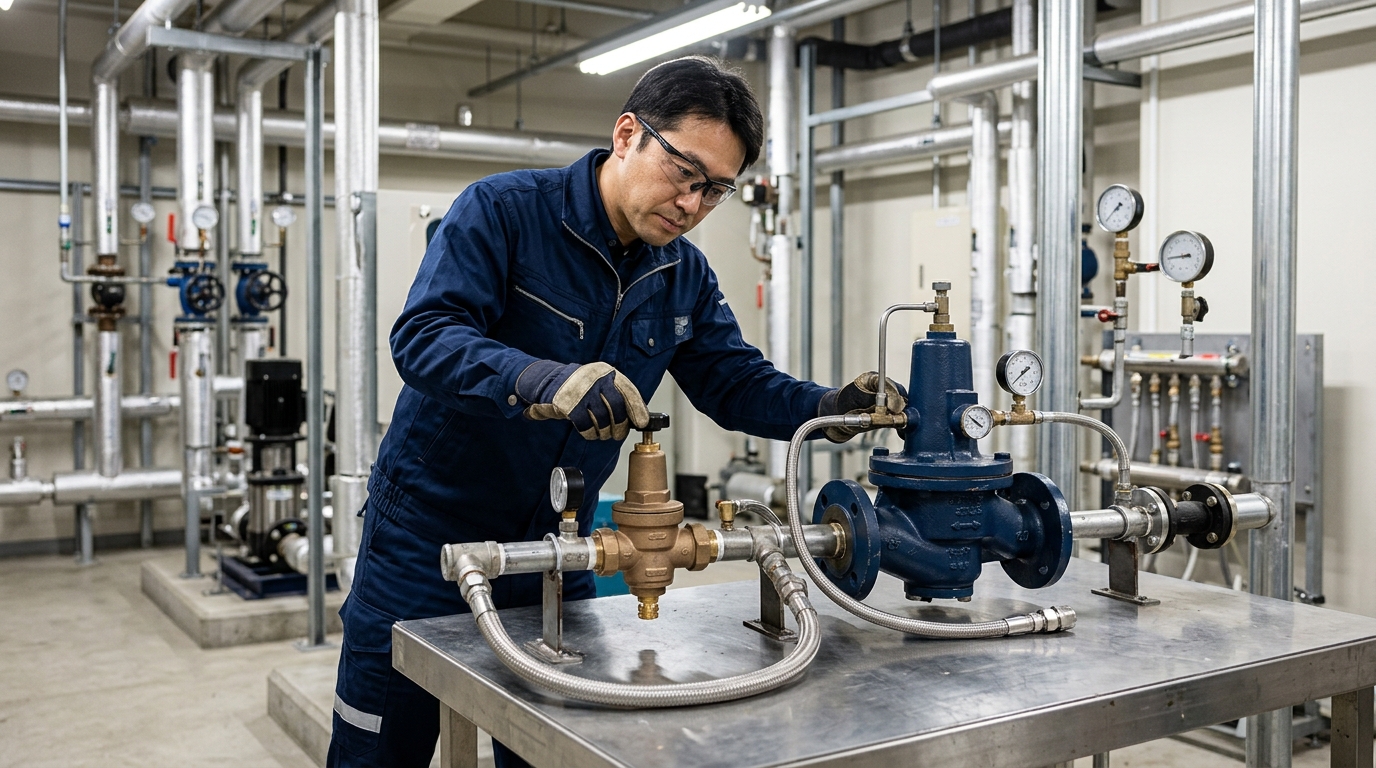
Direct-acting and pilot-operated pressure reducing valves differ in the “control mechanism” they use to stabilize the secondary (downstream) pressure, and this difference produces variations in the flow range each type handles well and in the stability of the secondary pressure (pressure characteristics). Broadly speaking, direct-acting valves suit low-flow applications or those with small flow fluctuations, while pilot-operated valves suit high-flow applications or those where the secondary pressure must be held as constant as possible. Actual selection, however, is not determined by flow rate and accuracy alone. It is judged by considering the fluid type, primary pressure, secondary pressure, maximum and minimum flow rates, required Cv, reduction ratio, flow fluctuation, installation environment, and other conditions together. The mechanisms and key points for making this decision are organized below.
Key points of this article
- The basic difference: direct-acting = simple direct control, suited to low flow; pilot-operated = indirect control, strong in high flow and secondary pressure stability
- “Accuracy” can be compared concretely by looking mainly at the drop in secondary pressure when flow changes (offset / pressure characteristics)
- Selection is a comprehensive judgment across multiple conditions. It is important to check not only the maximum flow rate but also the minimum flow rate and the reduction ratio
Differences in the mechanisms of direct-acting and pilot-operated valves
Direct-acting pressure reducing valve
In a direct-acting valve, the secondary pressure is received directly by a diaphragm (or piston), and the valve opening is determined by the balance against the force of the adjusting spring. The operation is simple: when the secondary pressure falls, the spring opens the valve, and when it rises, the valve closes. With few components, it offers the advantage of easy maintenance.
On the other hand, as flow increases the amount of spring compression changes, so the secondary pressure tends to drop somewhat below the set value (offset, a drop in the pressure characteristic). This makes it an easy-to-handle type for applications with small flow fluctuations or relatively low flow rates.
Pilot-operated pressure reducing valve
A pilot-operated valve is an indirect control system in which a separate pilot section controls the opening and closing of the main valve according to the secondary pressure. The pilot section detects even a slight change in the secondary pressure and converts and amplifies it into a pressure that drives the main valve. As a result, even when the flow rate fluctuates greatly, the drop in secondary pressure is small, and a relatively flat pressure characteristic is obtained.
In return, the structure is more complex, and there are conditions for its operation: a certain amount of differential pressure between the primary and secondary sides is required, and control tends to be unstable in extremely low-flow ranges. It is the type chosen for high-flow applications or those where the secondary pressure must be held constant with high accuracy.
Criteria for deciding which to choose
Viewing “accuracy” concretely through the pressure characteristic
The accuracy of a pressure reducing valve is easier to compare when captured not as an abstract good-or-bad, but as how much the secondary pressure moves when the flow rate changes (offset / pressure characteristic). The more the equipment requires the secondary pressure to be held constant, the more it demands a characteristic with a small drop during flow fluctuation, and on this point pilot-operated valves tend to have the advantage.
Conversely, for applications that can tolerate some fluctuation in the secondary pressure and have small flow fluctuations, the pressure characteristic of a direct-acting valve is often sufficient.
Judging by considering flow and pressure conditions together
For selection, check conditions such as the following together.
- Fluid type (steam, water, air, oil, etc.) and temperature
- Primary pressure, secondary pressure, and reduction ratio
- Maximum flow rate, minimum flow rate, and the range of flow fluctuation
- Required Cv (required flow coefficient)
- Installation space, maintainability, and the allowable pressure characteristic
The minimum flow rate is especially easy to overlook. Pilot-operated valves can be unstable when the minimum flow rate is extremely small, and selecting a valve based on the maximum flow rate alone can result in an oversized bore, which can also cause hunting.
Points to note
The bore should, as a basic principle, be selected from the required flow rate and Cv rather than “matched to the pipe size.” An oversized bore can lead to instability in the very-low-flow range and to disturbances in the pressure characteristic. Using the flow diagram (pressure characteristic curve) in the catalog, confirm that the expected minimum to maximum flow range falls within an appropriate range.
Frequently asked questions
Q1. Which is higher-performing, direct-acting or pilot-operated?
A1. There is no uniform superiority. Pilot-operated valves have the advantage in secondary pressure stability (pressure characteristics) and in handling high flow, while direct-acting valves are easier to handle in terms of low flow, simplicity, and maintainability. The choice is made according to the application conditions.
Q2. What specifically determines the accuracy of the secondary pressure?
A2. It appears mainly as the drop in secondary pressure when the flow changes (offset). The larger the flow fluctuation and the more the secondary pressure must be held constant, the more a flat pressure characteristic is required.
Q3. Which is suited to applications with a small minimum flow rate?
A3. In general, direct-acting valves tend to be easier to handle in extremely low-flow ranges. Because pilot-operated valves have operating conditions to satisfy, we recommend checking in advance when the minimum flow rate is unknown.
Q4. How should I choose when the reduction ratio is large?
A4. For large reduction ratios and high primary pressures, pilot-operated valves tend to be a strong candidate. However, since this depends on the differential pressure and flow conditions, the decision is made after organizing the conditions.
Q5. Should the bore be matched to the pipe size?
A5. As a basic principle, it should be selected from the required flow rate and required Cv rather than the pipe diameter. An oversized bore can invite instability at very low flow.
Q6. Does selection differ between steam use and water/air use?
A6. Yes, it does. Because the suitable model and specifications differ depending on the fluid and temperature, selection is made including the fluid conditions.
Summary
The difference between direct-acting and pilot-operated valves lies in the mechanism that controls the secondary pressure and, as a result, in the pressure characteristics and the flow range each handles. As a basic guideline, choose direct-acting for low flow or when simplicity is a priority, and pilot-operated for high flow or when secondary pressure stability is a priority. In practice, however, selection is a comprehensive judgment across conditions such as fluid, pressure, flow rate, reduction ratio, and required Cv. All figures are guidelines only and vary with the conditions.
If you find yourself in situations such as “I know the pipe size but cannot judge whether the bore is appropriate,” “I know the maximum flow rate but not the minimum flow rate,” “I want to select an equivalent to an existing valve,” or “I want to know how far the drop in secondary pressure can be suppressed,” Yoshitake can help with your selection once you have organized the operating conditions. Please feel free to contact us for technical and selection consultation, along with conditions such as fluid, primary pressure, secondary pressure, and flow rate.