
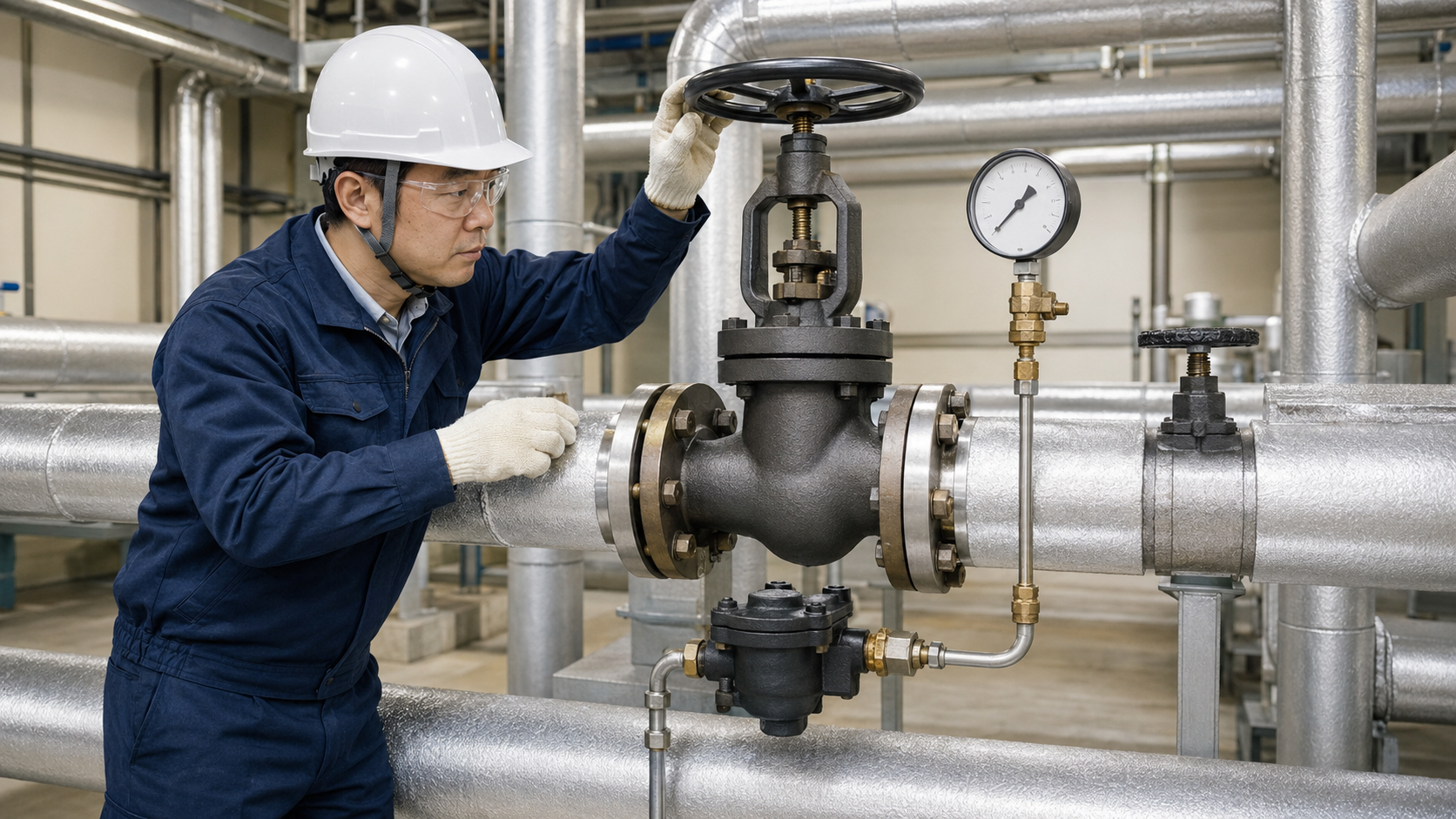
Valves used in steam lines are not simply components that “pass or stop” steam. They are functional components that condition the steam to match the pressure and temperature required by the equipment, delivering it in a stable and safe manner. For this reason, selection is not a matter of “choosing a single valve.” The fundamental approach is to treat the pressure reducing valve as the core and consider the strainer, safety valve, and trap together as one combined set. This article organizes the way of thinking behind selecting valves for steam equipment, along with a list of key decision points to keep in mind.
Key points of this article
- Steam valves are functional components for “matching pressure and temperature to the equipment’s specifications.” As a rule, they should be selected for the line as a whole rather than as standalone units.
- Installing a pressure reducing valve makes a strainer and safety valve necessary as accompanying items, and when the straight-pipe distance is long, an intermediate trap should also be considered.
- Thermal efficiency and energy savings are effects obtained as a result of selection. First comes building a configuration that satisfies the specifications and safety.
The role valves play in a steam line
Steam produced in a boiler is not necessarily sent to each piece of equipment at the same high pressure and temperature at which it was generated. Many devices have a “usable pressure range” defined as a specification, and the steam condition must be adjusted to fit that range. The valves in a steam line are what handle this “conditioning.”
The first consideration is “matching the equipment’s specifications”
The starting point of selection is not energy savings or thermal efficiency, but the required specifications on the equipment side. The first objective is to check the operating pressure, temperature, and required flow rate, and to close the gap with the steam pressure on the supply side.
For example, when the supply pressure is higher than the equipment’s operating pressure, a mechanism to lower the pressure is needed. Here, a pressure reducing valve is installed to adjust the secondary side to a pressure that matches the equipment’s specifications. Conversely, supplying steam as is without reducing the pressure can affect the equipment’s pressure resistance or controllability.
Installing a pressure reducing valve also makes surrounding equipment necessary
A pressure reducing valve cannot stand on its own. To make it function stably, several pieces of equipment accompany it upstream and downstream.
On the primary side, it is common to install a strainer to protect the valve seat from scale and debris in the steam. This is because foreign matter caught in the valve can be a cause of unstable pressure adjustment or leakage. On the secondary side, a safety valve is combined to protect the equipment in case the pressure rises beyond expectations due to a malfunction of the pressure reducing valve or similar issue.
In this way, the decision to “install a pressure reducing valve” is almost synonymous with selecting a single combined configuration that includes the strainer and safety valve.
Consider selection as the “whole line,” not as a “point”
When individual valves are selected in isolation, the conditions may not match for the piping as a whole. It is important to make decisions from the overall picture, taking into account the circumstances unique to steam lines.
When the straight-pipe distance is long, drain countermeasures are added
As steam flows through the piping, it loses heat, and a portion condenses into drain (condensate). In sections with a long straight-pipe distance or just before a riser, drain tends to accumulate along the way, and if left unaddressed, it can be a factor in carryover into the equipment or in water hammer.
In such sections, a configuration that installs an intermediate trap to properly discharge the drain should be considered. Removing drain on the primary side is also an important prerequisite for maintaining the performance of the pressure reducing valve.
Treat thermal efficiency and energy savings as a “result”
Thermal efficiency and energy savings are often discussed when talking about steam equipment. However, at the point of selection, it is practical to first build a configuration that satisfies the specifications and safety, and to regard efficiency as an effect obtained as a result. The details of efficiency design are covered in a separate article.
We recommend first checking the combination across the whole line, with the focus on whether “the configuration can supply the pressure and flow rate matched to the equipment’s specifications safely and stably.”
Frequently asked questions
Q1. Is it enough to select just one type of steam valve?
A1. In many cases, a strainer, safety valve, and other items accompany the pressure reducing valve at the core. We recommend considering the combination for the whole line rather than a single unit.
Q2. Is a strainer always required before the pressure reducing valve?
A2. To protect the valve seat from foreign matter in the steam, it is generally installed on the primary side. Although it depends on the conditions, installation is recommended in many situations from the standpoint of stable operation.
Q3. For what purpose is a safety valve installed?
A3. Its purpose is to protect the equipment in case the secondary-side pressure rises beyond expectations due to a malfunction of the pressure reducing valve or similar issue. The set pressure is chosen based on the equipment’s allowable range.
Q4. When should an intermediate trap be considered?
A4. A general guide is when drain tends to accumulate, such as in sections with a long straight-pipe distance. It can help suppress water hammer and carryover of drain.
Q5. What should be decided first?
A5. The basic starting point is checking the operating pressure, temperature, and required flow rate on the equipment side. Based on the difference from the supply pressure, the configuration of the pressure reducing valve and surrounding equipment is built.
Q6. Is it acceptable to prioritize energy savings in the selection?
A6. It is practical to first have a configuration that satisfies the specifications and safety, and to regard efficiency as a result of that. Efficiency design is considered according to individual conditions.
Summary
The selection of valves for a steam line starts from conditioning the pressure and temperature to match the equipment’s specifications. Installing a pressure reducing valve brings along a strainer and safety valve, and if the straight-pipe distance is long, an intermediate trap also comes into view. Rather than choosing a single valve, thinking of the whole line as one combined configuration is the shortcut to stable operation.
If you have concerns such as “I can’t judge whether the secondary-side bore size is appropriate,” “I don’t know which pressure reducing valve to choose based on the difference between the supply pressure and the equipment’s operating pressure,” or “I want to select an equivalent product to an existing valve,” please make use of Yoshitake’s technical consultation and selection consultation services. We will ask about your equipment conditions and help you with a selection that takes the entire configuration into account.