
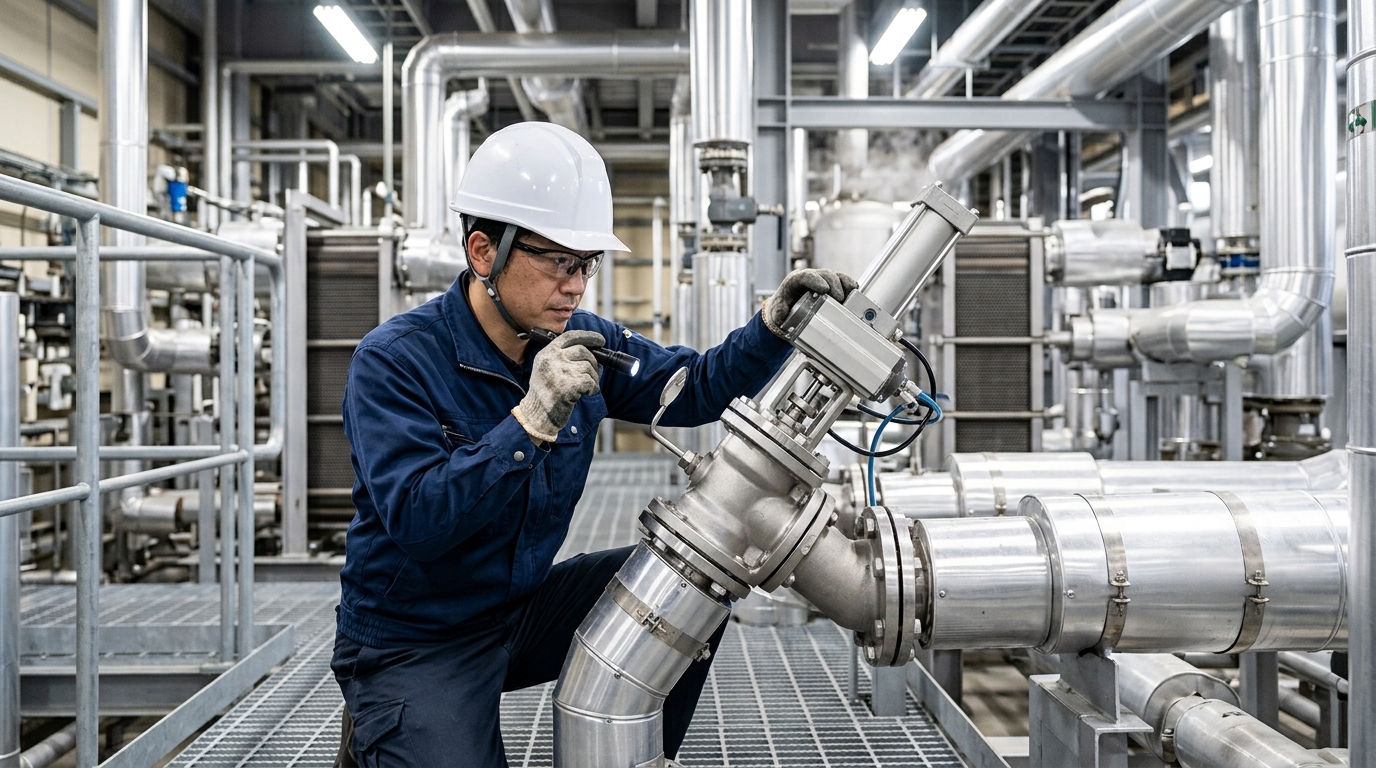
An angle seat valve is an on-off valve in which the valve seat is positioned at an angle to the flow path (generally around 45 degrees) and is opened and closed by a piston-type actuator. The angled seat and the nearly straight flow path result in low fluid resistance when fully open, and because the valve disc lifts well clear of the flow path when opening, the structure allows relatively free flow even for high-temperature fluids such as steam and hot water, as well as fluids containing particles or fibers. This article organizes the structural characteristics of angle seat valves and the fluids and applications for which they are chosen.
Key points of this article
- The angled seat and straight-line flow path give low fluid resistance, making it easy to achieve a large Cv value.
- Because the valve disc lifts far from the flow path, there is a tendency for foreign matter and viscous fluids to accumulate less readily.
- They suit high-frequency on-off operation and on-off service for high-temperature fluids, with material selection matched to the operating temperature and fluid.
Structure and characteristics of angle seat valves
Low fluid resistance from the angled seat structure
The most distinctive feature of an angle seat valve is that the valve seat is arranged at an angle to the axis of the flow path. When fully open, the valve disc (plunger) retracts well clear of the flow path, and the flow follows a nearly straight path. Compared with a globe valve of the same nominal size, this makes it easier to keep pressure loss low and to obtain a large Cv value (flow coefficient). It is an easy-to-handle type for piping where you want to secure flow rate or keep pressure loss small.
Reliable opening and closing with a piston-type actuator
Many angle seat valves are equipped with a piston-type actuator driven by compressed air, and the actuator’s thrust raises and lowers the valve disc to open and close it. Combining a spring with air pressure, you can select normally closed (NC), which opens when energized (air supplied) and closes with no air supply, or the opposite, normally open (NO). Because it is mechanically simple with few moving parts and responds quickly, it is also well suited to high-frequency on-off applications that repeat many times a day.
Why they are chosen for high-temperature fluids and fluids containing foreign matter
Angle seat valves are used for high-temperature fluids not because “high temperature makes other valves prone to clogging,” but because of the structural advantages this type possesses. Because the valve disc lifts far from the flow path when opening, there is a tendency for foreign matter to remain less readily near the seat even with fluids containing particles, fibers, or viscosity, so the flow path is easier to keep clear. High-temperature capability itself is determined by the selection of materials used for the seat and seals (packing), such as PTFE, and is chosen to match conditions such as steam, hot water, and heat-transfer media. However, since resistance to accumulation varies with fluid properties and operating conditions, actual application is premised on verification for each set of conditions.
Where to use them and points to note when selecting
Suitable applications
They are suitable for on-off service of high-temperature fluids such as steam, hot water, and warm water; fluids containing particles or fibers; opening and closing of fluids with a certain degree of viscosity; and automatic on-off lines that repeat opening and closing over short cycles. They are also easy to handle in piping where you want to secure flow rate while keeping fluid resistance low.
Points to keep in mind
An angle seat valve is fundamentally an on-off valve used in the two positions of “open” and “closed,” and it is generally not suited to proportional control that continuously adjusts flow rate at intermediate openings. When you want to finely control flow rate or pressure, a control valve suited to the application needs to be considered. In addition, a power source such as compressed air and a separate solenoid valve for switching are required for actuation. When selecting, verify, in line with your conditions, the material compatibility with the operating temperature and fluid, the required Cv value, the nominal size, whether it is normally open or normally closed, and the operating pressure range. All figures and compatibilities are approximate guides, and actual feasibility varies with operating conditions.
Frequently asked questions
Q1. What is the difference between an angle seat valve and a globe valve?
A1. The main difference is that the valve seat is arranged at an angle to the flow path, and the flow path when fully open is nearly straight. At the same nominal size, it tends to keep pressure loss lower and to achieve a larger Cv value.
Q2. Why are they often used for high-temperature fluids?
A2. Structurally, the valve disc lifts far so foreign matter remains less readily, and material selection makes it easy to handle high temperatures. High temperature itself is not the cause of clogging.
Q3. Can they be used for flow adjustment (throttling)?
A3. They are basically for on-off service, and are generally not suited to continuous flow adjustment at intermediate openings. For fine flow control, consider a control valve of a different type.
Q4. What is needed to operate them?
A4. Since many operate on compressed air, you need compressed air as the power source and a solenoid valve to switch the air supply and exhaust. Normally open or normally closed can be selected by specification.
Q5. Up to what temperature can they be used?
A5. It depends on the materials of the seat and seals. If you provide the fluid and the temperature and pressure conditions, we can advise on a guide to a suitable specification.
Q6. Will they never clog if the fluid contains foreign matter?
A6. They tend to resist accumulation, but the result varies with fluid properties, particle size, and operating conditions. We recommend judging individually based on the conditions of the actual fluid.
Summary
An angle seat valve, with its low fluid resistance from the angled seat structure and the large lift of the valve disc, is a valve that is easy to handle for on-off service of high-temperature fluids and fluids containing foreign matter. High-temperature capability and resistance to accumulation are established only with material selection and verification of the fluid and operating conditions.
If you have concerns such as “I want to know a specification that can be used on a high-temperature steam line,” “the fluid contains particles and I am worried about clogging,” “I cannot judge whether the required Cv value or nominal size is appropriate,” or “I want to select an equivalent to an existing valve,” please let us know your conditions such as fluid, temperature, pressure, and nominal size. Yoshitake will help you select a suitable specification.