
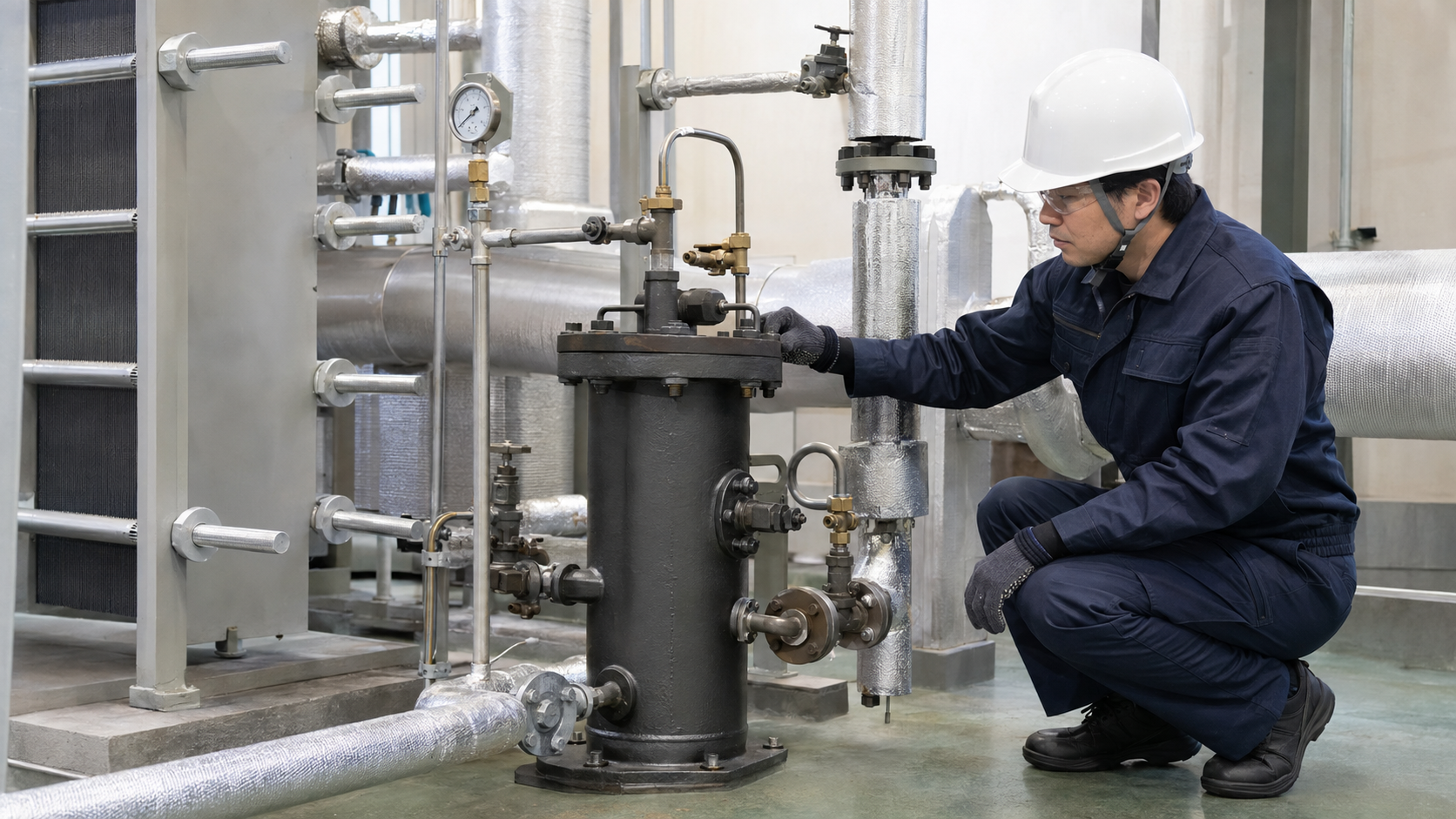
When controlling the temperature of a heat exchanger or heater, the moment the load drops, condensate (drain) can stop draining out, causing uneven heating, temperature drops, and water hammer. This is known as the stall phenomenon. Its main cause is that, as the control valve is throttled, the steam pressure inside the equipment falls below the back pressure on the trap outlet side, and the differential pressure needed to push out the condensate is lost. An effective countermeasure for this is the pumping valve (mechanical pump), which uses the pressure of steam or air (the motive fluid) to discharge condensate. Because it mechanically pushes out accumulated condensate without using electricity or any other external power, it can reliably send condensate out of the system even at sites without power wiring or during a power outage.
Key Points of This Article
- The stall phenomenon is mainly caused by the equipment’s internal steam pressure dropping below the back pressure so that condensate can no longer be pushed out
- A pumping valve discharges condensate using the pressure of the motive fluid and requires no external power
- Before installation, organizing conditions such as the required motive pressure, back pressure, and condensate volume is key to making the right decision
Why the Stall Phenomenon Occurs
In a heat exchanger that uses steam, the control valve adjusts the amount of steam supplied in order to maintain the secondary-side temperature. When the load becomes lighter, the control valve is throttled and the steam pressure inside the equipment falls. On the other hand, in order to discharge condensate from the steam trap, the internal pressure of the equipment must exceed the back pressure on the recovery piping side.
When the Differential Pressure Disappears, Condensate Stagnates
When the internal pressure of the equipment falls to or below the back pressure, the differential pressure needed to push out condensate cannot be secured even if the trap is functioning normally, and condensate stagnates inside the equipment. This is the stall phenomenon. It can lead to reduced heating capacity as the heat transfer surface becomes submerged in condensate, temperature hunting, and can also become a cause of water hammer and corrosion that occur when steam and water are mixed together. It tends to occur more readily in equipment with large load fluctuations or in recovery systems with high back pressure.
How a Pumping Valve Pushes Out Condensate Without Power
A pumping valve (mechanical pump) is a device that uses the pressure of a motive fluid such as steam or compressed air as its power source to discharge accumulated condensate. Because it does not use external power like an electric pump, it is easy to install even outdoors or in locations where power cannot be brought in or wiring is difficult.
Switching Between Filling and Discharging With a Float
In a typical structure, the body contains a float and a switching mechanism. When the incoming condensate raises the water level, the motive fluid is introduced into the body, and its pressure pushes out the condensate. After discharge, the motive fluid is exhausted and condensate is admitted again, repeating this filling-and-discharging cycle. This action makes it easier to send out condensate even in recovery systems with high back pressure or under conditions where the internal pressure of the equipment falls below the back pressure.
The Functional Difference From a Steam Trap
A steam trap is a component that discharges condensate using differential pressure, so it inherently struggles to function under conditions where there is no differential pressure. A pumping valve differs in that it actively applies the pressure of the motive fluid to push out the condensate, which allows it to compensate for situations where differential pressure is insufficient. Depending on the equipment, a configuration that uses a trap and a pumping valve in combination can also be considered.
Points to Check Before Installation
When selecting a pumping valve, organizing several conditions is a prerequisite. First, whether sufficient pressure can be secured for the steam or air used as the motive fluid. Next, how high the back pressure of the recovery piping at the discharge destination is. And finally, the volume of condensate to be handled (at both maximum and minimum load).
Discharge Capacity Changes With the Relationship Between Motive Pressure and Back Pressure
The amount of condensate that can be discharged varies with conditions such as the difference between the motive pressure and the back pressure. In general, the higher the back pressure and the lower the motive pressure, the lower the discharge capacity tends to be, so a selection with some margin is desirable. The figures are only a guide and will differ depending on the actual equipment conditions. If used under unreasonable conditions, discharge may not keep up and the condensate stagnation may not be fully resolved, so a thorough review of the conditions is important.
Frequently Asked Questions
Q1. Does a pumping valve require electricity?
A1. No. Because it is configured to use the pressure of a motive fluid such as steam or compressed air as its power source, external electric power is basically unnecessary. Its advantage is that it is easy to use even during a power outage or at sites without power wiring.
Q2. Can the stall phenomenon not be resolved with a steam trap alone?
A2. Because a steam trap is a component that discharges condensate using differential pressure, discharge becomes difficult under stall conditions where the differential pressure is lost. To compensate for insufficient differential pressure, using a pumping valve in combination or as a replacement becomes an option.
Q3. Which is better as the motive fluid, steam or air?
A3. Suitability changes depending on the fluid and pressure that are easy to secure at the equipment and on the surrounding environment. A common approach is to use steam in systems where steam can be used, and air in locations where you do not want to use steam. It varies with the conditions.
Q4. Can it be used in combination with an existing trap?
A4. Depending on the equipment configuration, a method that combines a pumping valve with a trap can also be considered. Because the optimal configuration changes with the back pressure of the recovery system and the piping layout, it is a prerequisite to consider it after checking the conditions.
Q5. How much condensate can be discharged?
A5. It varies with conditions such as the difference between the motive pressure and the back pressure and the model. A selection with margin against the condensate volume at maximum load is desirable, and the figures should be checked as a guide under the individual conditions.
Q6. In what kind of equipment is installation considered?
A6. It is a device often considered for equipment where the stall phenomenon tends to occur due to load fluctuations, such as temperature-controlled heat exchangers, heaters, and heating coils. It is also used in condensate recovery systems with high back pressure.
Summary
The stall phenomenon is mainly caused by the steam pressure inside the equipment falling below the back pressure, so that the differential pressure needed to push out condensate is lost. Because a pumping valve (mechanical pump) uses the pressure of steam or air as its power source to push out condensate, it serves as a solution that suppresses condensate stagnation without external power. To make it function properly, organizing conditions such as the motive pressure, back pressure, and condensate volume is essential.
If you are experiencing symptoms such as “the temperature drops when the control valve is throttled” or “the condensate does not drain and water hammer occurs,” or if you find yourself in situations such as “we know the condensate volume at maximum load but not at minimum load,” “we cannot judge whether the required motive pressure and back pressure are appropriate,” or “we are unsure how to incorporate this into an existing trap configuration,” please make use of Yoshitake’s technical and selection consultation. We will help you select the optimal system while organizing your equipment conditions.