
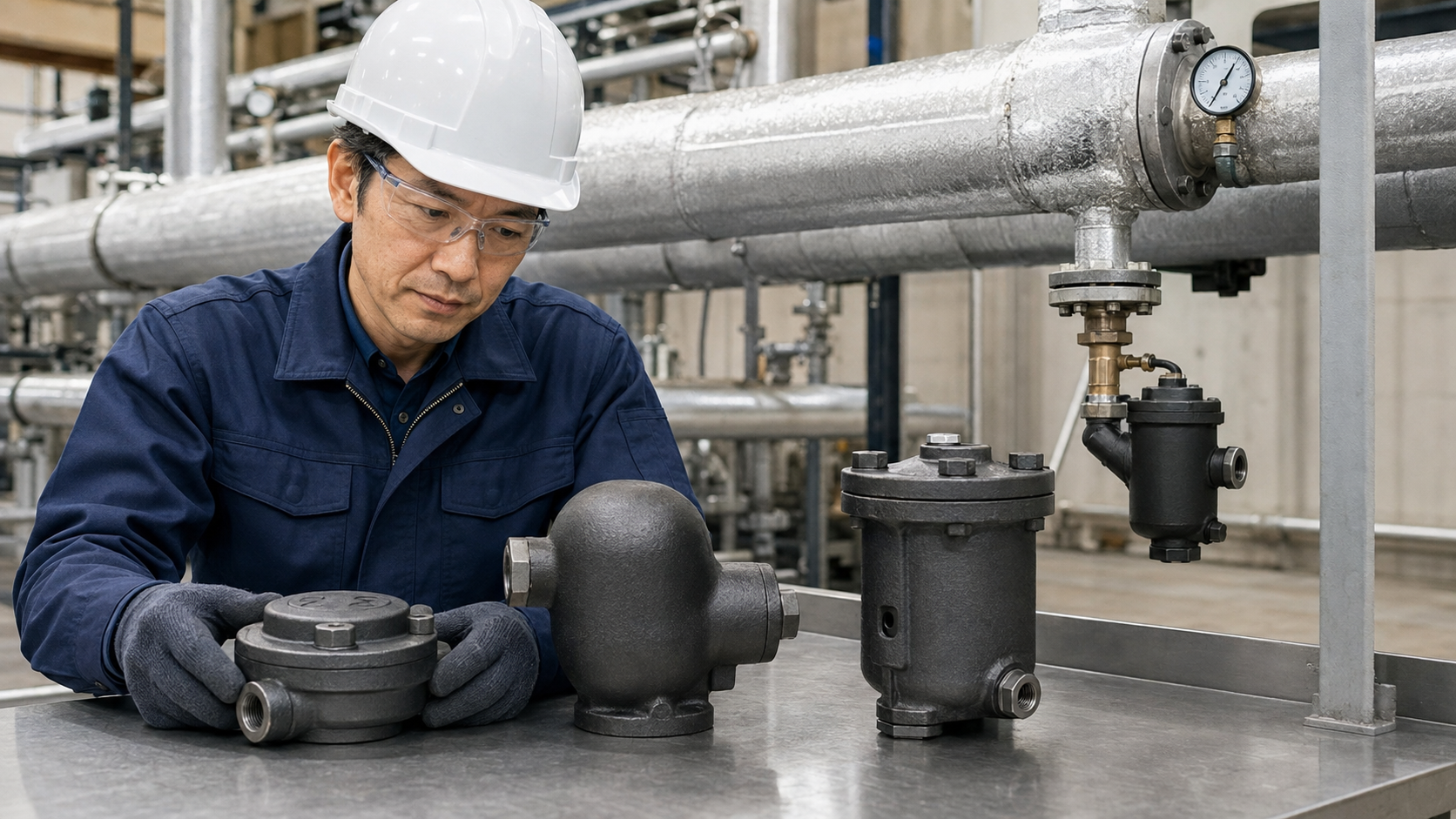
A steam trap is an automatic valve that discharges only the condensate (drain) and air that accumulate in steam piping and steam-using equipment, while preventing steam from escaping. The three representative types are the disc type, float type, and bucket type. The basic approach to selection is to match the “operating principle” against the “conditions of pressure, flow rate, and installation environment.” The disc type is compact, lightweight, and easy to handle; the float type discharges continuously and copes well with temperature fluctuations; and the bucket type discharges intermittently with excellent durability. Each excels in different applications. This article organizes how each type works and how to choose between them by application.
Key Points of This Article
- The three types differ in how they discharge (intermittent/continuous) and in their operating principles; there is no single all-purpose type.
- Selection based on conditions is fundamental: for example, the disc type for main steam piping, and the float type for process applications on equipment.
- If you know the pressure, maximum/minimum flow rate, and installation environment, selection accuracy improves. It is safest to confirm any points of uncertainty early.
How the Three Types Work and Their Characteristics
Disc Type (Thermodynamic Type)
This structure opens and closes with a single thin valve element (disc), and is characterized by being compact, lightweight, and resistant to high pressure. Its operating principle is not simply “moving up and down by pressure difference.” When condensate flows in, the disc is pushed up and discharged; when high-temperature condensate or steam passes through, the flow velocity increases and the pressure on the underside of the disc drops, while at the same time the flash steam that is generated collects in the pressure chamber above the disc and presses down from above, closing the valve. Some models also incorporate a bimetal that moves with temperature to assist initial discharge during cold startup.
One point requiring attention is outdoor installation. When the pressure chamber above the disc cools, the flash steam inside condenses more quickly and the valve opens, making steam leakage more likely. Operation tends to become unstable not only with cold outside air and wind and rain, but also in locations where the temperature changes greatly due to solar radiation, or where the trap is rapidly cooled by rain or snow. For outdoor use, consider using an insulating cap, and give attention to the installation orientation and protection against rain exposure.
Float Type
In this type, a float rises and falls in response to the condensate water level, opening and closing the valve. Because it discharges continuously according to the water level, it is suited to process applications with large fluctuations in condensate volume or pressure (heat exchangers, air-conditioning coils, dryers, etc.). An advantage is that condensate is unlikely to accumulate due to temperature drops, making it easier to maintain the heat transfer efficiency of the equipment.
Discharging the air that accumulates during startup and at other times is also important, but most float-type traps have a built-in air vent mechanism. Therefore, rather than thinking “the float type requires separate air venting,” it is more practical to confirm at the selection stage whether a built-in air vent is present and what its capacity is.
Bucket Type
In this type, an upward- or downward-facing bucket floats and sinks to open and close the valve, discharging condensate intermittently. Its structure is robust and highly durable, and it is considered relatively resistant to water hammer and dirty environments. On the other hand, because it operates by retaining water inside, a sudden drop in steam pressure can cause the water inside the bucket to be lost, leading to steam leakage. Care is therefore needed in systems with large pressure fluctuations.
Choosing by Application and the Criteria for Selection
Which Type to Choose
As a general guideline, the disc type—compact and readily suited to high pressure—is often used for draining at the ends and branches of main steam piping; the continuously discharging float type is used for process equipment where the heat transfer load fluctuates; and the bucket type is used in harsh environments where dirt and shocks are anticipated. However, even for the same application the optimal solution changes with the pressure conditions, so it is important not to decide by the type name alone but to check against the conditions.
Pin Down the Conditions with Numbers
What determines selection accuracy is the operating pressure (maximum and minimum), the maximum and minimum condensate flow rates, the difference between startup and steady-state operation, and the installation environment (indoor/outdoor, freezing, vibration). In particular, for systems where condensate is not readily discharged during low-differential-pressure conditions at startup or shutdown, one option is to consider an assist trap (a trap with an auxiliary discharge function) equipped with a mechanism that aids discharge even at low differential pressure. Because stagnant condensate can be a cause of poor heat transfer and water hammer, do not overlook the minimum-flow-rate side of the conditions either.
Avoiding Repeated Replacement Based on “Cheapness Alone”
A low-priced trap is not inherently bad. What tends to become a problem is when a selection is made that does not match the conditions of pressure, flow rate, and installation environment, resulting in steam leakage or early failure that leads to repeated replacement and steam loss. When you consider not only the initial cost but also the energy loss from steam leakage and the maintenance effort, choosing a type that matches the conditions ultimately helps keep costs down.
Frequently Asked Questions
Q1. I have heard that the disc type is prone to steam leakage. Is that true?
A1. There is a tendency for it to open more easily when the pressure chamber cools in outdoor or rapidly cooled environments. In many cases this can be improved by insulation or by reviewing the installation conditions, so it cannot be broadly called a flaw of the type.
Q2. Does the float type require a separate air vent valve?
A2. Most models have a built-in air vent. First, confirm whether the trap you are selecting has a built-in air vent and what its capacity is.
Q3. Why does the bucket type suddenly leak steam?
A3. If the retained water (priming water) inside the bucket is lost due to a sudden pressure drop, the valve may not close properly. It is effective to check the magnitude of the pressure fluctuations.
Q4. Can a single unit discharge the condensate from multiple pieces of equipment together?
A4. As a rule, we recommend an individual trap for each piece of equipment. Combining them tends to become a cause of malfunction due to back pressure and condensate backflow.
Q5. What is the minimum information needed for selection?
A5. The operating pressure (maximum and minimum), the maximum/minimum condensate flow rates, the installation environment, and the type of target equipment. Once these are known, narrowing down the type and bore size can proceed.
Summary
Steam traps differ in operating principle and discharge method among the disc, float, and bucket types, and the basic approach is to choose one that matches the conditions of pressure, flow rate, and installation environment. By not deciding on the type name alone but making a judgment that includes the maximum and minimum pressures, the minimum flow rate, and whether outdoor installation is required, you can more easily avoid steam leakage and early failure.
If you find yourself thinking “I cannot judge which type is appropriate for the application,” “I know the maximum flow rate but the minimum flow rate is unclear, so I am uncertain about the selection,” or “I want to choose an equivalent of the existing trap but do not know the specifications,” please organize the conditions and then consult Yoshitake. Based on your operating conditions, we will assist with the selection of the type and bore size and provide technical advice suited to your site.