
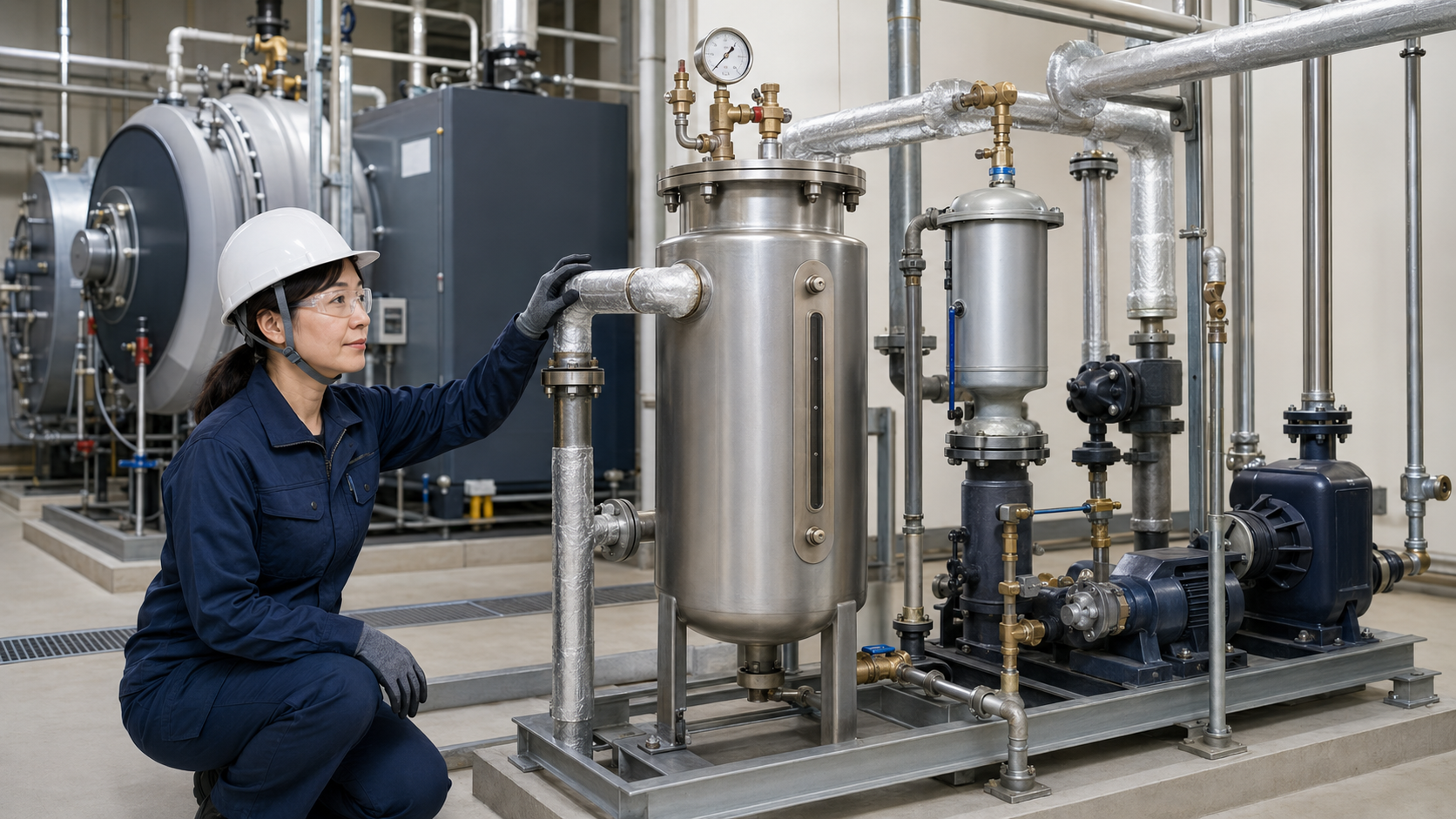
The condensate (drain) that forms after steam has given up its useful heat still holds high-temperature heat (sensible heat). Condensate recovery is the practice of returning this warm condensate to the boiler feedwater and reusing it, rather than draining it away as is. Because the feedwater temperature rises, less fuel is needed for heating, and at the same time the burden of treated water and wastewater treatment is reduced. Turning waste heat that was previously discarded into fuel savings is the central benefit of condensate recovery. Since the size of the effect varies with steam pressure, the amount of condensate, and the recovery method, the starting point is to understand how much heat your own steam system can recover.
Key points of this article
- Steam condensate retains sensible heat, and discarding it as is wastes heat, water, and wastewater treatment capacity all at once.
- Returning condensate to the boiler feedwater to raise the feedwater temperature reduces the fuel needed for heating. Depending on the recovery method, flash steam can sometimes be put to use as well.
- Because the effect changes with pressure, condensate volume, and piping conditions, the reliable approach is to estimate the recoverable heat before deciding on a method.
How condensate recovery turns waste heat into energy savings
When steam releases its heat and condenses, it becomes high-temperature condensate corresponding to that temperature. The higher the saturation pressure, the higher the condensate temperature, and the more sensible heat it still contains. If this is discarded as cold water, you throw away both the heat that fuel was used to produce and the water that was treated.
What is being thrown away is both “heat” and “water”
When a boiler drains condensate away, it must reheat an equivalent amount of cold makeup water (such as city water) from ambient temperature, which requires extra fuel. Returning high-temperature condensate to the feedwater raises the feedwater temperature and reduces the amount of heating needed to turn it into steam. At the same time, the burden of makeup water volume, water treatment, and wastewater treatment is also reduced. This is why condensate recovery is called a measure that combines “waste heat recovery” and “water conservation.”
The recoverable heat changes with the recovery method
Recovery methods can be broadly divided into the open type, in which condensate is returned to a tank at atmospheric pressure, and the closed (pressurized) type, in which condensate is returned while its pressure is maintained. The open type has a simple configuration, but the flash steam (re-evaporated steam) generated as the pressure drops tends to escape to the atmosphere, so that portion of heat is easily lost. The closed type can recover condensate while maintaining its pressure and temperature, and it also creates room to put flash steam to use for low-pressure applications, so when conditions are right it can recover much more heat. Which one is suitable depends on conditions such as the distance and elevation difference to the recovery destination, the back pressure, and the amount of condensate.
Criteria and precautions to keep in mind before implementation
Condensate recovery is a highly effective measure, but simply connecting piping without checking the site conditions can fail to produce the intended effect or invite other problems. Before selecting a method, it is important to organize a number of conditions.
Watch for conditions where condensate is “hard to return”
In heat exchangers and similar equipment where the heating rate is throttled by a temperature control valve, the steam pressure inside the equipment can drop at low load, and the condensate may be unable to be pushed out against the back pressure of the recovery piping (a condition known as stall). When condensate stagnates inside the equipment, temperature control can become unstable, and it can become a cause of water hammer or corrosion. Under such conditions, a configuration that combines a mechanical pump (pumping trap) with the steam trap to reliably send the condensate to the recovery destination is effective.
What should be noted here is that although a mechanical pump can discharge condensate without using an electric motor, it does not mean no motive power at all is required. It uses steam or compressed air as its motive power (driving source) for operation. While it is easy to install even in locations where power cannot be run, it consumes the driving fluid, so in practice it is realistic to evaluate the recovery effect including that consumption.
First estimate the “recoverable heat”
The recovery effect is determined by the temperature and volume of the condensate, the recovery rate, the unit fuel price, and so on, and it differs from site to site. Rather than deciding on a method based on expectations alone, the starting point is to grasp in numbers how much heat and water can actually be recovered. Even in the judgment criteria for business operators under the Energy Conservation Act (Act on the Rationalization of Energy Use), the recovery and use of exhaust heat is cited as one of the basic measures for energy conservation in factories. Estimating the recovery volume and cost savings in your own steam system makes it easier to make investment decisions and set priorities.
Note that in systems where the condensate may be contaminated by products, chemicals, or the like, it may not be possible to return it to the boiler as is. We recommend confirming whether recovery is possible for each system.
Frequently asked questions
Q1. What is condensate recovery?
A1. It is the practice of returning high-temperature condensate (drain) that forms after steam has been used, rather than draining it, to the boiler feedwater and reusing its heat and water. It reduces both the heating fuel and water consumption at the same time.
Q2. How much energy can be saved?
A2. The effect varies with the temperature and volume of the condensate, the recovery rate, and the unit fuel price, so it cannot be stated uniformly. To get a rough figure, it is reliable to estimate the recoverable heat and cost savings in your own steam system.
Q3. Which is better, the open type or the closed type?
A3. In general the closed (pressurized) type recovers more heat, but its suitability changes with conditions such as the distance and elevation difference to the recovery destination and the back pressure. Selection should be made after organizing the conditions.
Q4. Does a pumping trap require no motive power?
A4. It does not use an electric motor, but it uses steam or compressed air as motive power for operation. While it is easy to install even in locations without a power supply, it does consume the driving fluid.
Q5. What is stall? Is it related to recovery?
A5. It is a condition in which, at low load and similar situations, the pressure inside the equipment loses out to the back pressure of the recovery piping and the condensate can no longer be pushed out. Because stagnant condensate can cause disruption of temperature control and corrosion, it is addressed with a recovery configuration that incorporates a pump.
Q6. What information is needed to study this?
A6. As a guide, the steam pressure, the amount of condensate, the distance, elevation difference, and back pressure to the recovery destination, and the type and unit price of the fuel are relevant. Whether or not contamination is present also bears on judging whether recovery is possible.
Summary
Condensate recovery is an energy-saving measure that returns the sensible heat of condensate that was being discarded to the boiler feedwater to reduce fuel, while also contributing to water conservation and to a lighter wastewater treatment burden. The effect changes with pressure, condensate volume, recovery method, and piping conditions, and the configuration must be considered together with measures for hard-to-return conditions such as stall at low load. The reliable way to proceed is to first estimate the recoverable heat and then determine the method that suits your facility.
If you have concerns such as “I want to estimate how much fuel cost recovery would save,” “I cannot tell whether stall is occurring,” “I want to switch from an existing trap to closed recovery,” or “I am unsure whether the back pressure and bore of the recovery piping are appropriate,” please make use of Yoshitake’s technical and selection consultations. We will ask about your steam pressure, condensate volume, and recovery destination conditions, and propose a recovery method and equipment selection suited to your site.