
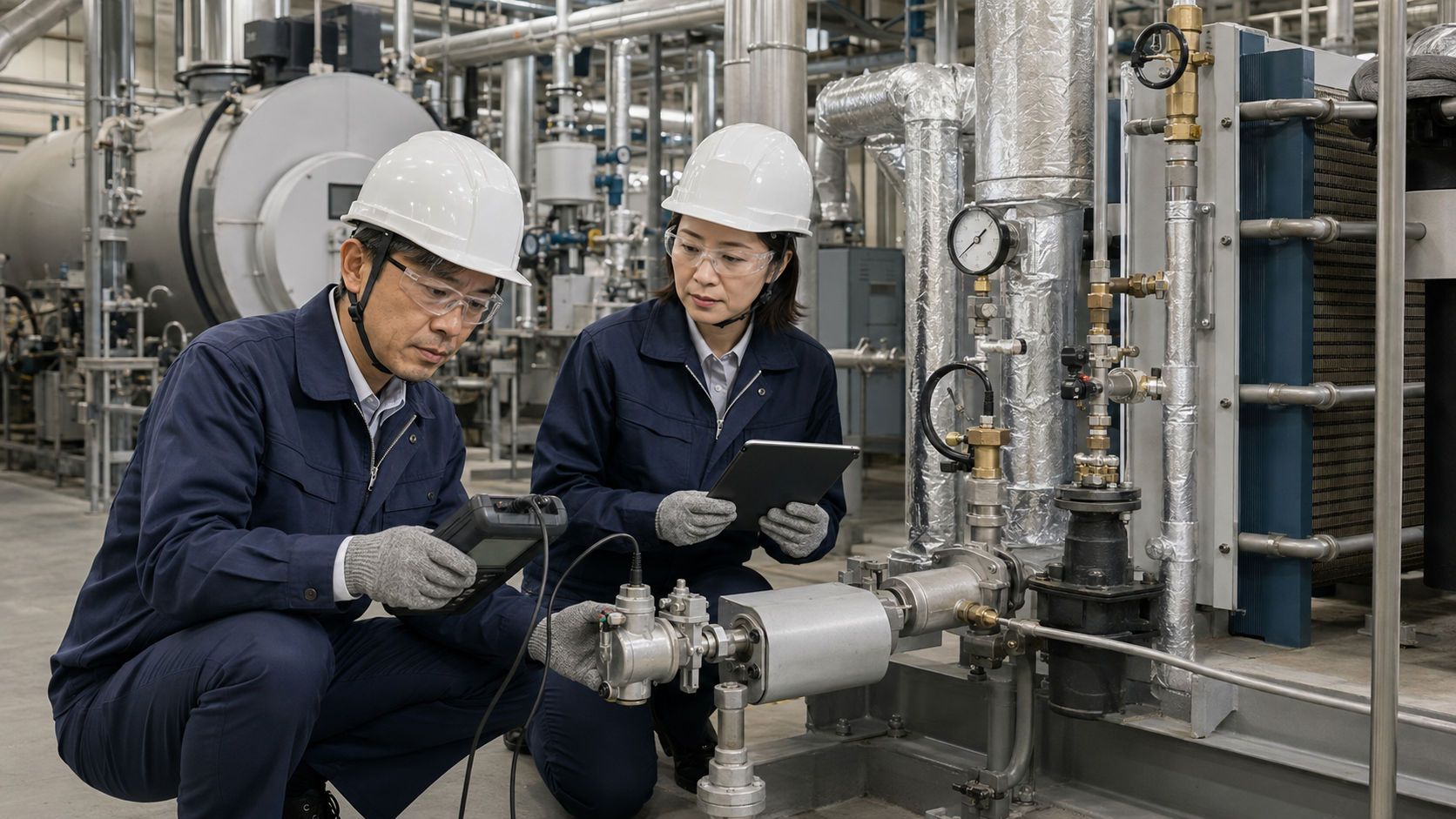
When it comes to steam energy savings, rather than immediately replacing equipment, proceeding in the order of “measure and understand the current state → narrow down the areas with the greatest losses → implement countermeasures and verify their effect” makes the return on investment easier to predict. Rather than addressing the entire plant all at once, a more practical approach is to separate the stages along the steam flow—generation, distribution, point of use, and recovery—and start with the areas where losses are largest. This article organizes the entire flow from plant diagnosis to implementation, together with the practical decision points involved.
Key points of this article
- Energy savings are easier to achieve when carried out in the order “diagnose → narrow down → implement → verify results”
- Divide the steam system into the generation, distribution, use, and recovery stages to visualize losses
- Because conditions tend to deteriorate again even after being fixed once, include post-implementation inspection in the plan
The flow from diagnosis to implementation for steam energy savings
First, understand the current state (plant diagnosis)
The first thing to do is not to decide on countermeasures based on assumptions, but to measure and understand the current state. Check the amount of steam used, the pressure, the condensate recovery status, and the condition of the piping and around the valves, and make visible where and how much loss is occurring. Whether the steam pressure is excessive relative to the pressure required at the point of use, whether there is any piping or fittings without insulation, and whether the steam traps are operating normally—these are items that are relatively easy to grasp and that directly translate into losses.
At this time, viewing the entire system by dividing it into the stages of “steam generation (boiler),” “distribution (piping),” “use (each piece of equipment),” and “recovery (condensate)” makes it easier to isolate the locations of losses.
Narrow down countermeasures starting from the areas with the greatest losses
Based on what you have learned, set priorities by comparing the effect, the cost, and the ease of implementation. In general, items such as steam leaks, trap malfunctions, insufficient insulation, and excessive pressure reduction or oversupply tend to yield results that are easy to obtain relative to the investment. However, since this varies with the conditions, the premise is to make judgments based strictly on your own company’s measurement results.
For example, when the pressure required at the point of use is clear, optimizing the pressure with a pressure reducing valve can sometimes suppress wasteful steam consumption. How much a given countermeasure works depends on factors such as the amount of steam, the pressure, and the operating time.
Implementation and verifying the effect afterward
Once you have implemented a countermeasure, do not stop there; measure again using the same indicators as before implementation to verify the effect. Keeping track of the improvement effect in numbers also provides material for deciding on the next countermeasure.
One point to note is that even once a steam system has been put in order, losses tend to occur again due to aging or changes in operating conditions. Because steam traps and leaks can worsen over time, building periodic inspection into your improvement plan helps the effect last longer. Energy savings are not something that is completed with a single implementation; viewing it as an ongoing effort of continued inspection and maintenance keeps it manageable.
Frequently asked questions
Q1. I don’t know where to start.
A1. The basic approach is to begin by measuring and understanding the current state. After making the locations of losses visible, starting from the areas where the effect and cost are in balance makes investment decisions easier.
Q2. About how often should steam traps be inspected?
A2. It depends on the operating conditions and installation environment, but it is advisable to build periodic inspection into your plan. Because malfunctions tend to increase over time, set the frequency to match your own company’s situation.
Q3. Do pressure reducing valves really save energy?
A3. When the supply pressure is excessive relative to the pressure required at the point of use, optimizing the pressure can sometimes suppress wasteful consumption. The effect varies depending on conditions such as the amount of steam, the pressure, and the operating time.
Q4. Is insulation effective?
A4. When there is piping, fittings, or valves without insulation, it is generally possible to suppress losses due to heat radiation. The amount of loss varies depending on the surface temperature, the surface area, and the operating time.
Q5. How should I verify the effect?
A5. Measure again using the same indicators as before implementation (steam volume, pressure, fuel consumption, etc.) and compare before and after. Keeping track of it in numbers also helps in prioritizing the next countermeasures.
Q6. Once improved, will the energy-saving state continue?
A6. Losses can occur again due to aging or changes in operating conditions. Continuing periodic inspection and necessary maintenance helps the effect last longer.
Summary
Steam energy savings become easier to gauge in terms of return on investment when carried out in the flow of starting with understanding the current state, narrowing down the areas with the greatest losses, and verifying the effect after implementation. Individual countermeasures such as pressure reducing valves, steam traps, and insulation are also easier to judge when positioned within the system as a whole.
In situations such as “I know the pressure required at the point of use, but I can’t judge whether the supply pressure is appropriate,” “I’d like to consult about selecting steam traps or whether replacement is necessary,” or “I want to select a pressure reducing valve bore size or an equivalent to an existing product,” a technical consultation after organizing the conditions is effective. Yoshitake offers technical consultation on the selection and use of products such as pressure reducing valves and steam traps used in steam systems. If you let us know your current conditions, we will help you with an appropriate review.