
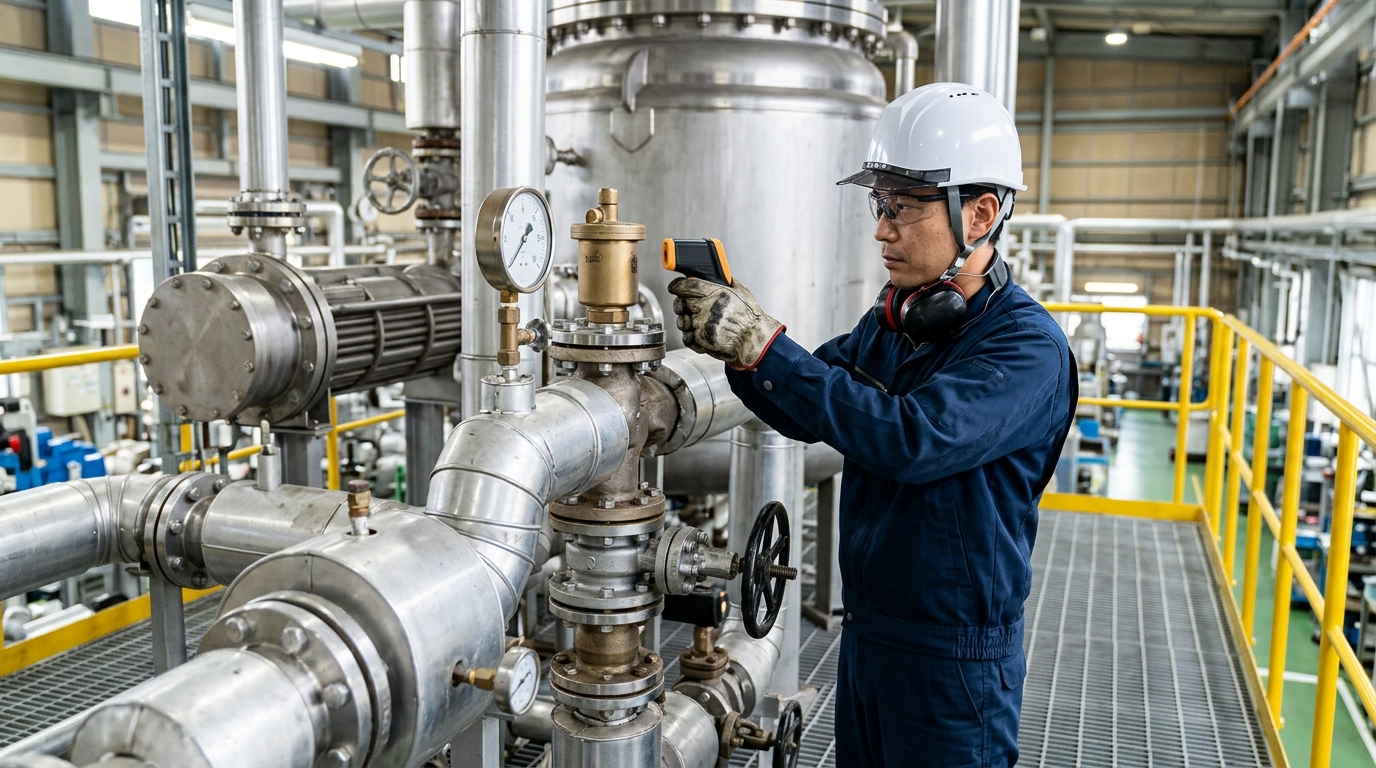
The most common mistake when installing a strainer is the mounting direction. A strainer has a defined flow direction, and installing it backward prevents it from capturing foreign matter adequately and makes it prone to accumulating drain (condensate) inside. The key points for correct installation are to align the arrow cast into the body with the flow direction, and to choose a piping orientation so that the screen section (pocket) of a Y-type strainer faces downward or horizontally. If the installation conditions are not appropriate, foreign-matter capture and drain discharge may be affected. The basic rule is to confirm the direction and orientation before allowing flow through the line.
Key points of this article
- Install the strainer aligned with the arrow (flow direction), and avoid reverse mounting
- For Y-type strainers, the orientation of the screen (position of the pocket) changes how easily drain accumulates
- On steam lines, secure an orientation and discharge path that lets drain escape, in order to prevent a drop in dryness fraction
Mounting direction and correct orientation of a strainer
Always confirm the arrow (flow direction)
An arrow indicating the flow direction is cast or stamped into the strainer body. Aligning this arrow with the direction of fluid flow is the fundamental requirement. If the strainer is installed backward, the fluid does not pass correctly from the outside to the inside of the screen, which can lower foreign-matter capture efficiency or allow accumulated foreign matter to flow downstream. Before installation, check the direction of the arrow against the flow direction of the piping line, and refer to the installation drawing if there is any doubt.
For Y-type strainers, screen orientation changes how easily matter accumulates
A Y-type strainer has a structure in which the screen (filter mesh) sits in a pocket that branches diagonally from the body. In horizontal piping, avoid an orientation where this pocket points straight up; downward or horizontal is the basic choice. When the pocket points upward, captured foreign matter and drain tend to remain inside the screen and become harder to discharge. When installing on vertical piping, choosing a section where the flow is downward (top to bottom) makes it easier for drain and foreign matter to escape under their own weight.
Points to note for preventing drain accumulation
On steam lines, watch for a drop in dryness fraction
When drain accumulates in steam piping, the dryness fraction of the steam sent downstream tends to drop. Because a lower dryness fraction can make it harder to stabilize the amount of heat supplied to heating equipment, it is important to choose an orientation in which drain does not keep accumulating in the strainer pocket. Since it is difficult for a strainer alone to fully discharge drain, on steam lines consider providing a drain-removal path before and after the strainer or at low points as needed.
Secure a blow (discharge) port and maintenance space
Some Y-type strainers have a threaded hole at the end of the pocket where a plug or blow valve can be fitted. Installing a blow valve here allows foreign matter and drain inside the screen to be discharged while flow continues, making it easier to manage cleaning intervals. During installation, securing space in the direction of the pocket so the screen can be pulled out for cleaning makes later maintenance smoother. When the differential pressure begins to rise, consider it a sign of clogging and review the timing for inspection and cleaning.
Frequently asked questions
Q1. What happens if the mounting direction is wrong?
A1. Effects may include reduced foreign-matter capture efficiency, accumulated foreign matter flowing downstream, and drain becoming harder to discharge. First, confirm that the arrow on the body matches the flow direction.
Q2. For a Y-type strainer, is downward or horizontal better for the screen?
A2. In general, downward or horizontal is the basic choice for horizontal piping. As a guide, select the orientation from which drain and foreign matter are most easily discharged, matched to the piping layout and inspection space.
Q3. Can it be installed on vertical piping?
A3. Many products can be installed this way, but choosing a section where the flow is downward (top to bottom) makes it easier for drain and foreign matter to escape under their own weight. Check the installation conditions for each product.
Q4. How can drain accumulation on a steam line be prevented?
A4. In addition to installing the strainer in an orientation that lets drain escape, consider securing a drain-discharge path at low points and ahead of equipment. The basic approach is to consider this together with a piping design that limits the drop in dryness fraction.
Q5. How do you judge the timing for cleaning?
A5. A rise in the differential pressure across the strainer is a guide to clogging. If the operating environment involves a large amount of foreign matter, consider setting shorter intervals for inspection and blowdown.
Summary and technical consultation
The basics for a strainer are to install it aligned with the arrow (flow direction) and to secure a screen orientation from which drain and foreign matter escape easily. On steam lines, it is advisable to set up the installation conditions to include the drain-discharge path and inspection space so as not to cause a drop in dryness fraction.
If you have concerns such as “I cannot judge whether it is acceptable to install it in this piping orientation,” “I want to check whether the bore size and screen mesh suit the application,” or “I want to select an equivalent product for an existing strainer,” please make use of Yoshitake’s technical and selection consultation service. We will ask about your working fluid and piping conditions and propose an appropriate mounting direction, orientation, and specification.