
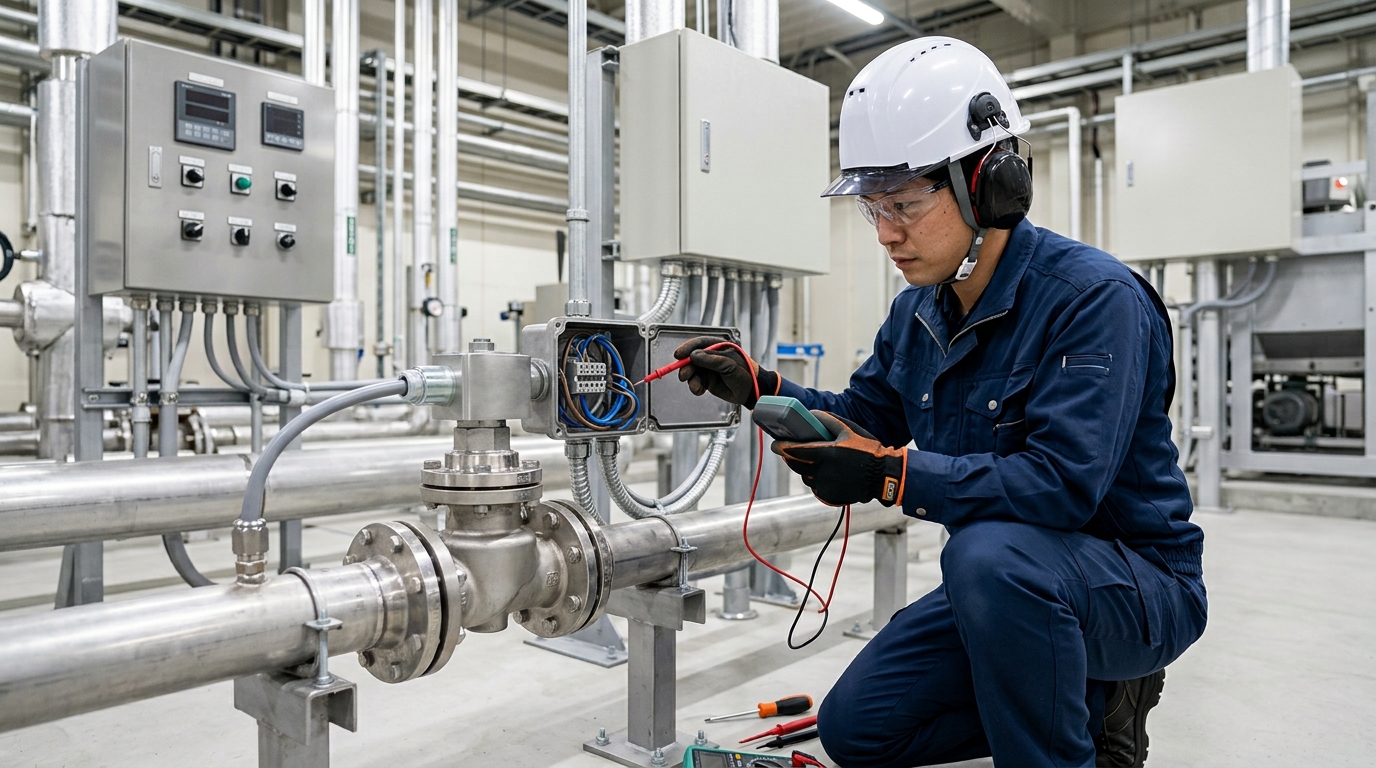
A solenoid valve is an electrically driven valve that opens and closes by energizing a coil. To use one correctly, there are three key points to keep in mind: matching the power supply specifications (voltage, AC/DC, frequency) and wiring exactly as instructed for the equipment, and observing the mounting orientation and piping conditions. When a solenoid valve does not operate, it is important to first check the power supply specifications, the wiring, and the mounting conditions. Here, we organize the wiring practices that prevent malfunctions and the basics of use in an order that is easy to check in the field.
Key points of this article
- Confirm the power supply specifications (voltage, AC/DC, frequency) on the nameplate, and wire exactly as instructed for the equipment
- Usage conditions such as mounting orientation, piping conditions, and energization time also have a major effect on stable operation
- When the valve fails to operate or malfunctions, tracing the cause in the order of power supply → wiring → mounting/fluid conditions makes it easier to identify
Basic use of a solenoid valve
Operating principle and checking the power supply specifications
A solenoid valve moves the valve element (or plunger) using the magnetic force generated by passing current through the coil, thereby opening and closing the flow path. There is the “normally closed (NC)” type, which opens when energized and closes when de-energized, and the reverse “normally open (NO)” type; choose the one that suits the application.
The first thing to check before use is the power supply specifications. Confirm the rated voltage, whether it is alternating current (AC) or direct current (DC), and, for AC, the frequency (50/60 Hz) on the nameplate or catalog, and match them to the supply power. Applying power of a different specification may lead to faulty operation or to overheating and burnout of the coil. Because conditions differ by model—such as models with a built-in rectifier circuit—give priority to the description in the instruction manual.
Basics of the wiring method
Wiring is carried out according to the terminal format, such as a terminal box, lead wires, or a connector (DIN, etc.). The common basics are to compare the terminal symbols and color coding against the instruction manual and correctly match them to the power supply side, and, on models with a grounding (earth) terminal, to make a reliable ground connection.
Loose terminals or protruding conductor strands can cause poor contact or short circuits. Tighten according to the specifications, and on terminal-box types, correctly refit the packing and cover to maintain waterproof and dustproof performance. On models with added functions such as surge protection or an indicator lamp, attention must also be paid to polarity and to the orientation of the diode. Perform wiring work with the power turned off.
Points to note in mounting and usage conditions
Even if the wiring is correct, the valve may not operate stably if the mounting or fluid conditions are not suitable. Many models specify a mounting orientation (such as facing the coil upward) and a flow direction (IN/OUT marking).
At the same time, check conditions such as the operating pressure, fluid temperature, ambient temperature, and energization time (whether continuous energization is permitted). Because debris or scale becoming caught is one cause of seat leakage or non-operation, measures against foreign matter—such as installing a strainer on the upstream side—are also effective. Detailed application conditions differ by model, so confirming the specifications at the selection stage provides peace of mind.
Frequently asked questions
Q1. What should be checked first when a solenoid valve does not operate?
A1. First check whether power is being supplied as specified (voltage, AC/DC, frequency). Next check the wiring and terminal tightness, and finally the mounting orientation and fluid conditions; tracing them in this order makes the cause easier to identify.
Q2. Can AC and DC be used interchangeably even if confused?
A2. In general, solenoid valves have different coil specifications for AC use and DC use, and they cannot be used interchangeably. Applying power of a different type causes faulty operation or overheating, so always match the marking on the nameplate.
Q3. Is grounding (earthing) necessary?
A3. On models with a grounding terminal, a reliable ground connection is recommended for safety. For details, follow the model’s instruction manual and carry out the work in accordance with electrical installation standards.
Q4. How do I choose between normally closed (NC) and normally open (NO)?
A4. As a guide, choose normally closed if you want flow when energized, and normally open if you want flow when de-energized. Select the one that is on the safe side for the system, such as considering which side you want to shut off in the event of a power failure.
Q5. Is there any problem with continuously energizing the valve?
A5. Whether continuous energization is permitted differs by model. Some models are rated for continuous operation, while others have a limit on energization time, so confirm the usage conditions in the specifications.
Q6. The coil gets hot—is this a fault?
A6. It is normal for the coil to warm up to some extent while energized. However, if it generates heat beyond the specification or is accompanied by an unusual odor, a mismatch in power supply specifications or an overload is suspected, so stop using it and inspect it.
Summary
The basics of using a solenoid valve stably are to confirm the power supply specifications on the nameplate and wire exactly as instructed for the equipment, to observe usage conditions such as mounting orientation and fluid conditions, and, when a problem occurs, to trace it in the order of power supply → wiring → mounting/fluid conditions. Simply keeping these points in mind makes many troubles—such as non-operation or malfunction—easier to prevent before they happen.
If you find yourself thinking “I want to select an equivalent for an existing solenoid valve,” “I don’t know how to choose the AC/DC or voltage specification,” or “I’m unsure about the normally closed/normally open or energization-time conditions,” please organize your usage conditions and consult Yoshitake. We provide selection support and technical consultation tailored to your application and piping conditions. If there are any points where you are unsure how to decide on specifications, please feel free to contact us.