
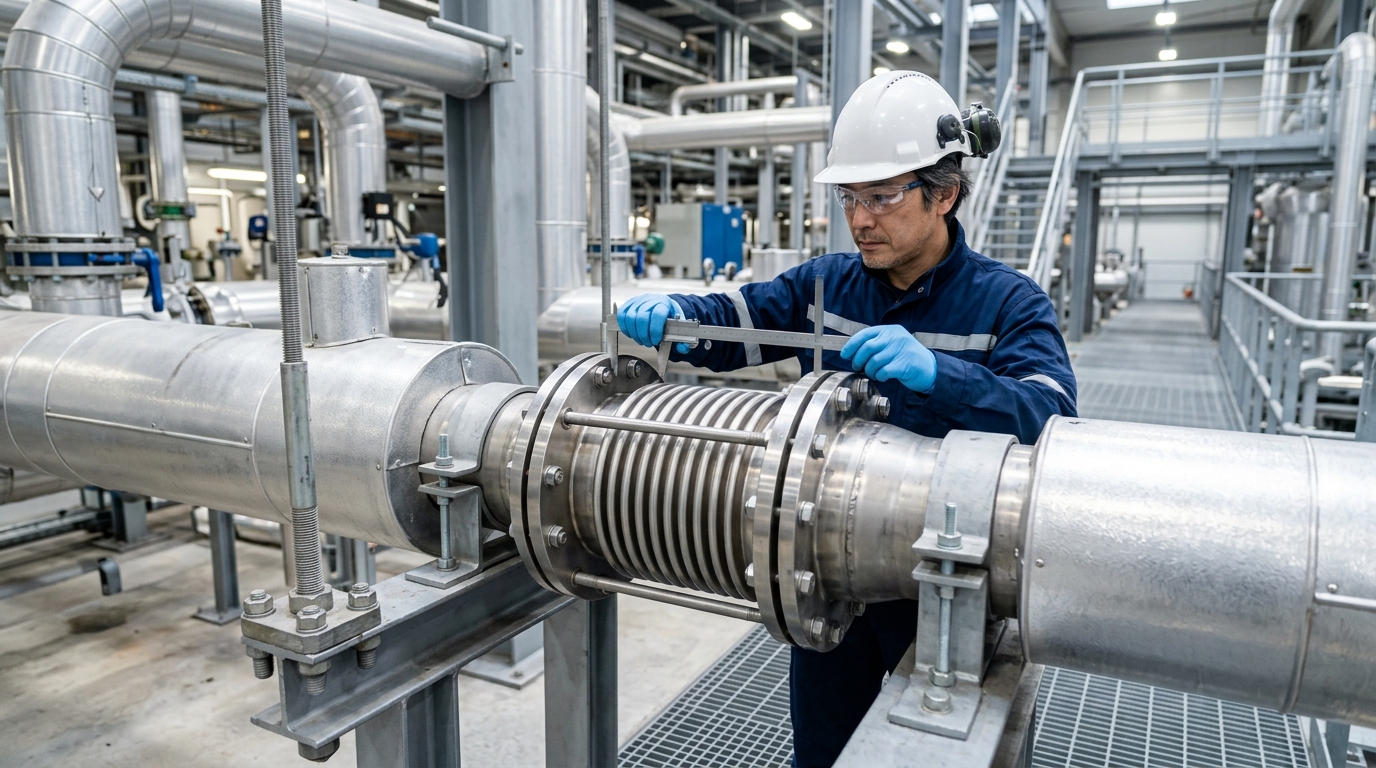
Piping always expands as its temperature rises and contracts as it falls. If this thermal expansion and contraction is fully restrained rather than allowed to relieve, large stresses build up at the piping, at equipment connections, and at supports, leading to problems such as leaks and cracking. An expansion joint is a component that absorbs this movement. The essentials of selection are to nail down “the direction and amount of displacement you want to absorb,” “the fluid, temperature, and pressure conditions,” and “the available installation space.” Estimating the amount of pipe expansion first, then choosing a type that matches it, is the order of thinking that reduces mistakes.
Key points of this article
- Preventing thermal-expansion problems comes down to “estimating the amount of displacement” and “using the right type for the job.”
- The main types are bellows type, sleeve type, flexible joint, and ball joint, each absorbing different kinds of movement.
- When in doubt, organize the piping conditions and make use of technical consultation at the selection stage for certainty.
Why expansion joints are needed, and how the types differ
Metal piping expands and contracts by roughly 0.01 mm per meter of length for each 1°C of temperature difference (a guideline that varies with the material). In steam or hot-water piping running several tens of meters, it is not unusual for the pipe to move tens of millimeters from the difference between operating temperature and the shutdown state alone. If this displacement cannot be absorbed, it leads to loosening of flange bolts, fatigue of welds, and excessive loads on equipment nozzles. The expansion joint plays the role of keeping this movement within the allowable range set in the design.
Main types and the movement each handles well
- Bellows type: Absorbs axial expansion and contraction with an accordion-shaped bellows. It is compact and highly responsive, but lateral offset and excessive pressure require condition checks.
- Sleeve type (sliding type): An inner pipe slides within an outer pipe to absorb axial displacement. It handles relatively large expansion and contraction more easily, but it has a sliding packing section and requires periodic inspection as a premise.
- Flexible joint: A flexible tube of rubber or metal absorbs vibration, axial movement, and some lateral displacement. It suits vibration isolation and misalignment absorption around pumps.
- Ball joint: A spherical joint absorbs angular displacement (swing). Multiple units are combined in piping designs that relieve three-dimensional displacement.
Even within the same idea of “absorbing expansion and contraction,” the suitable type changes depending on whether the movement to be relieved is mainly axial, lateral, or angular. Organizing which movement is dominant in the piping system is the starting point for selecting a type.
Conditions to confirm during selection
- Fluid, temperature, and pressure: With steam, high-temperature water, chemicals, and so on, both the suitability of use and the choice of material and seal material change.
- Amount and direction of displacement to be absorbed: Calculate the amount of expansion and contraction, and choose a product whose allowable displacement provides a margin.
- Installation space and the position of anchor supports: For a joint to work, the placement of anchors (fixed points) and guides on both sides is a prerequisite. Installing only the joint will not function unless the support design accompanies it.
- Maintainability and service life: Sliding sections and bellows fatigue under repeated displacement, so ease of inspection and replacement should also be included in the selection criteria.
Points that often trip up selection
If the amount of expansion is underestimated, unexpected displacement can cause the joint to bind, in turn placing loads on the piping. For example, there are cases where, on a long steam line, only the axial expansion was considered and a bellows type was chosen, but in reality thermal displacement also produced lateral offset, causing biased fatigue in the bellows over a short period that led to a leak. In such a case, it is effective either to revise the configuration to one that can also absorb lateral displacement, or to restrain the direction of movement with supports and guides. Thinking in terms of the entire piping system, including anchor supports and guides, rather than the joint alone, is the shortcut to preventing problems.
Frequently asked questions
Q1. How should the amount of expansion be estimated?
A1. It can be roughly calculated from the pipe length, the coefficient of linear expansion of the material, and the temperature difference between operating and shutdown states. It is common practice to set the allowable displacement with a margin on the safe side.
Q2. How do I decide between the bellows type and the sleeve type?
A2. If you prioritize compactness and responsiveness, the bellows type is a candidate; if you are handling relatively large axial expansion and contraction, the sleeve type is a candidate. Judge together with inspection frequency and installation conditions.
Q3. Which type suits vibration countermeasures for pumps?
A3. Generally, a flexible joint suits vibration isolation and misalignment absorption. The selection changes depending on the vibration source and the piping conditions.
Q4. If I install a joint, are anchor supports unnecessary?
A4. No. An expansion joint functions as designed only when there are fixed points (anchors) and guides. Consider it as a set with the support design.
Q5. Can it be used outdoors or for chemical piping?
A5. It requires selecting a material and seal material suited to the fluid, temperature, and environment. Organize the conditions and then confirm a compatible product.
Q6. Is there a guideline for replacement?
A6. Sliding sections and bellows fatigue under repeated displacement. Because this varies with operating conditions, we recommend confirming their condition through periodic inspection.
Summary
The basics of selecting an expansion joint are to estimate the amount of pipe expansion and contraction, choose a type that matches the direction of movement you want to absorb (bellows type, sleeve type, flexible joint, or ball joint), and design it across the entire piping system together with anchor supports and guides. Organizing the conditions, not just the standalone specifications, is what prevents failures.
If you have concerns such as “I am not sure whether the amount of pipe expansion has been calculated correctly,” “movement may occur not only axially but also as lateral offset or angular displacement, so I am unsure which type to use,” or “I want to select an equivalent to an existing expansion joint,” please make use of Yoshitake’s technical and selection consultation. If you tell us the fluid, temperature, and pressure along with the installation conditions, we will help you consider a suitable type and specification.