
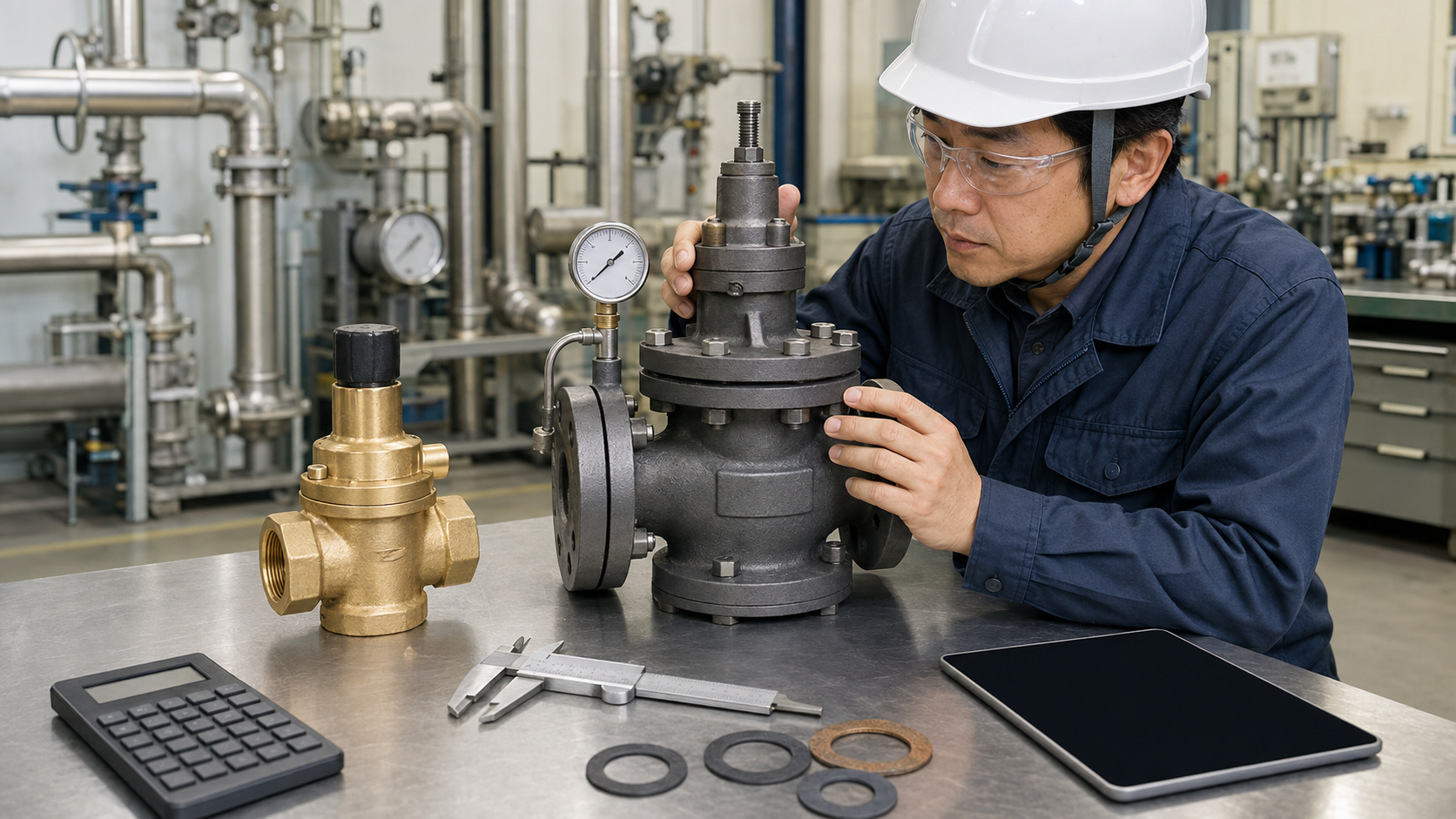
Choosing a pressure reducing valve based on body price alone can end up costing more overall. This is because the cost of a pressure reducing valve is determined not just by its “purchase price,” but by the “cost over the entire service life,” which includes suitability of bore size and specifications, durability, maintenance frequency, and the risk of downtime. This article organizes how price appears and how to approach comparisons so that you do not fail by chasing the lowest price. In conclusion, what you should compare is not the unit price but the “total cost of ownership after meeting the required specifications.”
Key Points of This Article
- The price of a pressure reducing valve varies greatly depending on bore size, connection, material, and specification grade, making simple comparison difficult.
- Even an inexpensive product is fine if its specifications match, but if the conditions do not fit, it tends to become more expensive due to reselection and downtime.
- Comparing from the perspective of total cost, “initial price + maintenance cost + downtime risk,” is less likely to lead to mistakes.
Why Do Pressure Reducing Valve Prices Vary So Much
Even among products all called “pressure reducing valves,” price differences are large because the underlying conditions differ from product to product. First, the larger the bore size, the higher the body price tends to be. The price range also changes depending on the connection type (threaded, flanged, union, etc.) and the body material (bronze, cast iron, stainless steel, etc.).
Main Factors That Affect Price
In general, the price is determined by a combination of the following factors. These are only rough guides, and the actual amount depends on the conditions.
- Bore size and connection type (larger sizes and flanged connections tend to be more expensive)
- Body material and working fluid (the applicable model changes for steam, water, air, chemical liquids, etc.)
- Specification grade, such as accuracy and adjustment range
- Whether accessories (strainer, pressure gauge, bypass, etc.) are required
For this reason, simply lining up and comparing the lowest catalog prices is not a meaningful comparison unless the specifications are aligned. It is important to first settle on the specifications that match your own operating conditions, and then compare prices in that order.
How to Compare So You Do Not Fail by Choosing on Price Alone
A pressure reducing valve is not equipment where “installation is the end of it”; it is equipment you continue to use. Therefore, placing the axis of comparison not on the body price alone but on the cost incurred over the entire service life makes it less likely that you will misjudge.
Three Perspectives for Thinking in Terms of Total Cost
- Initial cost: Estimate not only the body price but also the required accessories and the labor for installation and piping.
- Maintenance cost: The ease of disassembly and cleaning and of replacing consumable parts, and the availability of repair parts. A model that is hard to maintain tends to become more expensive over the long term.
- Downtime and non-conformance risk: If the specifications do not match and pressure reduction is unstable, or if a fault appears early, the cost of line downtime and re-ordering can exceed the body price.
Points to Note When Aiming for a “Cheaper Equivalent Product”
When updating an existing valve, there are many occasions when you think of getting “an equivalent product more cheaply.” In this case as well, the prerequisite is to confirm whether the bore size, connection dimensions, working fluid, and the primary-side and secondary-side pressure conditions truly match. Even if the appearance and size are similar, if the specifications differ, it may not reduce pressure as expected. Before prioritizing low price, first making sure the required specifications are met is what ultimately prevents wasted expenditure.
Frequently Asked Questions
Q1. I would like to know the approximate price range of a pressure reducing valve.
A1. Because it varies greatly with bore size, material, and specifications, it cannot be stated categorically. The surest approach is to first determine your operating conditions and then obtain a quotation for the applicable model. Please consider any figures to be rough guides that depend on the conditions.
Q2. Is it fine to choose the cheapest model?
A2. It is fine as long as the specifications match your operating conditions. However, if you choose a model that does not fit the conditions based on price alone, it may become more expensive due to reselection or downtime.
Q3. What costs should I look at besides the body price?
A3. These include accessories, installation labor, maintenance costs such as consumable part replacement and cleaning, and the availability of repair parts. It is safest to make a judgment with a long-term view.
Q4. Do more expensive models last longer?
A4. Price and service life are not necessarily proportional. Suitability for the working fluid and operating conditions, and whether appropriate maintenance is performed, affect durability.
Q5. The same model number as the existing one has been discontinued. Is a cheaper alternative acceptable?
A5. Before price, the first step is to confirm whether it is an equivalent specification matching the bore size, connection, fluid, and pressure conditions. A substitute is possible if the specifications match, but we recommend confirming this carefully.
Q6. Are there any tips for comparing quotations?
A6. The key is to compare after aligning them under the same specification conditions. Because the amount changes depending on whether accessories are included, clarifying the scope of what is included makes comparison easier.
Summary | Compare Price by “Total Cost”
The cost of a pressure reducing valve is less likely to lead to a misjudgment when viewed as the total cost of ownership, which includes not only the body price but also maintenance costs and downtime risk. Low price is an important factor, but the prerequisite is that the required specifications are met. We recommend the order of first settling the conditions and then comparing prices.
If you have concerns such as “I want to know which grade is appropriate for my current operating conditions, including a sense of the price,” “I want to select an inexpensive equivalent to an existing valve but am unsure whether the specifications will match,” or “I don’t know what configuration I need, including accessories,” please make use of Yoshitake’s technical and selection consultation. After organizing your operating conditions, we will help you select the appropriate model, including on the cost side.