
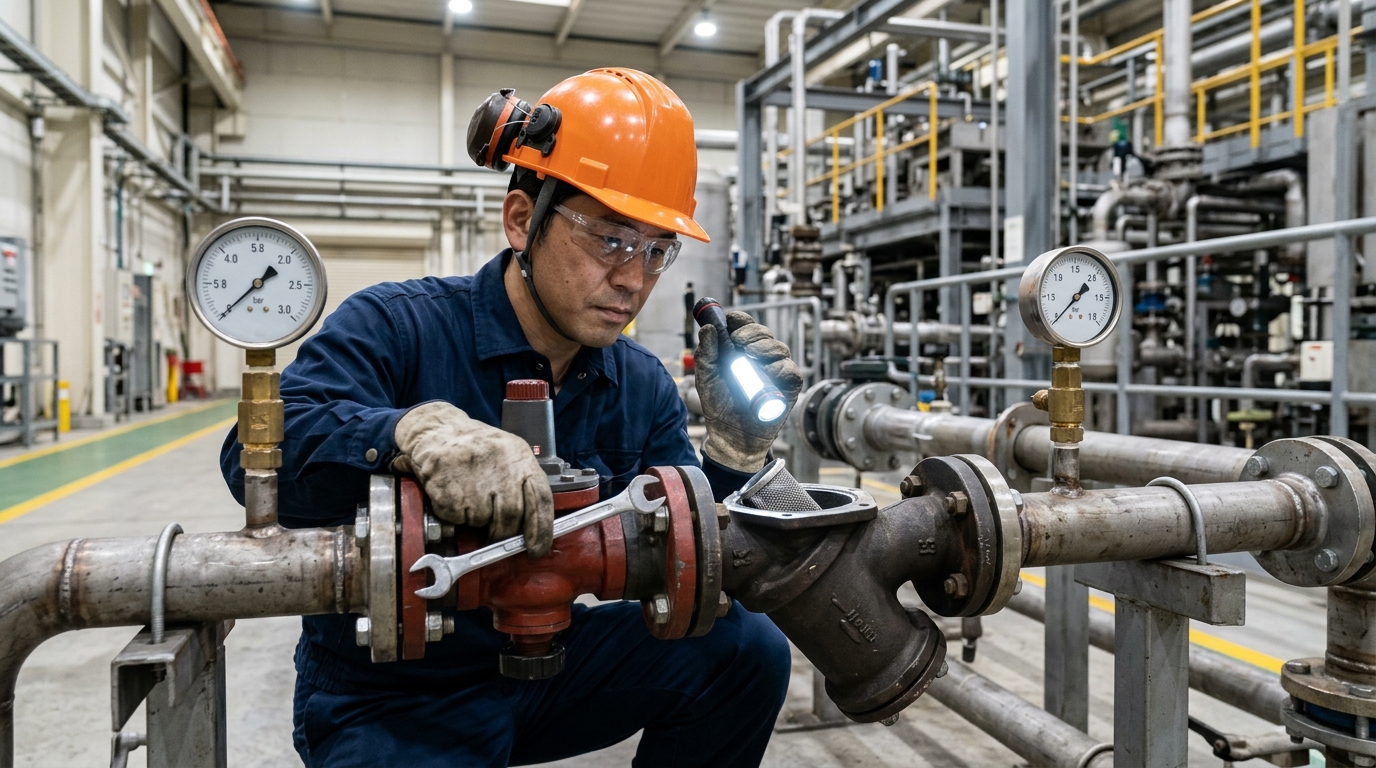
Among the most common problems with pressure reducing valves are a gradual rise in the set secondary pressure (“secondary pressure creep”) and foreign matter becoming lodged in the valve seat (“debris clogging”). In conclusion, these issues are not caused solely by deterioration of the pressure reducing valve itself; they frequently arise from a combination of surrounding conditions, such as scale or seal fragments inside the piping, a faulty steam trap, and the piping layout or installation orientation. Rather than pinning the cause on a single factor based on the symptom alone, inspecting the entire system before taking action is the quickest route to preventing recurrence. This article organizes common field questions about secondary pressure creep and debris clogging in an FAQ format.
Key points of this article
Most cases of secondary pressure creep are related to foreign matter lodged in the valve seat or damage to the sealing surface. The cause may lie not only in the pressure reducing valve but also in the piping and surrounding equipment, so simply replacing the unit may result in recurrence. If you are unsure how to assess the situation, please consult Yoshitake.
Main causes of secondary pressure creep and debris clogging
A pressure reducing valve has a structure in which the valve disc seats tightly against the valve seat to maintain the pressure on the secondary side. When this tight contact is compromised, fluid leaks and the secondary pressure rises.
How secondary pressure creep occurs
Secondary pressure creep is a phenomenon in which, under no-flow conditions (at shutoff), the secondary-side pressure rises above the set value. It occurs when a slight gap forms between the valve disc and the valve seat, allowing fluid from the primary side to leak through. Possible causes of this gap include foreign matter lodged in the valve seat, scratches or wear on the sealing surface, and deterioration of the diaphragm or spring. Rather than any single cause, several may be progressing simultaneously.
Background of debris clogging
Debris clogging is a phenomenon in which scale, rust, fragments of seal tape, or cutting chips from installation inside the piping become lodged in the valve seat. It is often seen immediately after new installation or after piping modifications, and it tends to occur when flushing (rinsing out) is insufficient. Cases in which no strainer is fitted on the primary side of the pressure reducing valve, or in which a clogged strainer is left unattended, can also be contributing factors.
Inspect the surrounding equipment and piping as well
A frequently overlooked situation is when the cause lies somewhere other than the pressure reducing valve. For example, in a steam system, if the steam trap is not operating properly, the behavior of condensate and pressure becomes disturbed, which can affect the operation of the pressure reducing valve. In addition, piping layout problems, such as insufficient straight pipe length, incorrect installation orientation of the pressure reducing valve, or a bore that is too large for the line and therefore operates outside the minimum flow range, can also be a factor in unstable pressure. If the symptoms recur even after replacing the pressure reducing valve, we recommend suspecting the entire system.
Frequently asked questions
Q1. The secondary pressure rises little by little at shutoff. Is this a malfunction?
A1. Foreign matter lodged in the valve seat or damage to the sealing surface is suspected. First, shut off the primary side, disassemble and inspect, and check whether cleaning the valve seat restores normal operation. If there is no improvement, wear of the internal parts may be the cause.
Q2. Debris clogging keeps recurring. How can I prevent it?
A2. The basic measure is to fit a strainer on the primary side and clean it periodically. In addition, thoroughly flush the piping and check for upstream sources of scale and rust, which will help suppress recurrence.
Q3. The symptoms recur even though I replaced the pressure reducing valve.
A3. The cause may lie not in the pressure reducing valve alone but in a faulty steam trap or in the piping layout. We recommend inspecting the operating conditions of the entire system.
Q4. The secondary pressure does not stabilize as set.
A4. Please check whether the flow rate has fallen below the proper range of the pressure reducing valve, particularly below the minimum flow rate. Instability tends to occur when the bore is too large, and depending on the conditions, reviewing the selection can be effective.
Q5. Hunting (periodic fluctuation of pressure) occurs.
A5. Insufficient straight pipe length or interaction with downstream equipment can be a factor. Since reviewing the installation position or piping conditions may improve the situation, please let us know the details and we will check.
Q6. Is there a guideline for periodic inspection?
A6. It varies with the operating conditions, but in general, periodic disassembly inspection and strainer cleaning serve as a guideline. Please adjust the interval according to the properties of the fluid and the operating hours.
Q7. I cannot judge how much I should handle myself.
A7. If cleaning does not improve the situation or the cause cannot be identified, please do not force it and consult us. We will guide you through isolating the cause, including the surrounding equipment.
Summary
Secondary pressure creep and debris clogging in pressure reducing valves are related not only to deterioration of the valve itself but also to multiple factors, such as foreign matter inside the piping, the condition of the strainer, the steam trap, and the piping layout. Rather than pinning the cause on a single factor based on the symptom, inspecting the entire system leads to the prevention of recurrence.
If you have concerns such as “I cannot judge whether the bore is appropriate,” “I know the maximum flow rate but not the minimum flow rate, and it is unstable,” “I want to select an equivalent to an existing valve,” or “the symptoms recur even after replacement,” please make use of Yoshitake’s technical and selection consultation service. If you let us know the working fluid, pressure, flow rate, and piping conditions, we will help isolate the cause, including the surrounding equipment, and propose the appropriate selection.