
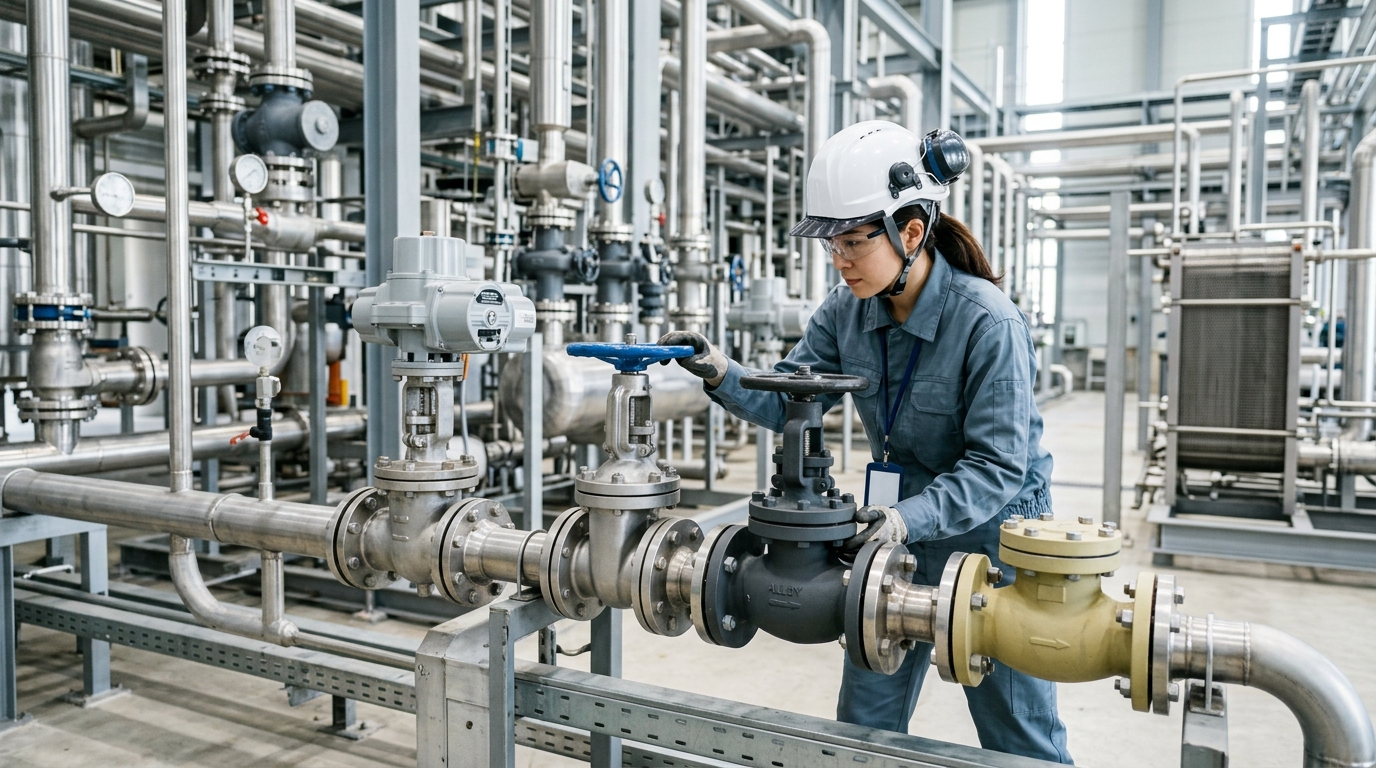
Valve material selection is fundamentally narrowed down from three conditions: the fluid, the temperature, and the pressure. Particularly with special fluids such as hydrogen and ammonia, the effect on metal materials and the compatibility of sealing materials govern the selection. While standard materials can often handle common fluids like water, air, and steam, special fluids require individual judgment based on the specific conditions in order to avoid unexpected degradation or leakage. Whenever you are unsure, the surest approach is to start with a consultation about feasibility.
Key Points of This Article
- Material selection is narrowed down from the three conditions of fluid, temperature, and pressure
- For hydrogen and ammonia, the key points are the effect on metals and the compatibility of sealing materials
- For fluids you are unsure about, it is best to start with a consultation, even before all the conditions are in place
The Basic Approach to Material Selection
Valve materials are easier to organize when you consider the body separately from the internal sealing materials (packing, O-rings, diaphragms, and the like). The main criteria are strength and corrosion resistance for the body, and chemical compatibility with the fluid for the sealing materials.
Narrow Down the Body Material by Fluid, Temperature, and Pressure
For common water or air, standard materials such as bronze, cast iron, and stainless steel can often handle the application. Under high-temperature or high-pressure conditions, or with corrosive fluids, stainless steel or specific alloys become candidates. Because the suitable material can change even for the same fluid when the concentration or temperature differs, it is important not to make a final decision based on the fluid name alone.
Sealing Materials Are Determined by Compatibility with the Fluid
Sealing materials must be selected so that they do not swell, harden, or decompose when in contact with the fluid. The options are wide-ranging—rubber-based, fluorine-based, metal, and others—and suitability can differ by temperature range even for the same fluid. Even if the body poses no problem, an unsuitable sealing material can lead to leakage or premature degradation, so it is advisable to consider both together as a set.
Points to Keep in Mind for Special Fluids Such as Hydrogen and Ammonia
With special fluids, additional factors come into play that make judgment difficult as a mere extension of standard products. Here, rather than proceeding on general principles alone, we recommend verification according to the conditions.
With Hydrogen, Pay Attention to the Effect on Metal Materials
Hydrogen has small molecules and tends to leak even through tiny gaps. In addition, depending on the conditions, it has been noted that hydrogen may affect the properties of metal materials, so consideration extending to the material selection and the structure of joints and seals is required. Because the approach changes with the pressure and temperature range, individual verification based on the operating conditions is more practical than a blanket material specification.
With Ammonia, the Key Is Distinguishing Compatible from Incompatible Materials
Ammonia is said to be poorly compatible with certain metal materials such as some copper alloys, while there are cases where it can be handled with an appropriate material. The conditions also differ depending on whether it is an aqueous solution or a gas. It is safest to verify against the actual operating conditions while keeping the process-of-elimination perspective of “avoiding materials that cannot be used.”
If You Are Unsure, Consult Us Even Before All Conditions Are in Place
Special fluids are prone to uncertainty in judgment, and if you think you must gather complete information first, the consultation tends to be delayed. It is enough to inquire simply at the entry point of “Is there a product that can handle this fluid?” Even with just the fluid name, we can provide a rough indication of feasibility and the points to check next. The details of the conditions can be organized together in the course of our exchange.
Frequently Asked Questions
Q1. I only know the fluid name—can I still consult you?
A1. That is fine. To start, we can give you a rough indication of feasibility with just the fluid name. Temperature and pressure are fine to the extent that you know them.
Q2. Do valves for hydrogen require special materials?
A2. It depends on the operating conditions. We consider the material and structure according to the pressure and temperature range and the leakage-control requirements. We will provide individual guidance based on the conditions.
Q3. Can stainless steel be used for ammonia?
A3. It can be a candidate depending on the conditions, but its suitability changes with the concentration and state. Rather than a blanket yes or no, it is surest to verify while taking the operating conditions into account.
Q4. What is the difference between a standard product and a product for special fluids?
A4. It is mainly the selection of the body material and the sealing material. To satisfy compatibility with the fluid, a material different from the standard product may be selected.
Q5. If the fluid is the same, is the material always the same?
A5. Not necessarily. Because the suitable material changes when the concentration, temperature, or pressure changes, we recommend verification for each set of conditions.
Q6. Can I handle it by changing only the sealing material?
A6. It depends on the case. In some cases, matching the sealing material is enough; in others, the body material must also be reconsidered. We make the judgment by looking at both together.
Summary
Valve materials are fundamentally narrowed down along the three conditions of fluid, temperature, and pressure, from both the body and the sealing-material sides. Particularly with special fluids such as hydrogen and ammonia, rather than deciding on general principles alone, individual verification based on the operating conditions leads to peace of mind.
“I want to know whether there is a product that can handle this fluid,” “I want to select an equivalent for an existing valve,” “I cannot judge whether the bore size is appropriate,” “I have narrowed down the material candidates but am unsure about the final decision”—in situations like these, please feel free to send Yoshitake your technical and selection consultations, even before all the conditions are fully in place. Even with just the fluid name, we will guide you on the next step.