
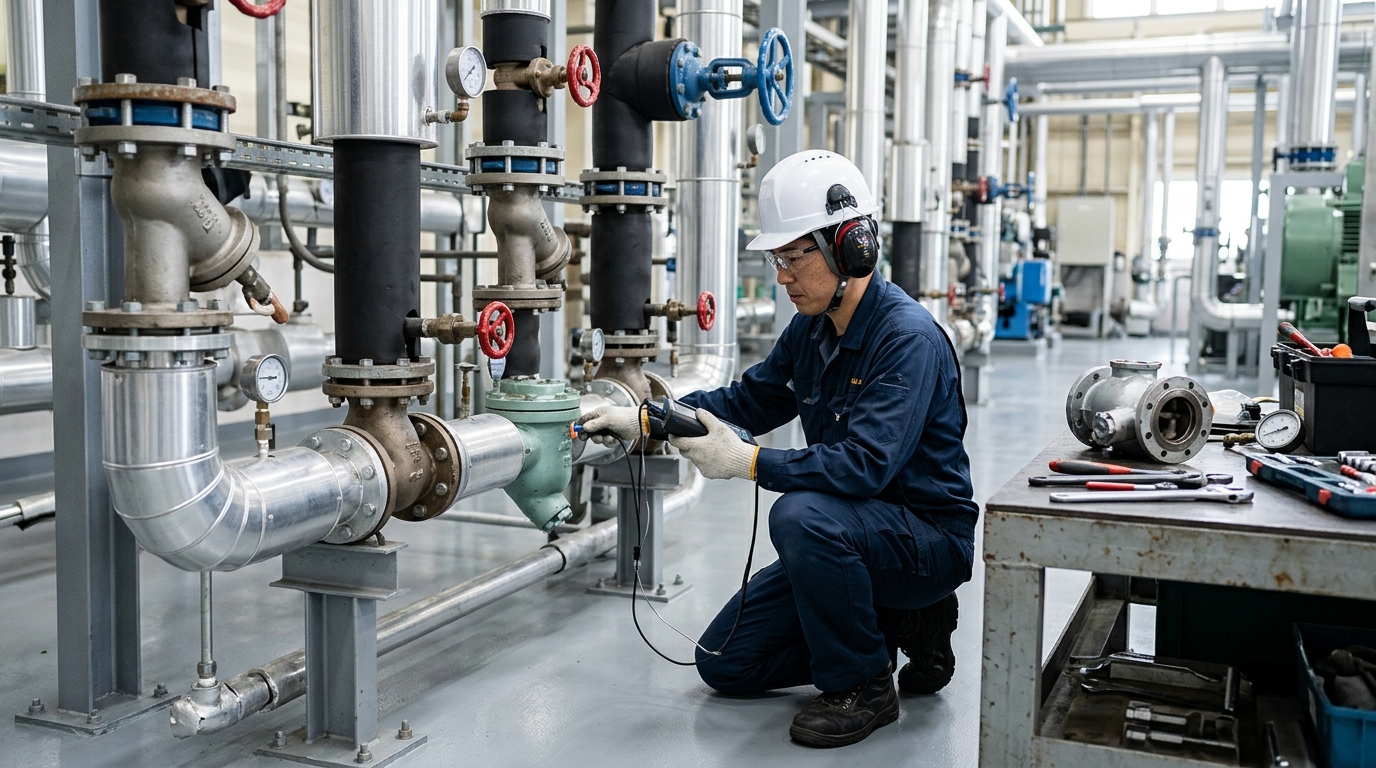
When managing steam traps to prevent steam leaks, two points are essential: “setting inspection intervals in advance” and “having a system in place to detect failures early.” Because traps contain wearing internal parts, leaving them unattended will cause a certain proportion to fail, which tends to lead to steam leakage and condensate retention. As a general guideline, we recommend inspecting all in-service traps once a year as a baseline, and checking critical lines with high pressure or high operating rates every six months. The first step toward stopping wasteful steam loss is to understand your own failure rate.
Key Points of This Article
- Steam traps are consumable items. As a baseline, inspect them once a year, with critical lines checked every six months as one guideline.
- Steam leakage from a single failed trap can lead to fuel losses on the order of tens of thousands to over one hundred thousand yen per year, depending on conditions.
- It is effective to start by “understanding the failure rate,” then use diagnostic instruments and inspection-record systems to enable early detection.
The Losses Caused by Neglected Steam Leaks
Losses Are Easier to Grasp When Expressed as Money
Steam trap failures are hard to see and tend to get put off. However, steam is energy itself, produced by burning fuel, so a leak translates directly into a loss of fuel costs.
For example, if a single trap continues to leak about 5 kilograms of steam per hour, a simple calculation over 24-hour, year-round operation comes to roughly 44,000 kilograms per year. Estimating the unit price of steam at a few yen per kilogram, this generally corresponds to a fuel loss of around 100,000 yen per year. If the leak volume is large, a single trap can amount to over 100,000 yen per year, and once failed traps accumulate across the entire plant, the losses reach an amount that cannot be ignored.
Of course, the actual figures vary with steam pressure, the form of leakage, fuel unit price, and operating hours, so these are only rough guides. Even so, viewing them as “money” tends to raise the priority given to management.
First, Understand Your “Failure Rate”
The starting point of management is understanding the failure rate—that is, how many traps are currently failed. In general, uninspected equipment can reveal failures ranging from a few percent to, depending on conditions, even higher.
Since replacing all traps at once is not realistic, a reasonable approach is to first grasp the overall picture and then address the lines with the largest losses—high-pressure, large-bore, and continuously operating lines—as a priority.
How to Think About Inspection Frequency and Maintenance
Set Frequency by Importance, Not Uniformly
Rather than setting inspection frequency at “the same interval for everything,” it is more practical to divide it by the importance of the line. As a general guideline, normal lines should undergo a full inspection once a year, while lines with high steam pressure or operating rates—and lines whose shutdown would affect production—should be checked every six months.
For traps that have just been newly installed or replaced, it is also reassuring to inspect them once early on to check for initial defects. The premise is that frequency should be adjusted to match your own operating conditions.
Have a System to Detect Failures Early
What determines the quality of an inspection is how failures are identified. They can be judged from operating sound, the surface temperature of piping, the condition of condensate discharge, and so on, but this is also an area where differences in experience easily show.
For this reason, using diagnostic instruments that rely on ultrasound or temperature helps reduce variation in judgment between personnel. With an instrument such as Yoshitake’s steam trap diagnostic tool “STC-1,” you can check the operating condition through numerical values and patterns, making it easier to narrow down locations suspected of leaking.
Keep Records to Carry Over to the Next Inspection
Rather than treating each inspection as a one-off, it is important to record the results in a ledger or installation drawing. Recording the installation location, model, inspection date, and assessment makes it easier to compare at the next inspection, and reveals failure trends and whether the maintenance frequency is appropriate. Accumulated records form the foundation for reducing both excessive inspection and overlooked failures.
Frequently Asked Questions
Q1. About how often should steam traps be inspected?
A1. One guideline is a full inspection once a year for normal lines. For critical lines with high pressure or operating rates, we recommend checking every six months. Please adjust according to your operating conditions.
Q2. Can you tell whether a trap has failed just by looking at it?
A2. There are signs such as steam leakage and condensate retention, but judging by appearance alone can be difficult. The basic approach is to check operating sound, temperature, and discharge condition together.
Q3. How much do you lose by leaving a failed trap unattended?
A3. It depends on conditions, but a leak of a few kilograms per hour can lead to a fuel loss on the order of tens of thousands to over one hundred thousand yen per year. As the number of traps increases, the losses grow proportionally.
Q4. Should all traps be replaced at once?
A4. It is not necessarily required to replace them all at once. A realistic approach is to first understand the failure rate and then replace, as a priority, the lines with the largest losses—high-pressure, large-bore, and continuously operating lines.
Q5. What are the benefits of using diagnostic instruments?
A5. You can check the operating condition through numerical values and patterns, which helps reduce variation in judgment between personnel. It is also useful for narrowing down locations suspected of leaking.
Q6. How long is the service life of a trap?
A6. It varies with the model, operating pressure, condensate volume, and operating conditions. Since traps contain wearing parts, failures increase over time, so the most reliable way to determine service life is from inspection results.
Q7. What should be recorded in inspection records?
A7. It is effective to record the installation location, model, inspection date, and assessment. This allows comparison with the previous inspection and helps you understand whether the maintenance frequency is appropriate and identify failure trends.
Summary
The basics of steam trap management are to set inspection intervals in advance and to have a system in place to detect failures early. By viewing leaks as money and addressing them by priority starting from an understanding of the failure rate, you can steadily reduce wasteful steam loss.
For inquiries such as “We first want to check our current trap failure rate,” “We’d like you to diagnose locations where a steam leak is suspected,” or “We’d like to see the STC-1 diagnostic method in action,” Yoshitake’s technical staff are here to help. Whenever you have trouble deciding on inspection frequency, keeping records, or selecting a model, we will make proposals tailored to your on-site conditions, so please feel free to contact us.