
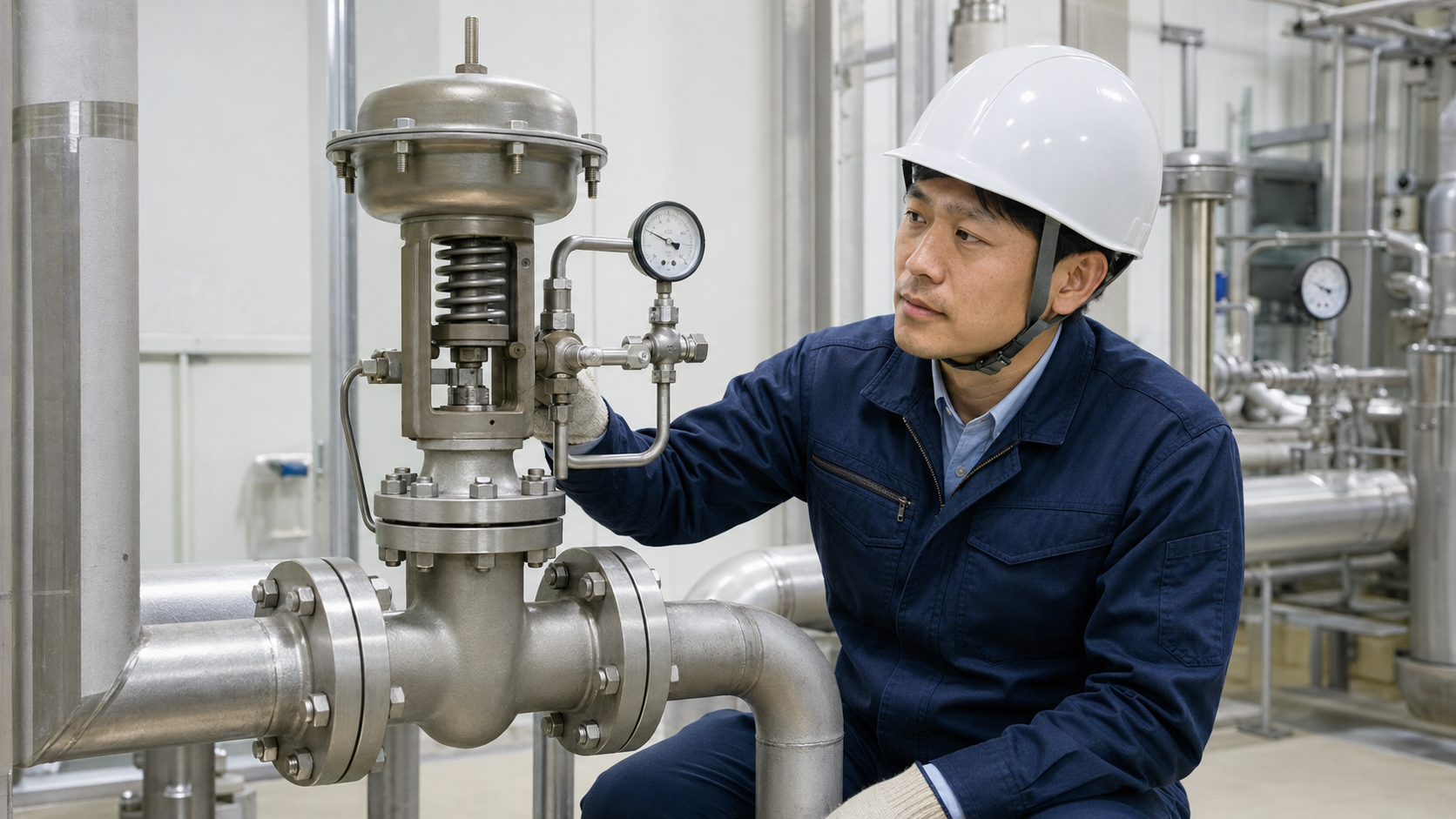
A power-free automatic valve is a “self-operated” automatic valve that opens and closes using the pressure or temperature of the fluid itself, without relying on external power such as electricity or instrument air. Its main advantages are a simple configuration that requires no wiring or air piping, and the ability to operate according to its setting even during a power outage or a loss of air supply. It is well suited to applications where pressure or temperature must be held constant. On the other hand, in fields where you want to open and close the valve at an arbitrary timing using an external signal, or to finely control the flow rate remotely, a “power-driven” automatic valve driven electrically or pneumatically is more suitable. The first step is to organize the roles of self-operated, power-driven, and manual valves, and to identify the type that matches your own site conditions.
Key points of this article
- Self-operated automatic valves work without external power (electricity or instrument air) and are strong in applications that “hold a set value constant,” such as pressure reduction and temperature regulation.
- Manual valves, self-operated valves, and power-driven valves each have different roles, and are used selectively according to site conditions.
- Rather than the notion of “using an automatic valve to save energy,” the appropriate approach is to select based on whether the required control can be achieved with the necessary power configuration.
The difference between self-operated, power-driven, and manual valves, and where power-free fits in
When considering an automatic valve, it is easier to organize your thinking by first separating “whether a person operates it or the valve moves automatically” and “where the power to move it comes from.”
Organizing the roles of the three types
Valves can be broadly divided into the following three types.
- Manual valve: A person opens, closes, and adjusts the flow rate using a handwheel or similar. It has no external power or automatic-tracking function, and cannot be operated remotely. It is used in locations that do not require constant control, such as main valves or shutoff during inspection and maintenance.
- Self-operated automatic valve (power-free): The valve itself detects the pressure or temperature of the fluid and opens or closes through the action of a built-in spring or diaphragm. It requires no external power, and its strength is automatic tracking to a predetermined set value. It basically does not support remote operation by external signals. Representative examples include pressure reducing valves, temperature regulating valves, safety valves, relief valves, and constant water level valves.
- Power-driven automatic valve: Driven by an electric or pneumatic actuator. Operation requires external power (electricity or instrument air), but in return, in addition to automatic tracking, it enables remote operation, precise control by external signals, and coordinated operation of multiple valves. It is suited to applications where you want to actively actuate the valve, such as process control and flow control.
In this way, even within the same “automatic valve,” self-operated and power-driven types differ in power configuration and in their areas of strength.
Main advantages of the power-free (self-operated) automatic valve
The advantages unique to the self-operated type arise from a configuration that does not depend on external power.
- No external power required: It does not need electricity or instrument air to actuate the valve. This eliminates the labor of installing and maintaining wiring and air piping.
- Simple configuration: It is relatively easy to introduce even in locations where a power source is hard to bring in, or as an addition to an existing line.
- Functions during power or air outages: Because it does not depend on external power, it operates according to its setting even during trouble with the power or air supply, and it tends to respond quickly to changes in pressure and temperature.
Note that these are strictly the advantages of “a configuration that does not use external power.” Using an automatic valve does not necessarily save energy; from a practical standpoint, it should be evaluated by whether the control required for the application can be achieved without power.
Sites where self-operated valves are and are not suitable
The decision on application becomes clearer when you consider “whether automatic tracking to a set value is sufficient, or whether active control is required.”
Sites where self-operated valves are suitable are applications where the purpose can be met by automatic tracking to a set value, such as holding the secondary-side pressure constant (pressure reduction), holding the temperature constant (temperature regulation), or relieving any excess beyond a specified pressure (safety and relief). They are also suited to locations where power is hard to bring in, or where a simple configuration is a priority.
On the other hand, in sites where you want to variably control opening, closing, and flow rate at an arbitrary timing using an external signal, monitor and operate remotely, or perform sequence control by linking multiple valves, a power-driven automatic valve is suitable. When such requirements exist, it is more reliable to consider power-driven and other types as well, rather than insisting on the self-operated type.
Frequently asked questions
Q1. What is a power-free automatic valve?
A1. It is a self-operated automatic valve that opens and closes as the internal spring or diaphragm moves due to the fluid’s own pressure and temperature, without using electricity or instrument air. Pressure reducing valves and temperature regulating valves are representative examples.
Q2. Does using a self-operated valve save energy?
A2. External power (electricity or instrument air) to actuate the valve becomes unnecessary. However, it is not something to select for energy savings in itself; the decision is made based on whether the control required for the application can be achieved without power.
Q3. I want to control opening, closing, and flow rate remotely.
A3. Self-operated valves are fundamentally about automatic tracking to a set value, and are not suited to remote operation by external signals. If remote or variable control is required, a power-driven automatic valve, electric or pneumatic, is suitable.
Q4. What happens during a power outage or loss of air supply?
A4. Because self-operated valves do not depend on external power, they operate according to their setting even during a power outage or loss of air. However, since behavior under abnormal conditions differs depending on the valve type and specifications, confirmation tailored to the site conditions is necessary.
Q5. Can I replace a manual valve with a self-operated automatic valve?
A5. For applications that hold pressure or temperature constant, replacement can be effective in some cases. Because suitability changes with conditions such as bore size, flow rate, and differential pressure, we recommend confirming the existing conditions.
Q6. What information is needed for selection?
A6. As a guide: the type and temperature of the fluid, the primary-side/secondary-side pressures, the maximum/minimum flow rates, the bore size, and the connection standard. The minimum flow rate in particular is easily overlooked and affects selection accuracy.
Summary
The power-free (self-operated) automatic valve has the strength of holding pressure or temperature constant without using external power, making it suitable for locations where power is hard to bring in or applications where you want to retain function even during a power outage. When active remote or variable control is required, the power-driven type is suitable, so the starting point for selection is first determining, for your own site, whether “automatic tracking is sufficient.”
If you have concerns such as “I cannot judge whether the bore size is appropriate,” “I know the maximum flow rate but not the minimum flow rate,” “I want to select an equivalent to an existing valve,” or “I am unsure whether a self-operated or power-driven valve fits my control requirements,” please make use of Yoshitake’s technical and selection consultation. We will ask about your conditions such as fluid, pressure, temperature, and flow rate, and propose how to choose a valve that suits your site.