
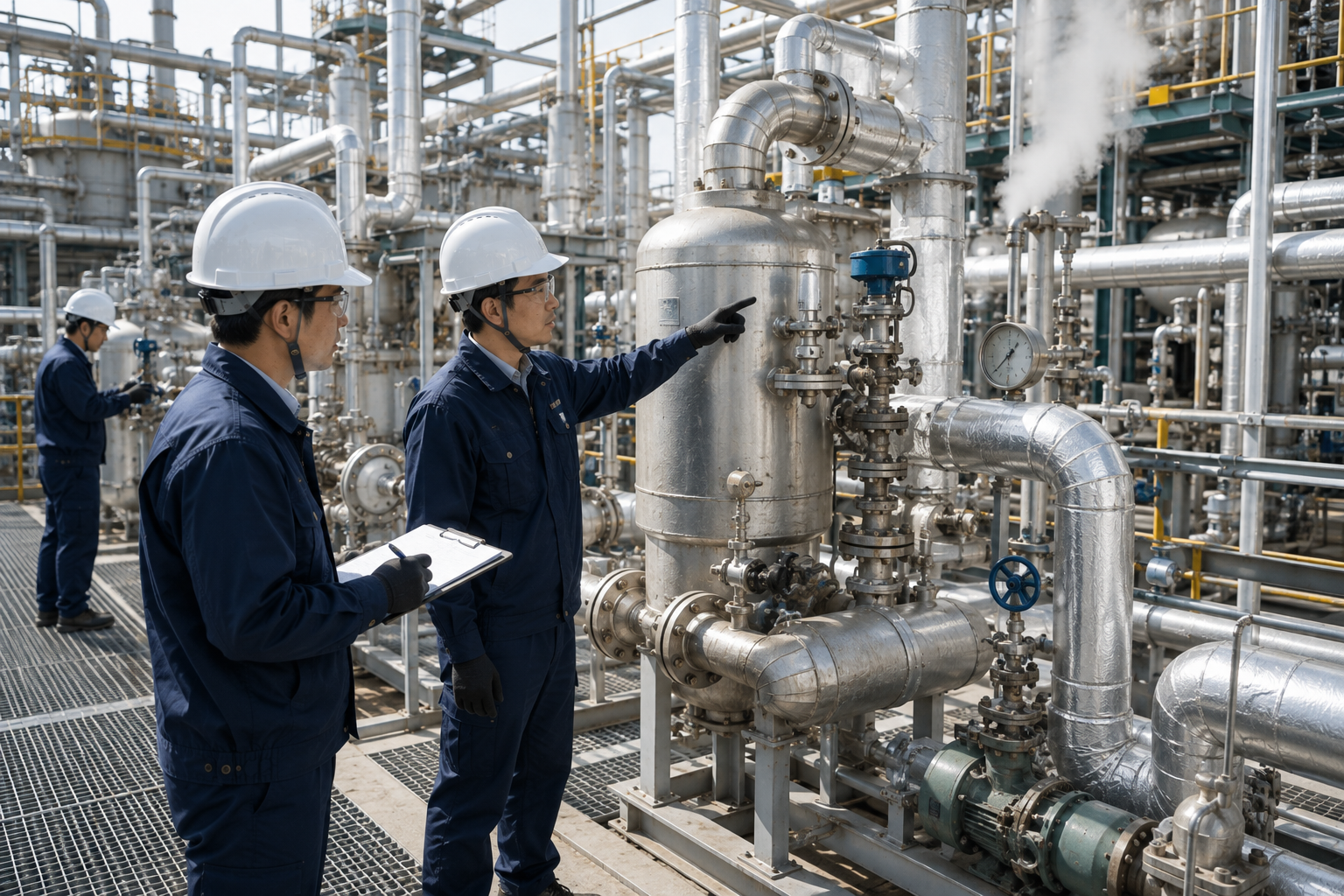
When high-temperature condensate (drain water) discharged from a steam trap is released to the low-pressure side, part of it turns back into steam. This is “flash steam” (re-evaporated steam), and releasing it straight into the atmosphere means throwing away all the heat it carried. The basic approach to recovery is to separate gas and liquid in a flash tank and reuse the resulting low-pressure steam for applications where a low pressure is sufficient, such as feedwater preheating or low-pressure lines. When the three conditions of generation rate, low-pressure-side demand, and back pressure are met, there is room to reduce fuel consumption. This article summarizes how flash steam is generated and the key points to consider when evaluating recovery.
Key points of this article
- Flash steam is steam that re-evaporates when high-pressure condensate is released to the low-pressure side; releasing it results in heat loss.
- The basis of recovery is gas-liquid separation in a flash tank and reuse as low-pressure steam.
- Whether “generation rate, low-pressure-side demand, and back pressure” hold is the core of the adoption decision.
What flash steam is, and why it can be recovered
The mechanism by which re-evaporation occurs
When steam releases heat in a piece of equipment, it becomes condensate (drain) while remaining at saturation temperature. This condensate is still “hot water” holding a high pressure and high temperature. When it is discharged to the low-pressure side through a steam trap, it tries to drop all at once to the saturation temperature at that pressure, and part of the surplus sensible heat (the heat held as a liquid) converts to latent heat, so a portion of the water turns back into steam. This is flash steam.
The proportion that re-evaporates (the flash rate) is determined mainly by the difference between the “pressure before discharge” and the “pressure at the release destination.” As a general guide, when relatively high-pressure condensate is released near atmospheric pressure, several percent to somewhere in the low tens of percent by mass is said to re-evaporate, but the actual value varies with pressure conditions, so individual verification is necessary.
Why it can be recovered and used (reuse as low-pressure steam)
Although flash steam is low in pressure, it holds latent heat as steam. Discarding it is a loss, but for applications where a low pressure is sufficient—preheating of feedwater and boiler makeup water, deaeration, low-pressure heating lines, and the like—it can potentially be used as a heat source as is. In plants that reduce the pressure of high-pressure boiler steam to feed low-pressure applications, if part of that can be replaced with flash steam, an effect of lowering the load on the supply side can be expected.
The recovery mechanism and points for the adoption decision
Gas-liquid separation with a flash tank and low-pressure use
The central piece of equipment for recovery is the flash tank (flash vessel). It draws in condensate from the high-pressure side and, by depressurizing and expanding it internally, separates the re-evaporated steam from the remaining water (low-pressure drain). The basic flow is to send the low-pressure steam drawn from the top to the demand side’s low-pressure header, and to send the drain remaining at the bottom to a recovery line or the feedwater system. A configuration that combines a pressure reducing valve and a safety valve to stabilize the low-pressure-side pressure is common.
Conditions to verify before adoption (generation rate, low-pressure demand, back pressure)
Whether recovery holds up is judged by the following three points. First, the generation rate—the larger the amount of high-pressure-side condensate and the pressure difference, the more flash steam is obtained. Second, low-pressure-side demand—since recovered steam will be left over if there is nowhere to use it, check whether the applications that consume low-pressure steam and their timing match. Third, the pressure balance of the entire piping system—if the pressure in the recovery line (the back pressure) rises too much, it affects the discharge capacity of the upstream steam traps.
Points to note (back pressure, surplus, safety measures)
A rise in back pressure hinders the trap’s drain discharge and can cause drain to accumulate on the equipment side. It is important to determine the pressure setting of the recovery system with the allowable range of the upstream side in mind. In addition, when low-pressure demand fluctuates, consider a route to release surplus steam and the setting of the safety valve. As a countermeasure against water hammer caused by a sudden inflow of condensate, attention to piping slope and drain removal is also essential. Because the optimal solution changes with the conditions of the existing equipment, we recommend a review of the system as a whole rather than a simple equipment addition.
Frequently asked questions
Q1. How much flash steam is generated?
A1. It is determined by the pressure difference between before discharge and the release destination. As a general guide, several percent to somewhere in the low tens of percent is often cited, but it varies with conditions, so an individual estimate is necessary.
Q2. Can the recovered steam be used as is?
A2. Because the pressure is low, it is mainly for applications where low pressure is sufficient (preheating, deaeration, etc.). Check consistency with the pressure required by the application.
Q3. Does adding a flash tank always save energy?
A3. An effect can be expected when the generation rate and low-pressure demand match. If there is nowhere to use it, it becomes surplus, so verifying the conditions is a prerequisite.
Q4. Can it be retrofitted to an existing drain recovery line?
A4. It is considered after verifying the effect on pressure balance and back pressure. Evaluating the impact on the discharge capacity of the existing traps is important.
Q5. What happens if the back pressure rises?
A5. The discharge capacity of the upstream steam trap decreases, which can lead to drain accumulating in the equipment. Determining the set pressure is necessary.
Q6. Are there any points to watch for in terms of safety?
A6. Consider a release route for surplus steam, the safety valve, and water hammer countermeasures (piping slope and drain removal) across the system as a whole.
Summary
Recovering flash steam is an effort to make use of the re-evaporated steam that was previously being released as a low-pressure heat source. The key is whether the three points of “generation rate, low-pressure-side demand, and back pressure” hold, and the decision must be made based on the balance of the entire system, not just the addition of equipment.
If you have specific concerns such as “I know the amount of high-pressure drain, but I want to estimate how much flash steam can be obtained,” “I am unsure whether the use for the recovered low-pressure steam is appropriate,” or “I am worried about the impact on existing traps and drain recovery lines,” please make use of Yoshitake’s technical and selection consultation. Based on your equipment conditions, we will work with you to organize an approach to the recovery system, including flash tanks, pressure reducing valves, and safety valves.