
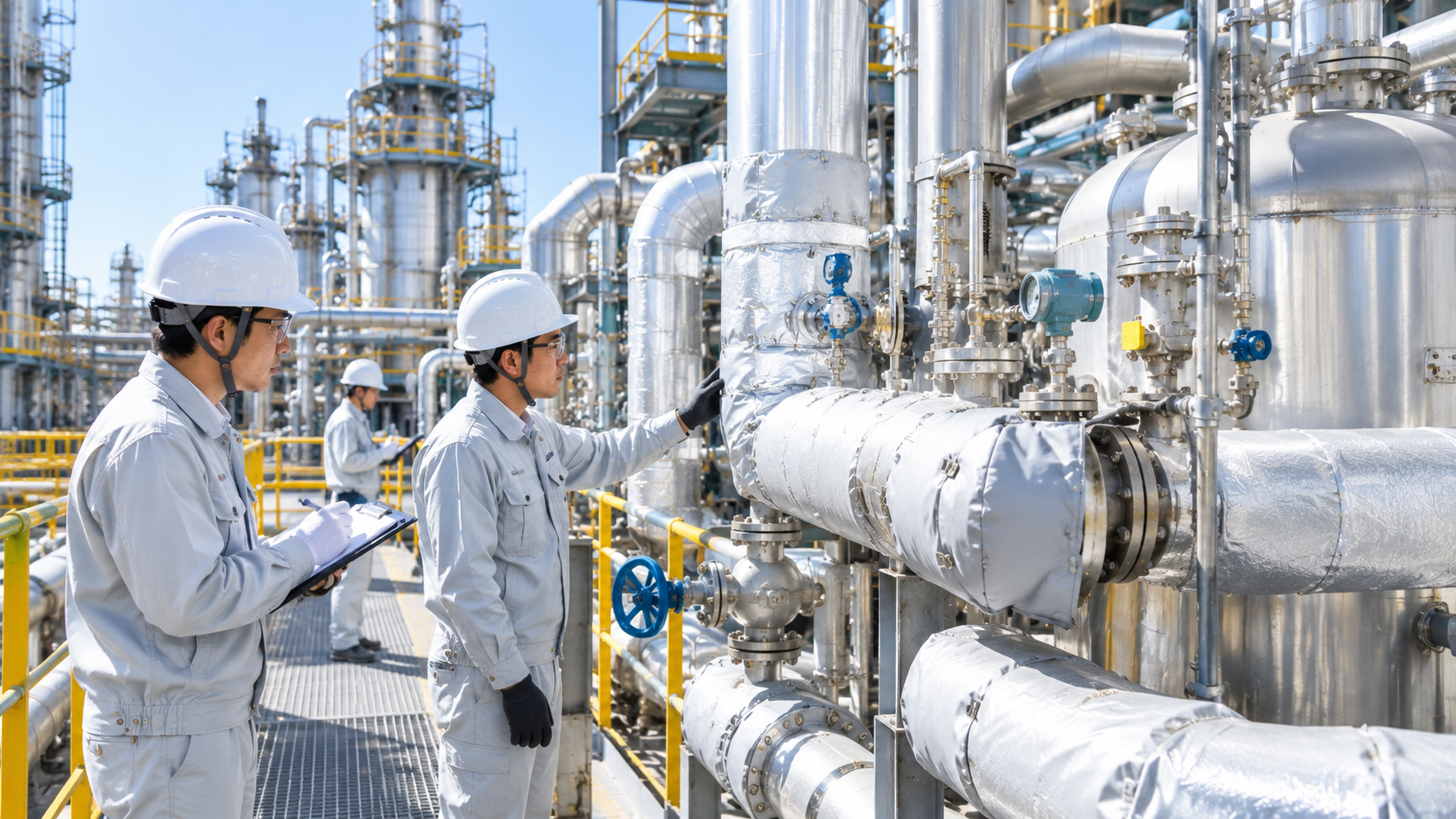
Insulating piping and valves is a fundamental measure that suppresses the heat-radiation loss escaping while steam, hot water, and other heat media are being conveyed, and this in turn helps reduce fuel costs. Irregular surfaces such as valves and fittings, in particular, are difficult to insulate and tend to be left uninsulated, and the amount of heat escaping from them cannot be ignored. Removable insulation jackets have the advantage of covering these complex-shaped areas while still being detachable for inspection. This article organizes how insulation works to curb heat-radiation loss and fuel costs, the criteria for deciding whether to adopt jackets, and points that call for attention.
Key Points of This Article
- Insulation suppresses heat-radiation loss from the piping surface, reducing the temperature drop of the heat medium and unnecessary fuel consumption; it is a fundamental measure.
- Irregular surfaces such as valves and fittings tend to be left uninsulated, and removable jackets make it easier to achieve both insulation and inspectability.
- The effect varies with conditions such as surface temperature, area, surrounding environment, and insulation thickness, so the figures are only a rough guide.
How Insulation Works to Curb Heat-Radiation Loss and Fuel Costs
Why Heat Escapes from an Uninsulated Surface
High-temperature piping and valves continuously release heat from their surfaces to the surroundings. Heat radiation occurs mainly through convection and radiation, and the higher the surface temperature and the larger the surface area, the more heat tends to escape. Because the escaped heat must be made up by burning additional fuel at the heat source, such as a boiler, heat-radiation loss translates directly into fuel costs. Covering the surface with insulation lowers the surface temperature and curbs the heat escaping to the surroundings, so in some cases the fuel required to convey the same amount of heat can be reduced.
Irregular Surfaces Such as Valves and Fittings Are Easily Overlooked
While straight pipe sections are easy to wrap with insulation, irregular surfaces such as valves, flanges, fittings, and strainers have complex shapes and are often operated with insulation omitted. However, such areas have a large surface area, and when uninsulated they tend to account for a high proportion of the heat-radiation loss. Even if the entire pipe run is insulated, if the irregular surfaces are left out they remain as “escape routes” for heat. To curb heat-radiation loss, it is important to check whether insulation covers not only the straight pipe but also the irregular surfaces.
Situations Where Removable Jackets Are Useful
A removable insulation jacket (lagging jacket) is an insulation cover made in advance to match the shape of a given area, and it can be attached and detached with hook-and-loop fasteners or bands. Even in areas such as valves and fittings that require periodic inspection, retightening, or parts replacement, the jacket can be removed to perform the work and then reattached—this is its advantage. It helps avoid the labor of splitting and reinstalling rigid insulation, making it an option when you want to balance insulation with maintainability.
Criteria and Precautions to Check When Adopting
Consider the Necessity Based on Temperature, Location, and Maintenance Frequency
Whether insulation or a jacket is needed is not uniform; the decision is based on the surface temperature, the size of the area, the operating hours, the surrounding environment, and the need to prevent burns to workers (burn protection). Systems that run at high temperatures continuously, and irregular surfaces where heat-radiation loss accounts for a large proportion, tend to show greater effect. On the other hand, for areas that are inspected frequently, a removable jacket may be easier to operate with than rigid insulation. Because energy-saving effect figures vary with conditions, it is important to treat them as a rough guide only.
Points to Watch in Installation and Management
Insulation is also affected by installation quality. If there are gaps or insufficient wrapping, heat escapes from those spots and the expected effect may not be obtained. Outdoors, attention is also needed to the deterioration of insulation from rainwater intrusion and to metal corrosion under the insulation (so-called corrosion under insulation), and management of the outer cladding and water shedding is required. For drain outlets, drain valves, and instruments that need inspection, examining in advance how they are covered and how easily they can be detached helps avoid rework after operation begins.
Frequently Asked Questions
Q1. How much will insulation lower fuel costs?
A1. It cannot be stated in general terms because it varies with surface temperature, area, surrounding environment, insulation thickness, and so on. Generally, systems with high temperatures, large surface areas, and long operating hours tend to show greater effect, and the figures require a case-by-case estimate under each set of conditions as a rough guide.
Q2. If I insulate the straight pipe, is it fine to leave the valve sections uninsulated?
A2. Valves and fittings have a large surface area and tend to account for a high proportion of heat-radiation loss. Because leaving out irregular surfaces creates escape routes for heat, it is advisable to consider the insulation method while also taking inspectability into account.
Q3. How should rigid insulation and removable jackets be used differently?
A3. The frequency of inspection and parts replacement is one guide. Use removable jackets for areas that need to be attached and detached, and rigid insulation for straight pipe with little movement—using each according to the area and maintenance frequency is the basic approach.
Q4. Is there no concern about corrosion when insulating?
A4. Outdoors or in damp environments, attention may be needed to metal corrosion under the insulation. Consider this together with management that suppresses water intrusion with outer cladding and water shedding and that periodically checks the condition.
Q5. Is there any point in insulating solely to prevent burns?
A5. Yes, there is. Preventing burns from worker contact is important for safety, and it serves as a motive for adopting insulation and jackets together with the reduction of heat-radiation loss.
Q6. Can I choose a jacket shaped to fit an existing valve?
A6. If the dimensions and shape of the area and the operating temperature are known, they provide a basis for consideration. Letting us know the valve model and installation situation makes it easier to narrow down a more suitable specification.
Summary and Please Consult Us
Insulating piping and valves is a fundamental measure to curb the heat-radiation loss escaping from the surface and to reduce the temperature drop of the heat medium and unnecessary fuel consumption. Irregular surfaces such as valves and fittings, in particular, tend to be left uninsulated, and using removable insulation jackets makes it easier to achieve both insulation and inspectability. Because the effect varies with conditions such as temperature and environment, determining the necessity for each area is the first step.
If you have specific concerns such as “I can’t judge which areas should be insulated,” “I’m unsure how to insulate frequently inspected valves,” “I want to select a jacket specification that fits an existing valve,” or “I want to consider this together with corrosion measures for outdoor piping,” please make use of Yoshitake’s technical and selection consultation. If you let us know the fluid used, temperature, area dimensions, installation environment, and so on, we can offer proposals tailored to your conditions.