
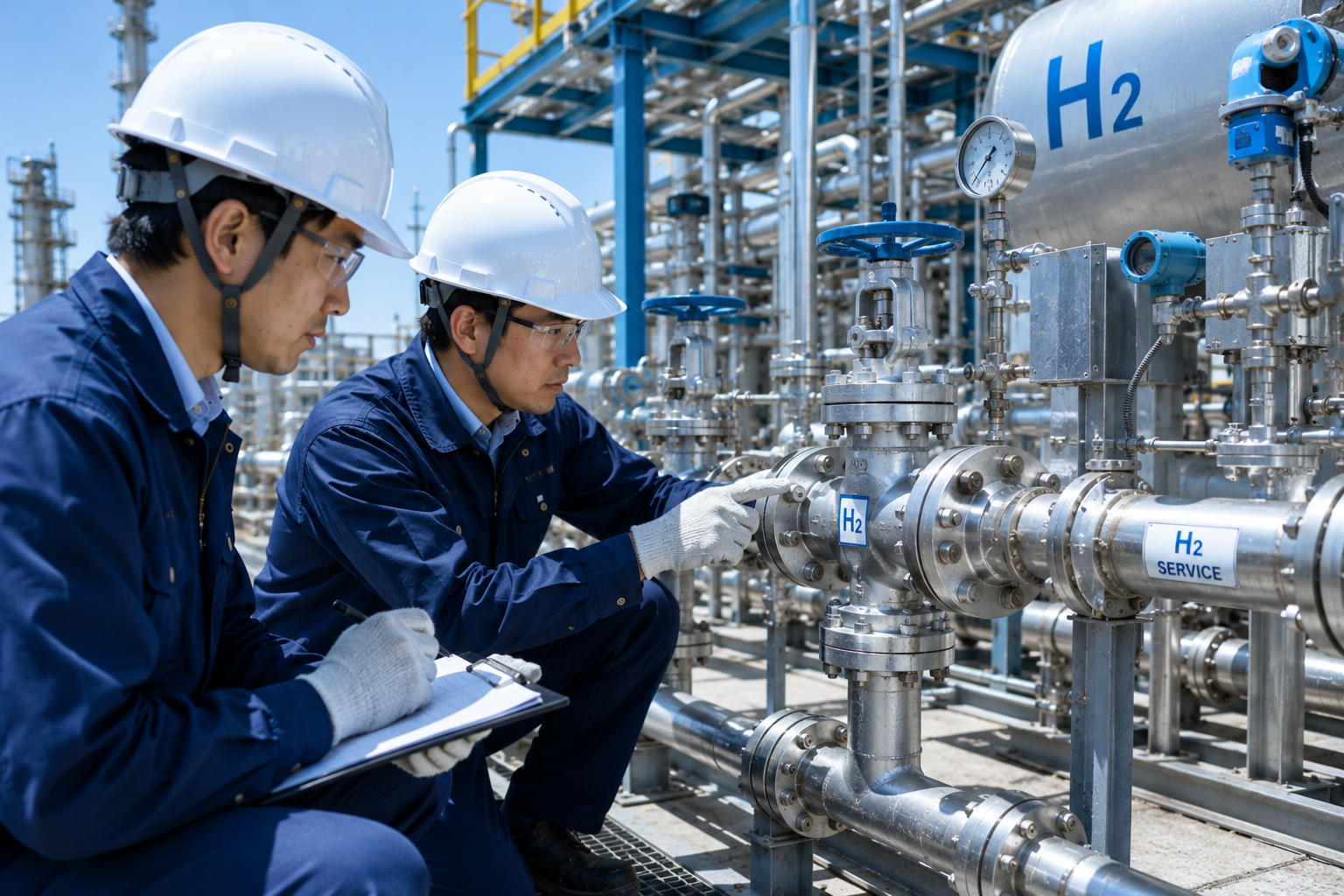
When selecting a hydrogen-compatible valve, the starting point is to keep two premises in mind—”hydrogen is a fluid with small molecules that leaks easily” and “some materials carry a risk of hydrogen embrittlement”—and to choose the wetted-part materials, sealing materials, and connection method to match the pressure and temperature of the application. Because hydrogen has a wide flammability range and is said to require little ignition energy, a design that suppresses even minute leaks is especially important. Here, we organize the material selection and points to check when handling hydrogen as a special fluid, in the order they arise in practice.
Key points of this article
- Because hydrogen has a small molecular diameter and leaks more easily than ordinary gases, leak countermeasures must be considered all the way down to the sealing materials, connection method, and surface finish.
- As a general guideline, it is common to select material systems that are less prone to hydrogen embrittlement, and austenitic stainless steels (SUS316, SUS316L, etc.) tend to be strong candidates.
- Because the optimal solution changes with conditions such as pressure, temperature, purity, and frequency of use, the premise is a judgment made per set of conditions rather than a single answer.
Understanding why hydrogen is a “special fluid that leaks easily”
Because its molecules are extremely small, hydrogen is a fluid that leaks more easily than other common gases, even through minute gaps. Threaded sections, sealing surfaces, or slight deterioration of packing can, depending on conditions, become leak paths. In addition, since hydrogen is said to have a wide flammability range and a low ignition energy requirement, it is important to build selection, installation, and maintenance on the premise that “even a slight leak is difficult to tolerate.”
For this reason, a perspective is required that considers not only the performance of the valve on its own but also the connection method (welding, flange, threaded), the type of sealing material, and the airtight design of the entire piping system as an integrated whole. Rather than judging by catalog bore size or pressure alone, it is safer to identify in advance the locations that are prone to becoming leak paths.
Select materials from the perspective of “avoiding hydrogen embrittlement”
Some metallic materials can undergo hydrogen embrittlement, in which mechanical properties degrade in a hydrogen environment. As a general guideline, higher-strength steels are said to tend to be more susceptible, while austenitic stainless steels (SUS316, SUS316L, etc.) are said to be relatively less affected. However, susceptibility to embrittlement depends not only on the material but also on multiple factors such as pressure, temperature, and stress state, so it cannot be stated across the board that “this material is always safe.”
In actual selection, it is a good guideline to clarify the operating pressure and temperature range as well as the assumed purity and moisture conditions, and then to check everything including the material and its heat-treatment and machining state.
Reduce leak paths through sealing materials and connection methods
In leak countermeasures, in addition to the metallic material of the wetted parts, the selection of sealing materials and connection methods is the practical key. Gaskets and packing must be chosen with hydrogen permeability and compatibility with the operating temperature in mind, and whether a soft seal or a metal seal is more suitable also changes with the pressure and frequency of the application. As for the connection method, welding or flanges may be considered from the standpoint of reducing leak paths, and in the case of threaded connections, seal treatment and tightening management become more important.
Frequently asked questions
Q1. Which material should I choose for hydrogen?
A1. As a general guideline, austenitic stainless steels (SUS316, SUS316L, etc.) tend to be candidates, but the judgment changes with pressure, temperature, and stress conditions. It is most reliable to organize the conditions first and then make the selection.
Q2. Can a general-purpose gas valve be diverted to hydrogen use?
A2. It cannot always be diverted. Because hydrogen leaks easily and there are concerns about hydrogen embrittlement, you need to check individually whether the material, sealing material, and connection method are suited to hydrogen conditions.
Q3. Does hydrogen embrittlement always occur?
A3. It does not always occur; multiple factors such as material, pressure, temperature, and stress are involved. Please understand it as an approach of lowering the risk by selecting a material that is less susceptible.
Q4. What criteria should I use to choose a sealing material?
A4. Compatibility with the operating temperature, hydrogen permeability, and frequency of use serve as the basis for judgment. The clearer the application’s pressure and temperature, the higher the selection accuracy, so we first recommend organizing the conditions.
Q5. Does the connection method also affect leak reduction?
A5. Yes, it does. From the standpoint of reducing leak paths, welding or flanges may be considered, and for threaded connections, seal treatment and tightening management are important. As a guideline, airtightness should be considered across the entire piping system.
Q6. Are there fewer points to note for low-pressure hydrogen?
A6. Even at low pressure, characteristics such as hydrogen’s tendency to leak and its wide flammability range do not change. The emphasis shifts according to pressure, but it is safer to regard the basic approach to leak countermeasures as being common to all cases.
Summary
Selecting a hydrogen-compatible valve is the work of translating the material, sealing material, and connection method into the operating conditions, on the premise that hydrogen is a “special fluid that leaks easily” and carries a “risk of hydrogen embrittlement.” Selecting materials such as austenitic stainless steel is a strong guideline, but because the optimal solution changes with conditions such as pressure, temperature, purity, and frequency, the premise is a judgment made per set of conditions rather than a uniform answer.
If you have concerns such as “I can’t judge which valve material is usable for a hydrogen line,” “I’m not sure whether an existing gas valve can be diverted to hydrogen,” or “I know the operating pressure and temperature but am unsure about selecting the sealing material,” please organize your conditions and make use of Yoshitake’s technical and selection consultations. Based on the application and the pressure, temperature, and fluid conditions, we will work with you to consider a suitable valve selection.