
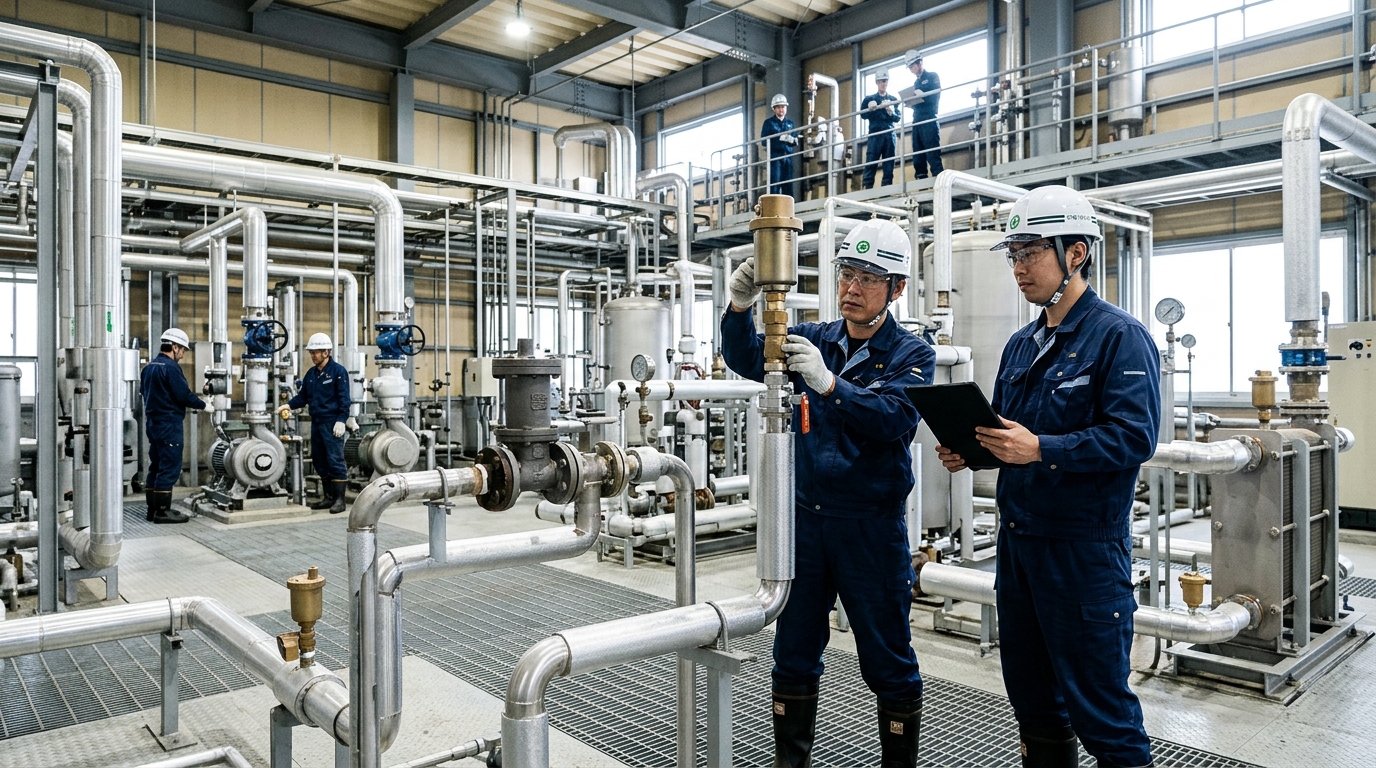
An air vent (automatic air release valve) that automatically discharges air accumulated inside piping is basically selected based on “which fluid, at what pressure and temperature, and at what location it is installed.” When air stagnates, it tends to cause reduced flow, water hammer, abnormal noise, and lower heat transfer efficiency, so placing the valve appropriately at high points and locations where air bubbles tend to collect determines its effectiveness. Here, we organize how air is automatically discharged and how the selection differs by application, such as water systems and steam systems, in the order used in actual practice.
Key points of this article
- Most air vents are float type, and they automatically repeat the action of opening the valve when the water level drops due to accumulated air and closing it when the water level returns.
- In selection, the basic flow is to first confirm the type of fluid, the operating pressure, and the temperature, and then decide the installation position and bore size.
- Because water systems and steam systems differ in both role and structure, even the same “air release” cannot be selected uniformly.
How an air vent automatically discharges air
Air and dissolved gas inside piping tend to accumulate at high points where the flow slows down, at headers, and on the suction side of pumps. If left unattended, they can be a cause of trouble such as unstable flow, water hammer, abnormal noise, and reduced efficiency at heat transfer surfaces. An air vent is a valve for discharging such stagnant air without human intervention.
In the most common float type, a float is provided inside, and when air accumulates and the internal water level drops, the float descends to open the exhaust port and lets the air escape outside. When the air is discharged and the water level returns, the float rises and closes the exhaust port to prevent the outflow of liquid. By automatically repeating this opening and closing, air can be released continuously during operation.
Difference in role from manual air venting
At locations where air only needs to be released once at start-up, a manual air-vent cock may be sufficient. However, for systems where air or gas is continuously generated or drawn in during operation, an air vent that can automatically repeat the exhaust is suitable. Which is appropriate is judged by determining whether the air generation is temporary or continuous.
How to select an air vent, which varies by application
Even for the same “air release,” the required role and structure differ between water systems and steam systems. In water systems such as chilled/hot water and water supply, the main purpose is to discharge air that is generated or drawn in during operation and thereby stabilize flow and heat transfer. In steam systems, on the other hand, the emphasis is on quickly discharging the air inside the piping mainly at start-up, so that it does not hinder the distribution of steam or the handling of drain. The starting point is first to distinguish which system the target belongs to.
Narrowing down by fluid, pressure, and temperature
In selection, in addition to the target fluid, the range of operating pressure and temperature is checked against the catalog specifications. The float, valve seat, and seal material have pressure and heat resistance suited to the operating conditions, and exceeding those conditions can cause poor exhaust or leakage. Especially for steam and high-temperature water, a guideline is to select a model that satisfies the expected maximum temperature and pressure with a margin.
Thinking about installation position and bore size
An air vent is basically installed in a nearly vertical orientation at high points of piping where air tends to accumulate, at the top of headers, and at air pockets in equipment. Even if it is installed at a low point or in a straight pipe section with fast flow, it is hard to capture the air, and it becomes difficult to obtain its intended effect. The bore size is selected based on the amount of air to be discharged and the scale of the system; if it is extremely small, the exhaust may not keep up. It is also reassuring to check the ease of inspection and cleaning after installation.
Frequently asked questions
Q1. What happens if an air vent is not installed?
A1. It depends on the conditions, but stagnant air tends to cause reduced flow, water hammer, abnormal noise, and lower heat transfer efficiency. The effects tend to appear more readily at locations where air easily accumulates, such as high points and the suction side of pumps.
Q2. How do you choose between float type and manual air venting?
A2. One guideline for the distinction is to use the automatic float type for systems where air is continuously generated or drawn in during operation, and manual venting at locations where releasing air once at start-up is sufficient. The judgment is based on whether the air generation is temporary or continuous.
Q3. Where is a suitable installation position?
A3. Since air accumulates at high points, the basic locations are high points of piping, the top of headers, and air pockets in equipment. At low points or locations with fast flow, it is hard to capture the air, and the effect may be difficult to obtain.
Q4. Can models for water and for steam be used interchangeably?
A4. Because both the role and the suitable conditions differ, in principle a model matched to the application is selected. Steam in particular reaches high temperature and high pressure, so it is safest to avoid diverting a water model as is.
Q5. How should the bore size be decided?
A5. It is selected based on the amount of air to be discharged and the scale of the system. If it is too small, the exhaust may not keep up, so it is reliable to select after organizing the conditions.
Q6. Why does water leak from the exhaust port?
A6. Several factors are conceivable, such as foreign matter caught in the float or seal, or a mismatch between the operating conditions and the specifications. First, check the match between the operating pressure/temperature and the model specifications, and whether there is any internal dirt.
Summary
Selecting an air vent becomes easier to organize when you proceed in this order: starting from distinguishing whether it is a water system or a steam system, narrowing down the model by fluid, operating pressure, and temperature, and installing it at high points where air tends to accumulate with the proper bore size and orientation. In every case, accuracy depends on starting from the “guideline” and applying it to your own system conditions.
If you have concerns such as “I know where the air pockets are but cannot judge the suitable model,” “I want to confirm whether the specifications are adequate for the operating pressure and temperature,” or “I want to select an equivalent for an existing air release valve,” please organize your system and operating conditions and make use of Yoshitake’s technical and selection consultation. Based on the fluid, pressure, temperature, and installation position, we will consider the selection of a suitable air vent together with you.