
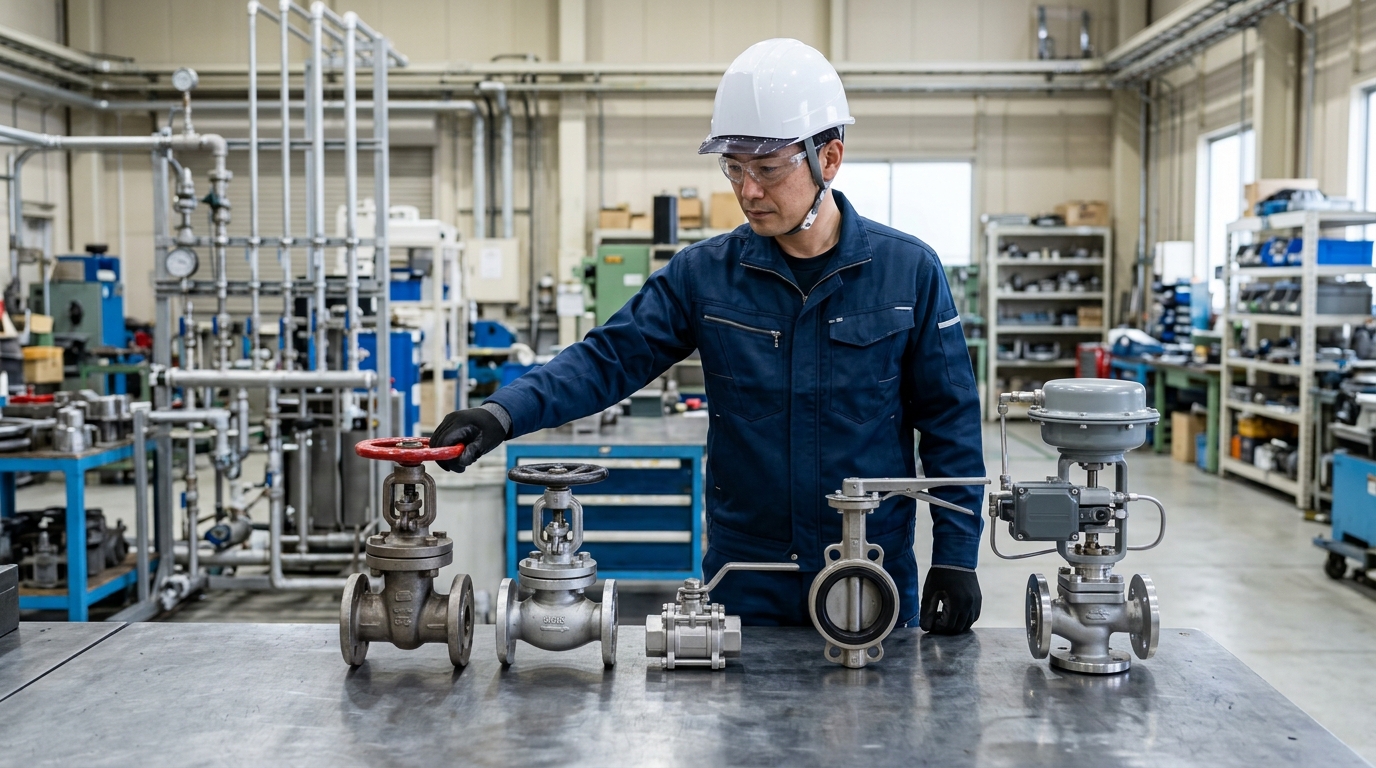
Automatic valves and manual valves are not a matter of “which is better”; they are selected according to how often they are operated, the required response speed, and safety requirements. Systems that require frequent opening and closing or remote/automatic control call for automatic valves, while locations where manual operation is sufficient, such as during inspections or shutoffs performed only a few times a year, are basically suited to manual valves. However, rather than starting from “automatic or manual,” you will make fewer mistakes if you proceed in this order: first decide what you want to do, next check the fluid, pressure, temperature, and flow rate, narrow down the appropriate structure and actuation method, and only then decide whether automation is necessary. This article summarizes quick-reference guidelines organized by application, along with the steps for making the decision.
Key points of this article
- Whether to go automatic or manual is decided last. First narrow down the structure and actuation method based on your purpose and fluid conditions
- As a guideline, choose automatic valves for frequent, remote, or high-speed response needs, and manual valves for occasional shutoff or on-site adjustment
- If in doubt, consult us for valve selection with the bore size, flow rate, and pressure conditions attached
The difference between automatic valves and manual valves
Even though both are “valves,” their roles differ depending on whether a person opens and closes them with a handle, or whether they operate automatically by an external force or by fluid pressure. Let us first clarify how the two are positioned.
What is a manual valve
A manual valve is one that a person operates by hand using a handle or lever to open, close, or adjust it. Representative examples include gate valves, globe valves, ball valves, and butterfly valves, and they are characterized by their relatively simple structure and ease of handling. They are suited to shutoff applications with a low frequency of opening and closing, or to locations where on-site manual adjustment is desired. On the other hand, they may be unsuitable for remote operation, reliable opening and closing in a short time, or unmanned operation.
What is an automatic valve
An automatic valve operates automatically by an external power source such as electricity or air pressure, or by the pressure of the fluid itself. In addition to motorized valves, solenoid valves, and pneumatically actuated valves, self-actuated pressure reducing valves and safety valves, which operate by pressure without using an external power source, are also included in the broad sense. They are suited to remote control, high-frequency opening and closing, and control that maintains a constant pressure, temperature, or flow rate, but they require consideration of the power supply, instrumentation, and fail-safe design.
Quick-reference guidelines by application
These are guidelines for choosing between the two from the perspective of “what kind of operation you want to perform.” They are only general tendencies, and the optimal solution changes depending on the actual conditions.
Cases suited to manual valves
- The frequency of opening and closing is low, and the main purpose is shutoff or isolation
- Operated on-site as a root valve for inspection and maintenance
- You want to finely adjust the flow rate by hand
- An environment where it is difficult to newly install a power supply or instrumentation
Cases suited to automatic valves
- Opening and closing is frequent, or you want remote or centralized control
- Control that maintains a constant pressure, temperature, or flow rate is required (including self-actuated pressure reducing valves and safety valves)
- You want reliable opening and closing in a short time, or unmanned operation
- A fail-safe that automatically closes/opens in the event of an abnormality is required
How to proceed with selection
If you start from the binary choice of automatic or manual, you may end up choosing a structure that does not match the conditions. Organizing your thinking in the following order makes it easier to narrow down the options.
Decide “automatic or manual” last
As a guideline, the order to think in is: (1) what you want to do (shutoff, adjustment, pressure control, etc.), (2) what the fluid is (water, steam, oil, gas, etc.), (3) what the pressure, temperature, and flow rate are, (4) which structure and actuation method are appropriate, and (5) whether automation is necessary. If you treat the need for automation as the last item to consider, discrepancies with the conditions are less likely to occur.
Fix the fluid conditions first
Even for the same application, the seat material and valve type change if the fluid, temperature, or pressure differs. Material selection is especially important for steam, high-temperature fluids, and corrosive fluids. If you check not only the maximum flow rate but also the minimum value and the range of variation, it becomes easier to select the bore size and actuation method in the later stages.
Frequently asked questions
Q1. Which is cheaper, an automatic valve or a manual valve
A1. Generally, manual valves tend to be less expensive as a standalone unit. However, because automatic valves can reduce manpower and the frequency of opening and closing, a guideline is to compare them including the operation of the entire system.
Q2. Can a manual valve be automated later
A2. Some products can be automated by attaching a motorized or pneumatic actuator. Whether attachment is possible depends on conditions such as the valve type, bore size, and the required shutoff torque.
Q3. How should I choose the actuation method for an automatic valve
A3. One guideline is motorized for locations where electrical wiring can be run, and pneumatic when response speed or fail-safe operation is important. The suitable method differs depending on the installation environment and safety requirements.
Q4. Are strainers and sight glasses valves
A4. These are not valves that stop fluid, but peripheral equipment for valves. The same applies to separators and expansion joints, which are distinguished as equipment that supports the piping system.
Q5. Are pressure reducing valves and safety valves automatic valves
A5. They are “self-actuated” valves that operate automatically by the fluid pressure without external power. Their operating principle differs from that of externally actuated automatic valves driven by electricity or air.
Q6. What should I decide first
A6. Rather than automatic or manual, organize the conditions in the order of purpose → fluid → pressure, temperature, and flow rate, narrow down the appropriate structure and actuation method, and then judge whether automation is necessary. This makes it easier to proceed with the selection.
Summary
Automatic valves and manual valves are not chosen based on superiority or inferiority; they are used selectively according to the frequency of operation, the response speed, and safety requirements. As a guideline, do not start selection from “automatic or manual.” Instead, fix the purpose and fluid conditions first, narrow down the appropriate structure and actuation method, and then judge whether automation is necessary.
If you have concerns such as “I cannot judge whether the bore size or actuation method is appropriate,” “I know the maximum flow rate but not the minimum flow rate,” “I want to select an equivalent product to an existing valve,” or “I do not know which material suits steam or high-temperature fluids,” please attach your conditions and consult Yoshitake. Based on information on the application, fluid, pressure, temperature, and flow rate, we will help you select a suitable valve.