
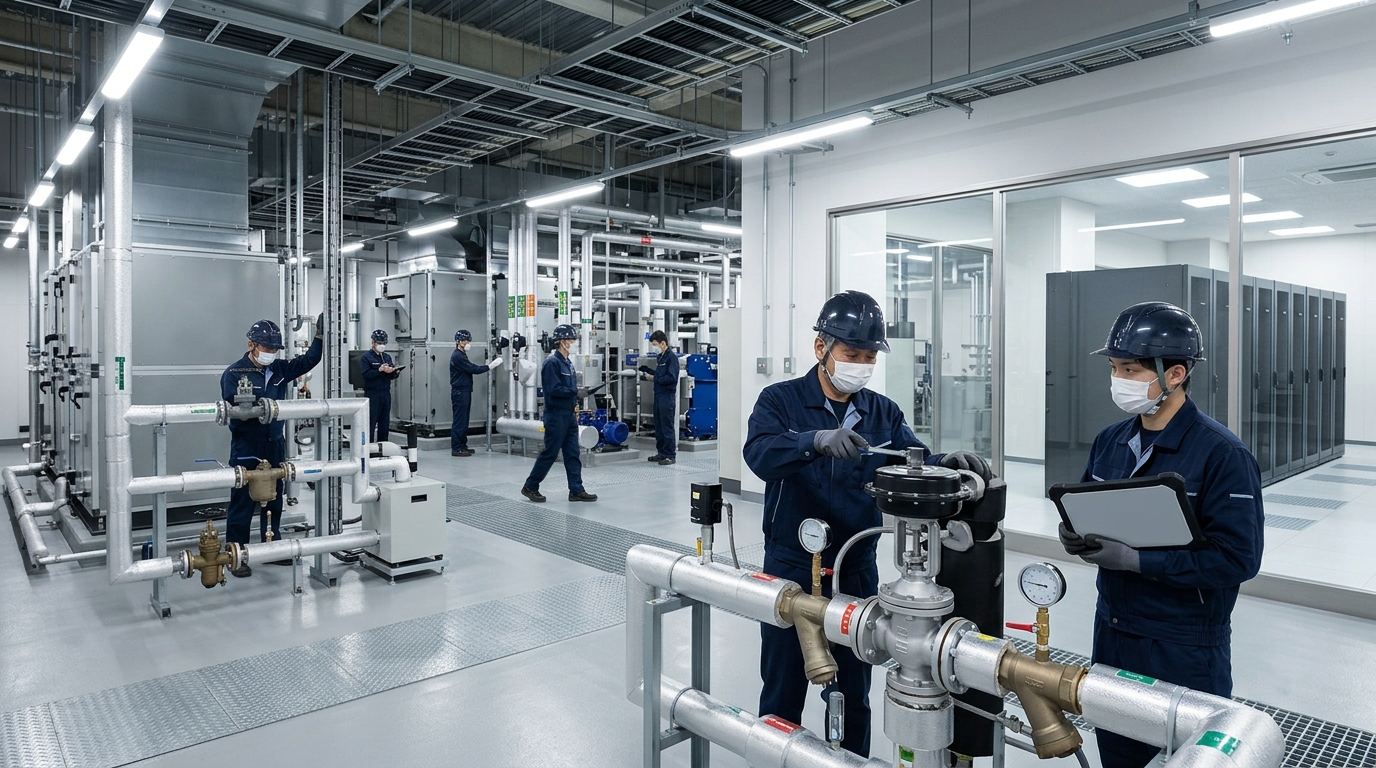
In data center air conditioning, managing not only temperature but also humidity is essential to keep servers running stably. Steam is sometimes used for this humidity control and as part of the heat source, and valves play a critical role in delivering steam in exactly the right amount. By stabilizing pressure with a pressure reducing valve, adjusting flow rate to match the load with a control valve, and promptly discharging condensate (drain) with a steam trap, it becomes easier to maintain heat exchange efficiency while curbing steam consumption. As a result, this contributes to energy savings and stable operation of the air conditioning, which is the main benefit of using valves in a data center.
Key Points of This Article
- In data center air conditioning, steam may be used for temperature and humidity control or as a heat source, and a stable steam supply is the key to energy savings.
- Pressure reducing valves, control valves, steam traps, and other devices optimize pressure, flow rate, and drain discharge, helping to maintain thermal efficiency.
- When you are unsure about a decision such as “whether the bore size or set pressure is appropriate,” the surest approach is to organize the conditions and consult the manufacturer on selection.
Why Steam Is Used in Data Center Air Conditioning
Data center air conditioning is not simply about lowering room temperature; its purpose is to keep an environment suited to server equipment stable at all times. As part of this, there are situations in which steam is used.
Temperature/Humidity Control and Steam Humidification to Protect the Server Environment
In a data center, managing humidity in addition to temperature is important. If humidity is too low, the risk of faults due to static electricity increases, and if it is too high, it can contribute to condensation and corrosion, so operation that keeps humidity within a certain range is generally recommended.
When steam humidification is adopted for this humidity control, it makes clean and fast-responding humidification easier, but on the other hand a mechanism to supply steam stably at an appropriate pressure is required. Because humidification output is difficult to keep stable when the pressure of the steam sent to the humidifier fluctuates, pressure stabilization by a pressure reducing valve becomes effective.
Cases Where Steam Is Used for Heat Sources or Waste Heat Recovery
Depending on the facility, a steam-driven absorption chiller may be incorporated as the heat source for air conditioning, or steam and waste heat from other equipment may be utilized. Such configurations can help level electric power peaks, but whether they can be adopted and how effective they are will differ depending on the equipment design and operating conditions. In any case, whether steam can be supplied stably and in exactly the right amount governs energy efficiency.
The Role of Valves That Support Energy Savings
In an air conditioning system that uses steam, multiple valves each share a role, and together they support energy savings and stable operation. Here we organize the main roles into “stabilizing pressure and flow rate” and “maintaining heat exchange efficiency.”
Stabilizing Pressure and Flow Rate (Pressure Reducing Valves and Control Valves)
A pressure reducing valve lowers the high steam pressure on the heat source side to a pressure suited to equipment such as humidifiers and heat exchangers, and keeps the secondary-side pressure stable even when the load fluctuates. When pressure is stable, humidification output and heat exchange capacity become stable, making it easier to curb waste caused by oversupply.
A control valve (such as a motorized valve) adjusts the steam flow rate to match fluctuations in the air conditioning load. Because a data center’s load changes with utilization rate and season, throttling the flow rate to follow the load is effective in curbing excess steam consumption.
Maintaining Heat Exchange Efficiency (Steam Traps, Air Vent Valves, and Safety Valves)
A steam trap promptly discharges the drain that accumulates in piping and heat exchangers while working so that the steam itself does not escape. When drain stagnates, heat exchange efficiency drops and it can also become one of the causes of water hammer. In addition, if a trap fails and steam keeps leaking, this leads directly to energy loss, so periodic operation checks serve as a benchmark for maintaining energy savings.
An air vent valve discharges the air that enters the piping, such as during startup. Because air impedes heat transfer, removing it helps prevent a drop in heat exchange efficiency. A safety valve serves to protect equipment from overpressure; it is not energy saving in itself, but it is indispensable as a prerequisite for keeping the system safe and stable.
Frequently Asked Questions
Q1. Is steam essential for data center air conditioning?
A1. It is not essential. It depends on the humidification method and the design of the heat source. When steam humidification or a steam-driven heat source is adopted, a set of valves such as pressure reducing valves and steam traps comes into play.
Q2. What is the difference between steam humidification and evaporative or water-spray humidification?
A2. In general, steam humidification responds quickly and makes clean humidification easier, but it requires a heat source. Evaporative and water-spray methods can be advantageous in terms of energy efficiency, and the choice is made in light of environmental conditions and cost.
Q3. Which valve is most effective for energy savings?
A3. It cannot be stated in a single answer. The roles differ—a pressure reducing valve for pressure stability, a control valve for load following, and a steam trap for maintaining thermal efficiency—and the effect comes from the combination.
Q4. What happens if a steam trap fails?
A4. There is a risk of energy loss due to steam leakage, as well as a drop in heat exchange efficiency and a cause of water hammer due to drain stagnation. We recommend periodic operation checks.
Q5. How is the set pressure of a pressure reducing valve determined?
A5. It is determined from the required pressure and flow rate of the equipment used and the piping conditions. There are rough guidelines, but ultimately selection matched to the equipment specifications is the prerequisite.
Q6. When updating an existing valve, can I choose an equivalent product?
A6. If conditions such as bore size, connection type, and pressure/temperature are known, an equivalent product can often be selected. When the specifications are unclear, it is surest to organize the conditions and consult the manufacturer.
Q7. If steam consumption increases due to expansion, where should I review?
A7. The capacity of the pressure reducing valve, the discharge capacity of the steam trap, and the piping bore size are the points to check. We recommend checking the balance of the entire system rather than just one specific spot.
Summary and Consultation
When steam is used in data center air conditioning, pressure stabilization by a pressure reducing valve, load following by a control valve, and drain discharge by a steam trap combine to enable energy savings that curb steam consumption while maintaining heat exchange efficiency. The first step is to organize how steam is used and by which equipment in your own air conditioning system.
If you have concerns such as “I cannot judge whether the bore size or set pressure of the pressure reducing valve sending steam to the humidifier is appropriate,” “I know the maximum flow rate but the minimum flow rate is unknown, so I cannot decide on a flow control valve,” or “I want to select an equivalent product for an existing valve,” please organize the conditions and consult Yoshitake for technical and selection advice. We can propose valve selection tailored to your operating conditions.