
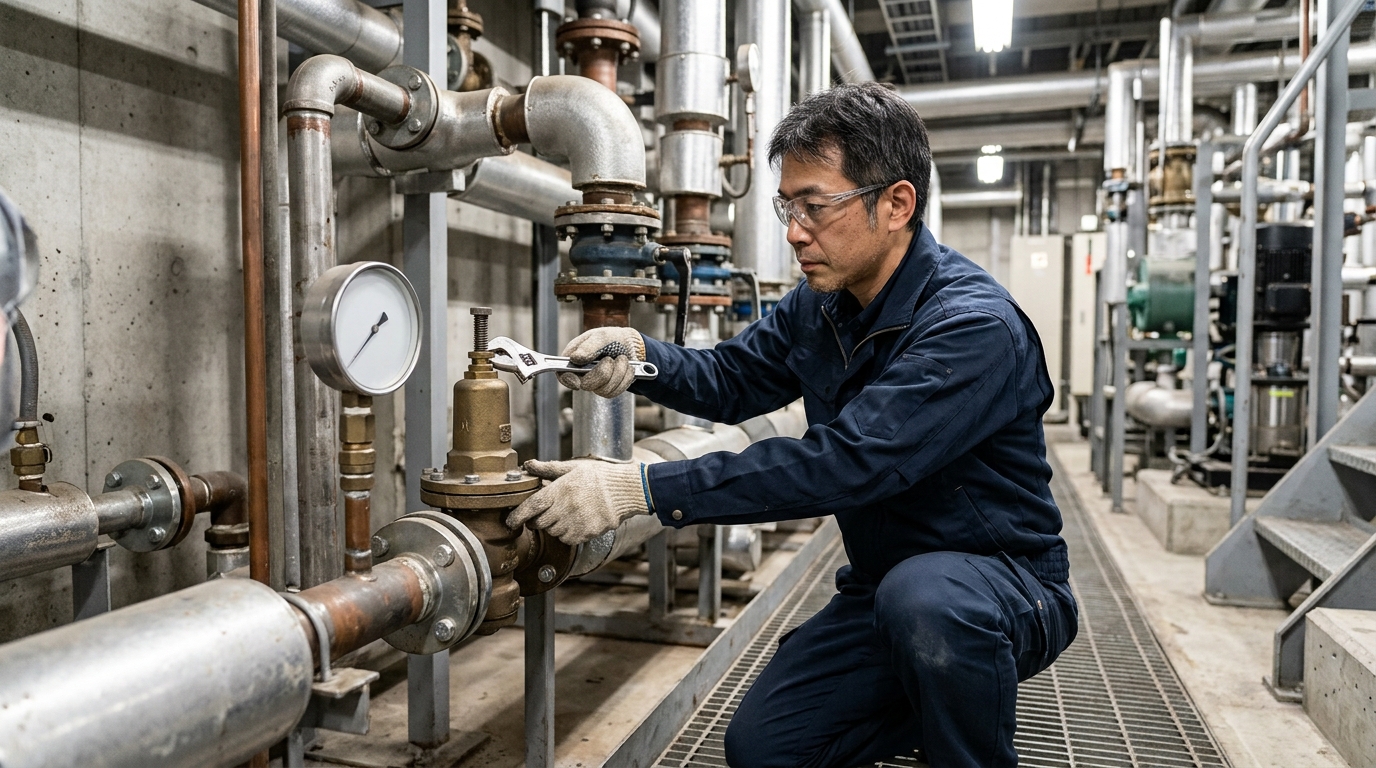
When the secondary-side pressure of a pressure reducing valve does not come out as set, the first thing to check is the instruction manual supplied with the product. The adjustment method for a pressure reducing valve is clearly described in the manual, which shows the procedure for each model, including the turning direction of the adjustment screw, the locking method, and how to release any sealed-in pressure. The basic principle is to “turn the adjustment screw little by little while watching the secondary-side pressure gauge, with the primary side charged with fluid or air.” On most models the secondary pressure rises when turned clockwise and falls when turned counterclockwise, but since the direction differs from model to model, checking the manual is a prerequisite. Below, we organize how to isolate and address typical problems such as the pressure not falling or not rising.
Key Points of This Article
- Carry out adjustment according to the manual, turning the screw little by little while watching the secondary-side pressure gauge.
- “The secondary pressure will not fall” is often caused by trapped pressure or back pressure from another system.
- Sorting out the symptom and operating conditions before consulting the manufacturer leads to a faster solution.
Basic Adjustment Procedure and the Right Way to Proceed
Adjust According to the Manual While Checking the Secondary Pressure
Adjustment of a pressure reducing valve is carried out by supplying fluid to the primary side and checking the actual pressure with the secondary-side pressure gauge as you proceed. Turning the adjustment screw a large amount at once tends to cause overshoot, so it is preferable to turn it a little at a time, wait for the pointer of the pressure gauge to settle, and then readjust. When the medium being adjusted is steam or a high-temperature fluid, note also that the indicated value may fluctuate until the equipment stabilizes.
On many models, after adjustment you fix the setting with a lock nut and add or release the sealed-in pressure. Because the turning direction and the fixing method differ from model to model, cross-checking a photograph or structural diagram against the manual while you work makes it easier to prevent operating errors.
How to Read the Situation When the Secondary Pressure Will Not Fall or Rise
When “the secondary pressure will not fall even though the adjustment screw is turned,” it is not uncommon for factors on the piping-system side to be involved rather than a fault in the valve alone. A particularly common case is trying to lower the secondary pressure without first releasing the pressure that was once applied during an airtightness test or pressure-resistance test. If trapped pressure remains, the indicated value will not fall even when the adjustment screw is loosened. The basic approach is to first release the secondary-side pressure safely and then adjust again.
Another common situation is one in which the secondary side is connected to another system and back pressure is applied. When return pressure from another line or pressure from a higher-pressure side flows back in, the secondary pressure may fail to fall even when the pressure reducing valve is throttled, or may appear to rise higher than expected. Check the connection relationships on the system diagram and, if necessary, isolate the sections with a check valve or an isolation valve.
On the other hand, when “the secondary pressure will not rise,” possible factors include insufficient primary pressure, a clogged strainer, foreign matter caught on the valve seat, and deterioration of the adjustment spring. Under conditions of extremely low flow rate, the secondary pressure can also be difficult to stabilize, and the valve may exhibit behavior close to so-called stall (a state in which the pressure will not settle and remains halfway). Rather than assuming a single cause, it is effective to check the primary pressure, flow rate, and filtration condition in turn.
Information to Organize Before Consulting the Manufacturer
When you cannot determine whether the symptom is on the piping-system side or the valve side, it is safer to consult the manufacturer before forcing a disassembly. In doing so, organizing the following information beforehand makes verification smoother: the nature of the problem (will not fall, will not rise, pulsates, etc.), the period of use, the current measured values of the primary and secondary pressures, the type of fluid (steam, water, air, oil, etc.), and the installation environment and operating conditions. If possible, also attaching the model number, the system diagram, and a photograph of the pressure gauge will improve the accuracy of estimating the cause.
Frequently Asked Questions
Q1. Which way should I turn the adjustment screw to lower the secondary pressure?
A1. In general, many models decrease when turned counterclockwise, but the direction differs from model to model. Always check the rotation direction in the manual before operating.
Q2. The secondary pressure will not fall even though I loosen the adjustment screw.
A2. Pressure trapped on the secondary side may remain. Release the test pressure or the like safely once, and readjust under normal operating conditions.
Q3. The secondary pressure is higher than expected and will not return even when I lower it.
A3. Back pressure from another system may be flowing back in. Check the system’s connection relationships and make your judgment after isolating the sections with isolation and check valves.
Q4. What could cause the secondary pressure not to rise all the way?
A4. Insufficient primary pressure, a clogged strainer, foreign matter on the valve seat, or spring deterioration can be factors. We recommend not concluding on a single cause and checking them in turn.
Q5. The pressure is unstable at a very small flow rate.
A5. When the flow rate used falls below the proper range of the pressure reducing valve, the pressure tends to become difficult to settle. Reviewing the selection to include the expected minimum flow rate may bring improvement.
Q6. Is it all right to disassemble it myself?
A6. Because it affects internal parts and settings, when the judgment is difficult it is safer to consult the manufacturer before disassembly. Please organize your operating conditions and contact us.
Summary
The basic approach to adjusting a pressure reducing valve is to do it little by little, following the procedure in the manual and watching the secondary-side pressure gauge. “Will not fall” problems are often related to trapped pressure or back pressure from another system, while “will not rise” problems are often related to the primary pressure, filtration, and part condition. Organizing the symptom and operating conditions to isolate the cause is the shortest path to a solution.
If you have any trouble with adjustment or selection, please contact Yoshitake for technical or selection consultation. If you let us know specific concerns such as “the secondary pressure will not fall and I cannot isolate the cause,” “I know the maximum flow rate but not the minimum, and the pressure will not stabilize,” “I want to select an equivalent for an existing valve,” or “I cannot judge whether the bore size is appropriate,” we can provide guidance suited to your operating conditions.