
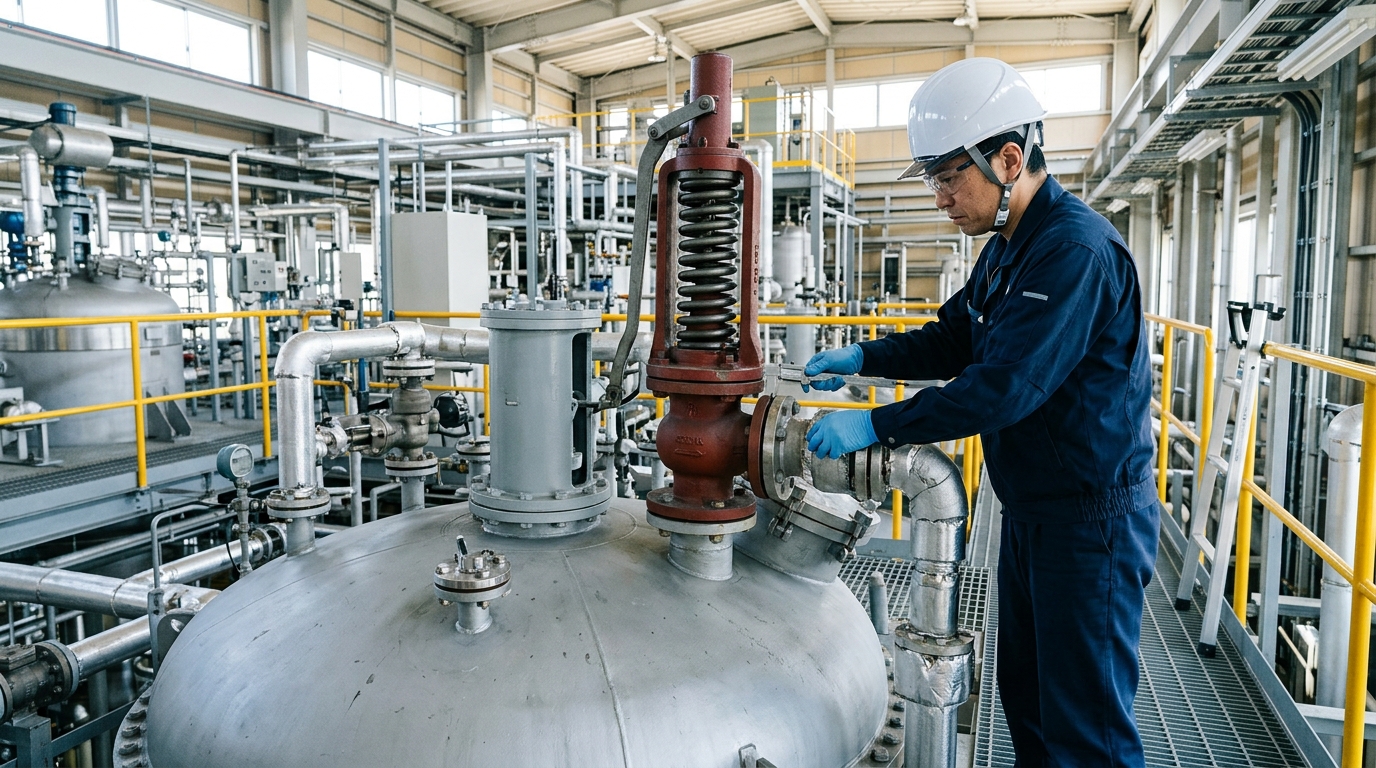
The first things to establish when selecting a safety valve are the set pressure and a relieving capacity that satisfies the “required relieving capacity” under actual operating conditions. Underestimating the relieving capacity means the pressure cannot be fully released during an abnormal event, which can lead to a serious accident. Conversely, an oversized selection can cause chattering (violent open-close oscillation of the valve), which can degrade performance and contribute to leakage. To prevent accidents caused by selection errors, the key is to comprehensively verify pressure, fluid, capacity, bore size, and back pressure in line with the operating conditions.
Key points of this article
- Securing the set pressure and the required relieving capacity forms the foundation of safety valve selection
- Too small a relieving capacity tends to cause overpressure, while too large a capacity tends to contribute to chattering
- Judge comprehensively based on the fluid, temperature, back pressure, and bore size in line with the operating conditions
Why selection errors in relieving capacity can lead to serious accidents
Required relieving capacity and the valve’s relieving capacity
A safety valve is a safety component that automatically opens when a pressure vessel or piping experiences an abnormal pressure rise, releasing the internal fluid to suppress the pressure increase. The benchmark here is the relationship between the “required relieving capacity”—which indicates how much needs to be discharged during an assumed abnormal event—and the “relieving capacity” that the selected valve can actually pass.
The required relieving capacity is derived from the pressure-rise factors that can occur in that equipment, such as fire, heating, external heat input, or dead-head operation of a pump or compressor. If the valve’s relieving capacity is insufficient relative to this amount, then even with the valve fully open the discharge cannot keep up with the pressure rise, and a condition (overpressure) arises in which the pressure continues to climb beyond the set pressure, potentially leading to deformation or damage of the equipment. Because the relieving capacity varies with the type of fluid—steam, air, liquid, and so on—as well as with pressure and temperature, it is advisable to convert the values to the actual conditions for verification rather than using catalog values as they are.
Chattering caused by oversizing
If, out of fear of insufficiency, the bore size or capacity is made too large, other problems tend to arise. When the actual discharge is small relative to the valve’s relieving capacity, “chattering” can occur, in which the pressure drops sharply immediately after opening so that the valve closes, then the pressure rises again and the valve reopens, repeating this cycle in a short period.
Chattering can contribute to wear of the valve seat and disc, seat leakage, and vibration or noise in the piping, and as a result it may impair the intended safety performance. A safety valve is not “the bigger the safer”; selecting a capacity commensurate with the required relieving capacity leads to stable operation. The basic approach is to avoid both oversizing and undersizing and to select a capacity that matches the conditions.
Operating conditions that are easy to overlook
Even at the same set pressure, the appropriate selection changes when the fluid, temperature, or back pressure conditions change. In particular, for systems with high pressure on the discharge side (back pressure), or when exhaust is combined into a common header, the back pressure can affect operation and relieving capacity, and it may be necessary to consider a type that is less susceptible to back pressure.
In addition, selecting the material and type according to the corrosiveness, high temperature, or presence of foreign matter in the fluid, and securing an appropriate operating pressure differential relative to the set pressure, are also factors that influence safety. These cannot be determined by uniform numerical values; it is important to judge comprehensively in light of laws and standards and the design conditions of the equipment.
Frequently asked questions
Q1. How should the relieving capacity be determined?
A1. Determine the required relieving capacity from the assumed pressure-rise factors, such as fire, heating, or dead-head operation. Convert that amount to the fluid, pressure, and temperature conditions, and verify that the valve’s relieving capacity exceeds it. If the judgment is difficult, we recommend organizing the conditions and consulting us.
Q2. Is it safe to choose a larger safety valve?
A2. Not necessarily. If the capacity is too large, chattering tends to occur, which can contribute to valve seat wear and leakage. Selecting a capacity commensurate with the required relieving capacity leads to stable operation.
Q3. Are the set pressure and the operating pressure the same?
A3. The set pressure is the benchmark at which the valve begins to open; in practice, opening and closing (blowdown) involve a certain pressure differential. It is advisable to secure an appropriate difference between the operating pressure and the set pressure. The details depend on the design conditions of the equipment.
Q4. Does back pressure affect the selection?
A4. It can. In systems with high discharge-side pressure or with common headers, back pressure relates to operation and relieving capacity, so a type that is less susceptible to back pressure may be considered. Because it varies with the conditions, advance confirmation is effective.
Q5. What should I be careful about when selecting an equivalent for an existing valve?
A5. It is important to verify not only the bore size and connection but also that the conditions of set pressure, fluid, temperature, and relieving capacity match. If the stamped or nameplate information is unclear, we recommend reselecting from the operating conditions.
Q6. Can the same valve be used for both steam and liquid?
A6. Because the relieving capacity calculation and the suitable type differ depending on the fluid, in principle you should select a specification suited to the application. Whether sharing is possible depends on the conditions, so verification based on the actual fluid, pressure, and temperature is necessary.
Summary
Safety valve selection hinges not only on maintaining the set pressure but also on whether the required relieving capacity can be secured under the actual operating conditions. Because too small a relieving capacity contributes to overpressure and too large a capacity contributes to chattering, judging comprehensively—including the fluid, temperature, back pressure, and bore size—makes it easier to reduce the risk of accidents caused by selection errors.
If you have concerns such as “I know the bore size but not how to determine the required relieving capacity,” “I want to select an equivalent for an existing valve but the nameplate information is unclear,” or “I cannot decide which type to choose for a system with back pressure,” please organize your operating conditions and make use of Yoshitake’s technical and selection consultation. We can provide selection guidance based on your conditions.