
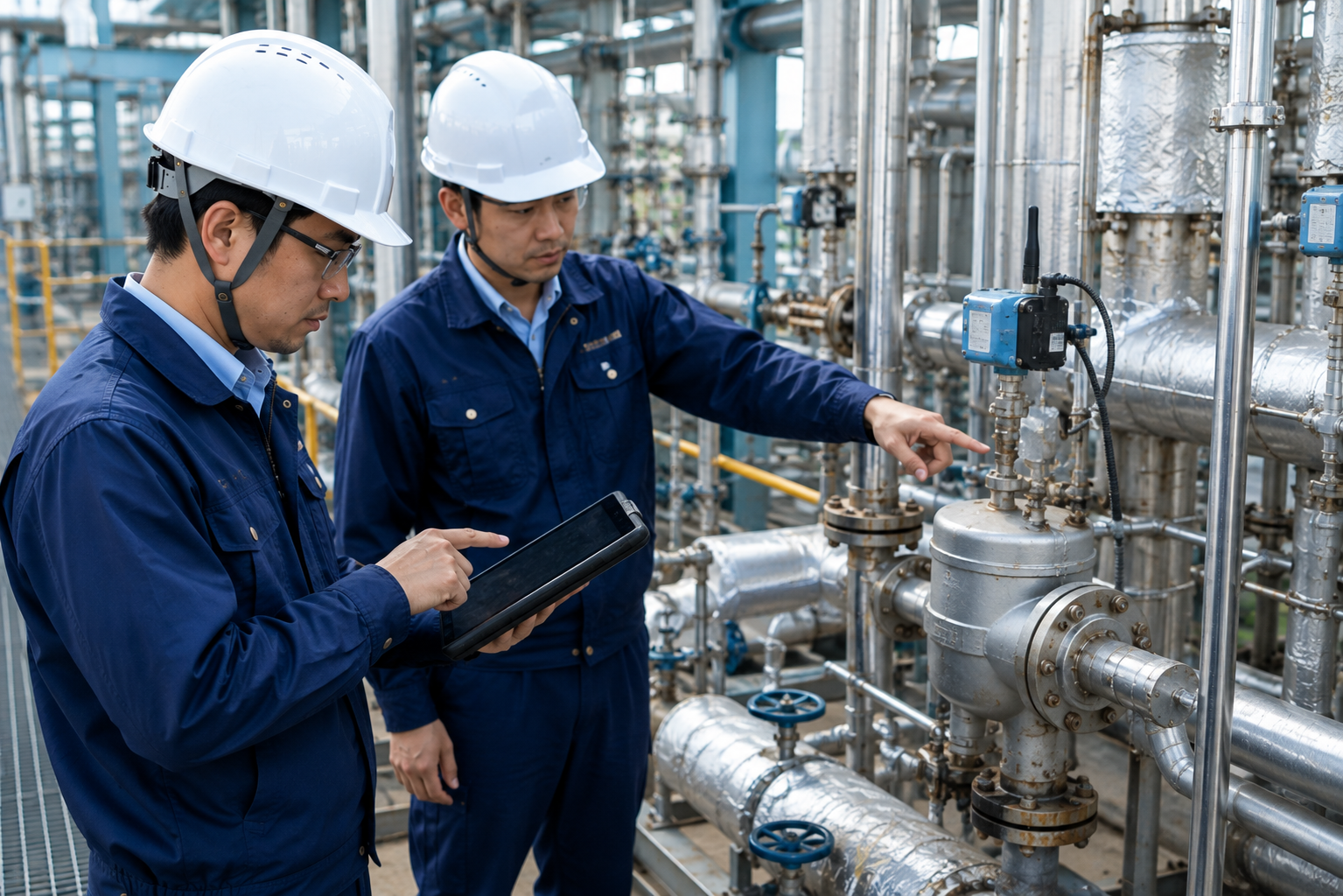
A steam trap failure leads to energy loss from steam leakage or, conversely, to condensate accumulation and water hammer caused by blockage. Yet with routine walk-through inspections alone, such problems tend to be detected too late. By using wireless remote monitoring such as Wi-Flo, you can check the operating condition of each trap as data from a remote location, catching the early signs of failure and moving toward “predictive maintenance.” This article organizes the thinking behind “not overlooking trap failures” through remote monitoring, along with the criteria to consider when evaluating adoption, for practitioners in production engineering, maintenance, and purchasing.
Key points of this article
- Remote monitoring tends to be most effective for grasping the condition of traps that are inspected infrequently or that are hard to reach, such as those at high elevations or high temperatures
- The aim of predictive maintenance is to continuously capture “signs of operation, leakage, and clogging” as data and to link this to planned replacement
- Rather than monitoring every trap all at once, a realistic approach is to introduce monitoring in stages, starting with locations where the loss amount or shutdown risk is greatest
Why steam trap failures are overlooked and the role of remote monitoring
A steam trap is a component that holds back steam and discharges only condensate (condensed water), and in practice it is difficult to tell from its external appearance whether it is in a normal, leaking, or blocked state. If a failure persists, a leaking trap can increase fuel costs, while a blocked trap can lead to insufficient heating, pipe corrosion, or water hammer.
Visual and walk-through inspections alone tend to cause delays
At many sites, ultrasonic or temperature-based inspections are carried out periodically, but failures that occur between one inspection and the next go unnoticed until the following round. The more traps a plant has, the longer the walk-through takes, and lower-priority locations may be checked only a few times a year. This “inspection blind period” tends to be one factor that lets losses accumulate.
What remote monitoring can and cannot reveal
Wireless monitoring such as Wi-Flo is a system that continuously acquires data such as the temperature around the trap and makes it possible to check operating trends from a remote location. This lets you narrow down the locations suspected of failure before the walk-through, shortening the inspection blind period. On the other hand, monitoring data is ultimately only material for making a judgment; the final determination of good or bad and whether replacement is needed is based on the premise that it be judged together with on-site confirmation. It should also be noted that how easily a problem can be detected varies depending on the trap type, installation conditions, and operating pattern.
Criteria for adoption that leads to predictive maintenance
Which traps to monitor first
Remote monitoring does not necessarily have to be installed on every trap. In general, prioritizing locations where a leak would cause large losses due to high steam pressure or large bore, equipment directly tied to production that cannot be allowed to stop, and hard-to-reach or high-risk points such as high elevations or high-temperature areas makes it easier to gauge the return on investment. Where records of failure frequency exist, it is also effective to start with the systems that have had the most trouble in the past.
How to estimate the effect
The effect of adoption is determined by “how much sooner you can find failures you had been overlooking.” As a guideline, convert the steam loss from leakage and the downtime until restart into a monetary amount, and evaluate this against the shortening of the time-to-detection that monitoring can achieve. Because the figures vary greatly with operating conditions and the unit price of steam, an estimate using your own actual performance values is essential. A realistic approach is to first adopt monitoring for a limited target, then expand the scope while confirming the effect.
Frequently asked questions
Q1. Can remote monitoring be added without replacing the existing steam traps?
A1. It depends on the type and installation conditions, but in some cases monitoring can be added while keeping the existing traps in use. Since suitability varies with the trap type and installation space, please confirm based on your current model and piping conditions.
Q2. Will inspections become unnecessary once remote monitoring is installed?
A2. It does not eliminate inspections entirely. Monitoring is a mechanism for narrowing down signs of abnormality at an early stage, and the final good/bad judgment is fundamentally made in combination with on-site confirmation.
Q3. Can both leakage and blockage be detected?
A3. In some cases both signs can be captured from temperature trends and the like, but how easily they can be detected differs depending on the trap type and operating pattern. We recommend confirmation according to your conditions.
Q4. How many units should we start with?
A4. There is no set number of units. A realistic approach is to start with a few units at locations with large loss or shutdown risk, then expand while observing the effect.
Q5. How much energy-saving effect can be expected from adoption?
A5. Because the effect varies greatly with the unit price of steam, operating hours, and failure conditions, no uniform figure can be given. Please consider it on the premise of an estimate using your own actual performance values.
Q6. We cannot decide which locations should take priority.
A6. Organizing factors such as pressure, bore, degree of impact on production, and difficulty of inspection makes it easier to set priorities. If the judgment is difficult, please feel free to consult us.
Summary and consultation
Remote monitoring of steam traps is a strong means of predictive maintenance that fills the inspection blind period and catches signs of failure at an early stage. However, because the effect varies with how the target locations are selected and with operating conditions, a realistic approach is to introduce it in stages, starting with high-priority locations.
If you have concerns such as “we want to prioritize which traps to start monitoring,” “we cannot decide whether monitoring can be added to existing traps,” or “we do not know how to convert leak losses into monetary amounts and estimate the effect,” Yoshitake will propose the selection of monitoring targets and the suitability of equipment based on your operating conditions, models, and drawings. Please feel free to contact us first for a technical or selection consultation.