
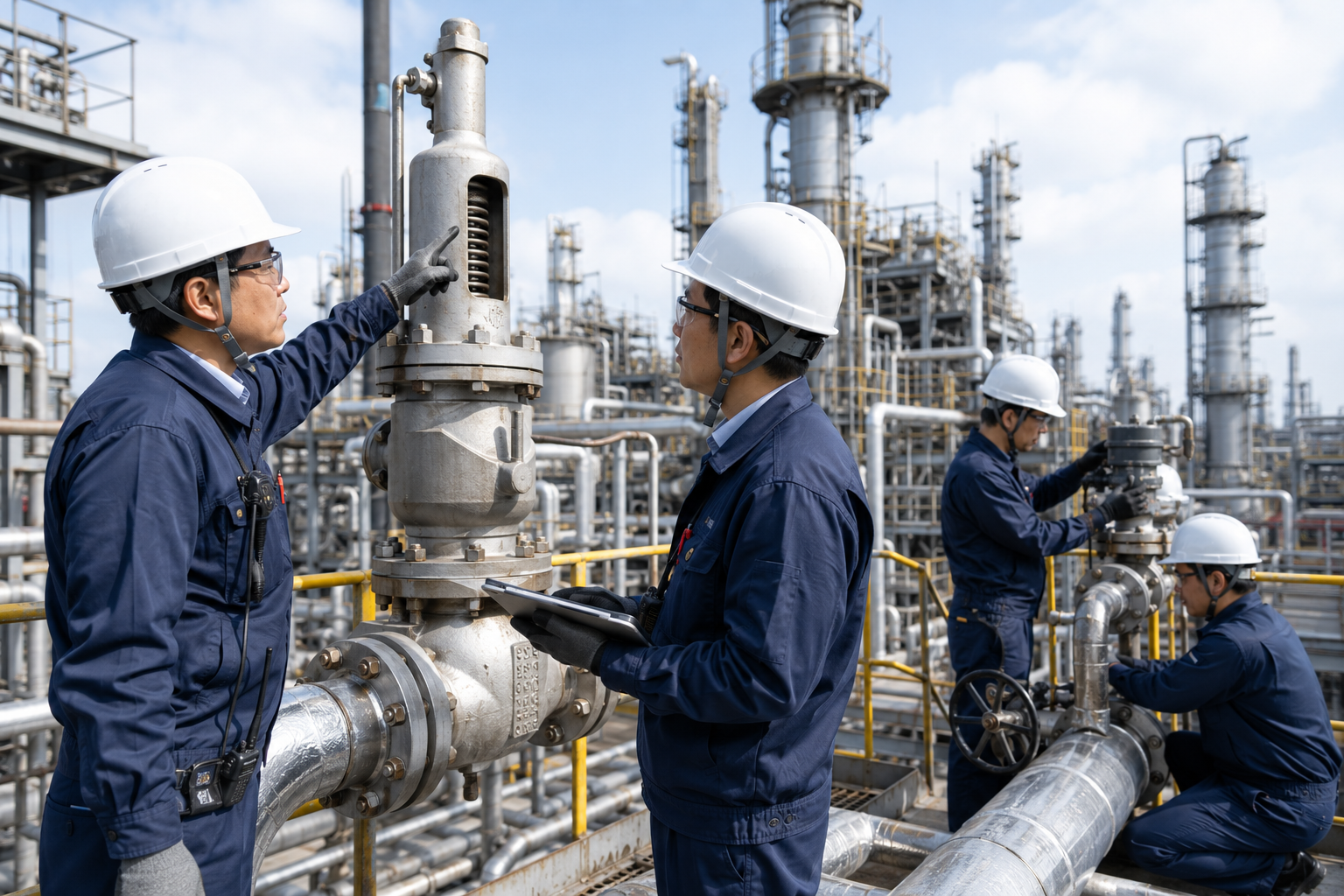
Safety valves in petrochemical plants are the last line of defense in processes that handle high-temperature, high-pressure fluids. They automatically release pressure that exceeds the equipment’s set pressure to the outside, preventing serious accidents such as rupture or explosion of vessels and piping. The two most important points in selection are that “the discharge capacity exceeds the anticipated overpressure of the equipment to be protected” and that “the material and type are suited to the service fluid and temperature.” In inspection, the focus is on verifying the operating pressure and managing seat leakage. This article organizes, from a practical standpoint, the key points to keep in mind for safety valve selection and periodic inspection, taking into account conditions specific to petrochemical plants.
Key points of this article
- Selection is judged along three axes: “required discharge capacity,” “set pressure,” and “a type and material suited to the service conditions (fluid, temperature, back pressure).”
- Under high temperature and high pressure, thermal expansion, back pressure fluctuation, and deterioration of the seat surface affect operation, so it is a prerequisite to grasp the conditions in numerical terms.
- For inspection, it is effective to periodically record and track the set pressure, seat leakage, external leakage, and operating response to follow changes over time.
The role of safety valves in petrochemical plants and the basics of selection
When the pressure inside piping or a pressure vessel reaches the set value (set pressure at start of discharge), a safety valve overcomes the spring force so that the valve disc opens, releasing a specified amount of fluid to suppress the pressure rise within the system. In petrochemical plants, multiple overpressure causes are anticipated to occur simultaneously, such as runaway reaction heat, erroneous operation of shutoff valves, and expansion of contents due to an external fire. For this reason, a safety valve is not simply “a valve that releases pressure”; the starting point of selection is whether it satisfies the required discharge capacity for each anticipated scenario.
How to think about required discharge capacity and set pressure
In selection, you first identify the maximum anticipated overpressure generation for each item to be protected, then select a type and bore size with a discharge capacity that exceeds it. The set pressure is determined based on the maximum working pressure of the item to be protected, taking into account the difference from the back pressure and process pressure (the spring margin). If the normal operating pressure of the process is too close to the set pressure, even slight fluctuations tend to cause seat leakage or inadvertent discharge, so it is generally recommended to secure an appropriate margin. The figures are only a guideline, and the actual judgment depends on the design conditions of each piece of equipment.
How to select type and material for high-temperature, high-pressure, and back pressure conditions
For high-temperature fluids, you need to allow for the effects of heat on the spring characteristics and seat surface, as well as dimensional changes due to thermal expansion. For systems where the back pressure fluctuates, or where the valve is connected to a closed discharge line, bellows-type or pilot-operated types, which are less affected by back pressure, become candidates for consideration. The material is selected according to the corrosivity and temperature of the service fluid, and for corrosive gases, high-temperature steam, and the like, it is essential to confirm the suitability of the body and trim materials. In petrochemical plants, flammable and toxic fluids are often handled, so it is important to consider the whole system, including a structure that suppresses external leakage and the treatment of the discharge destination.
Points that are easily overlooked in periodic inspection and maintenance
Precisely because a safety valve is a device that “normally does not operate,” it is necessary to periodically confirm that it will operate reliably when needed. The focus of inspection is confirming whether the set pressure (set pressure at start of discharge) is as specified, whether seat leakage is within the permissible range, and whether there is any external leakage or sticking.
Operation confirmation and seat leakage management
Operation confirmation is fundamentally based on measuring the set pressure with a dedicated test device. Because the method of confirming by bringing the pressure close to the set pressure during operation has a large impact on the system, many sites use post-removal testing or a test mechanism that applies force from the outside. Seat leakage arises from a combination of factors such as operation at a normal pressure close to the set pressure, entrapment of foreign matter or scale, and aging deterioration of the seat surface. When leakage is confirmed, you should isolate the cause and then consider maintenance or parts replacement.
Aging deterioration and how to keep records
In high-temperature, high-pressure environments, spring set (weakening), wear of the seat surface, and internal corrosion or deposits progress easily, and rather than appearing all at once, these gradually change the operating characteristics. By recording the measured set pressure value and the state of leakage at each inspection and following the trend over the years, it becomes easier to plan and judge the timing of replacement or maintenance. The maintenance cycle differs depending on fluid conditions, frequency of use, and legal requirements, so rather than applying a uniform standard, it is desirable to set it for each piece of equipment.
Frequently asked questions
Q1. What is the difference between a safety valve and a relief valve?
A1. In general, a safety valve is for gases and steam and operates with a rapid (pop) action, while a relief valve is for liquids and operates with an opening proportional to the pressure. However, the terminology differs depending on the application and standard, so we recommend confirming it under the actual service conditions.
Q2. How close to the normal operating pressure can the set pressure be?
A2. Setting it too close is one cause of seat leakage and inadvertent discharge. Because the appropriate margin depends on the equipment conditions, it should be considered individually based on the normal operating pressure, back pressure, and permissible overpressure.
Q3. Which type is suitable for systems with fluctuating back pressure?
A3. Bellows-type or pilot-operated types, which are less affected by back pressure, become candidates for consideration. Selection is made after grasping the configuration of the discharge line and the range of back pressure in numerical terms.
Q4. What is a guideline for inspection frequency?
A4. It differs depending on fluid conditions, frequency of use, and legal requirements, and is not uniform. An effective approach is to set the cycle for each piece of equipment based on measured set pressure values and records of seat leakage.
Q5. If seat leakage occurs, is replacement always necessary?
A5. Replacement is not necessarily required. Multiple causes are conceivable, such as entrapment of foreign matter, deterioration of the seat surface, and closeness to the normal operating pressure. After isolating the cause, you judge whether maintenance or replacement is needed.
Q6. What should be given particular attention with high-temperature fluids?
A6. The effects of heat on the spring characteristics and seat surface, thermal expansion, and material suitability. Clarify the service temperature and fluid in numerical and specification terms, and confirm the body and trim materials.
Summary
Safety valves in petrochemical plants are devices that help prevent serious accidents by being selected on the axes of required discharge capacity, set pressure, and suitability to the service conditions, and by building up records of operation confirmation and inspection for seat leakage and external leakage. Under high-temperature, high-pressure conditions, heat, back pressure, and aging deterioration affect the operating characteristics, so grasping the conditions in numerical terms is a prerequisite for selection and maintenance.
If you have concerns such as “I cannot judge whether the discharge capacity of the current safety valve is sufficient for the anticipated overpressure,” “I want to confirm whether the margin between the normal operating pressure and the set pressure is appropriate,” “I want to select a type suited to a discharge line with fluctuating back pressure,” or “I want to select an equivalent product for an existing valve,” please make use of Yoshitake’s technical consultation and selection consultation based on your conditions such as the service fluid, temperature, pressure, and back pressure. We will help you consider the type, material, and bore size that match your equipment conditions.