
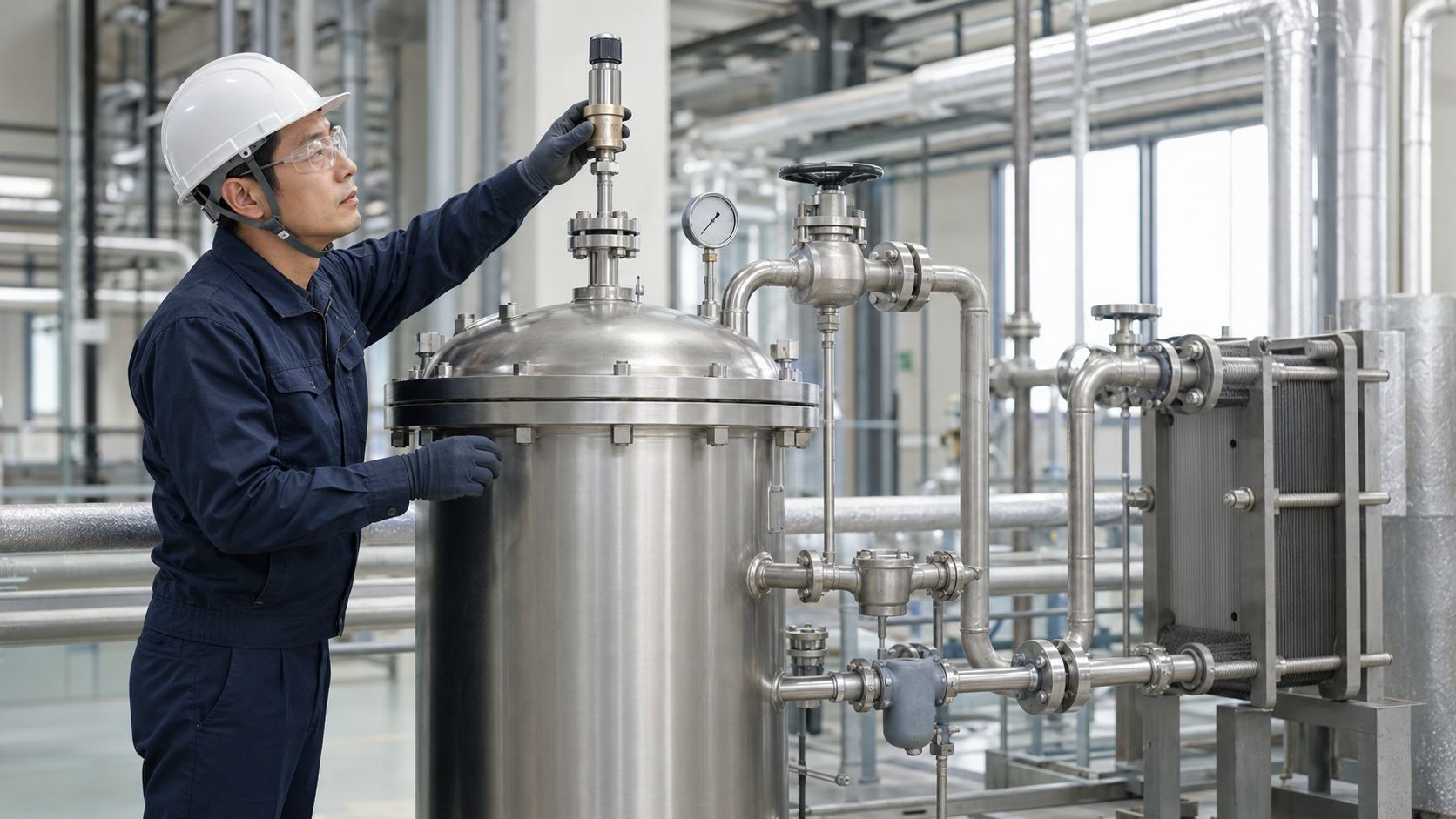
A vacuum breaker is a valve that admits air when the pressure inside piping becomes negative, restoring the pressure to near atmospheric and thereby preventing or suppressing the back-flow of condensate and the reverse-siphon phenomenon caused by negative pressure. In steam equipment in particular, residual steam can condense after the steam supply is shut off, and this can create negative pressure inside the piping. If this negative pressure is left unaddressed, condensate and air are drawn back toward the equipment, contributing to uneven heating and corrosion. The vacuum breaker serves to eliminate the very suction force that drives this.
Key points of this article
- When piping becomes negatively pressurized due to the condensation of steam, back-flow of condensate and the reverse-siphon phenomenon can occur.
- A vacuum breaker admits air to return the pressure to near atmospheric, suppressing suction caused by negative pressure.
- The key to getting results is installing it correctly on the system where negative pressure occurs, at a position where it will not be submerged.
How negative pressure comes to damage equipment
When steam condenses, the piping becomes negatively pressurized
Steam is a gas. When it cools, it returns to water (condensate) and its volume contracts sharply. If residual steam condenses while the steam space is shut off, there is no way for air to enter and make up for the reduced volume, and the piping can become negatively pressurized.
Negative pressure does not necessarily occur every time steam is shut off. Depending on the configuration of the system, the opening and closing of valves, and the degree of cooling by the surrounding air, it may or may not become a problem. In practical terms, it is realistic to think in terms of “applying countermeasures to systems where negative pressure becomes a problem.”
The back-flow and siphon phenomenon that negative pressure invites
When the piping becomes negatively pressurized, a force acts to draw in surrounding water and air. This leads to back-flow of condensate and the so-called reverse-siphon phenomenon. When condensate or air accumulates inside the equipment, the heating surface does not warm evenly, contributing to uneven heating and corrosion.
Even when it appears to be a malfunction of the equipment itself, the actual cause may lie on the negative-pressure side. Checking not only the symptoms but also how the pressure inside the piping changes before and after the steam is shut off makes it easier to isolate the cause.
How a vacuum breaker cuts off negative pressure
It “lets air in” to restore the pressure to near atmospheric
Whereas an air vent valve is a valve that “lets air out,” a vacuum breaker is a valve that “lets air in.” When the piping becomes negatively pressurized, the valve opens to admit outside air, restoring the pressure to near atmospheric. This prevents or suppresses the back-flow and reverse-siphon phenomenon caused by negative pressure. Note, however, that it is not a device that eliminates back-flow from every possible cause.
During normal operation, when the interior is pressurized, the valve remains closed to prevent the escape of steam. Understanding it as a passive valve that operates only when negative pressure occurs makes it easier to handle.
How to think about the installation position
The effect depends greatly on the installation position. Some vacuum breakers for steam service specify installation at “the highest point of a system that will not be submerged by condensate.” At a position that becomes submerged, the valve draws in water under negative pressure, making it difficult to obtain the intended function.
The actual mounting position and bore size should be determined by applying the instruction manual of the product to be used together with the equipment configuration. For systems in which the secondary side becomes negatively pressurized, there is also guidance to combine a vacuum relief valve (vacuum breaker valve).
Frequently asked questions
Q1. What is the difference between a vacuum breaker and an air vent valve?
A1. An air vent valve is a valve that discharges air from inside the piping to the outside, while a vacuum breaker is a valve that admits air into the interior when negative pressure occurs. Their purposes are opposite, and the two play different roles.
Q2. Does shutting off the steam always produce negative pressure?
A2. Not always. Negative pressure can arise from the condensation of residual steam, but its degree varies depending on the system configuration and cooling conditions. Countermeasures are considered for systems where negative pressure becomes a problem.
Q3. Can this completely stop back-flow?
A3. Its purpose is to prevent or suppress back-flow and the reverse-siphon phenomenon caused by negative pressure. It is not a device that prevents all back-flow arising from causes other than negative pressure, such as pressure differences or inflow from other systems.
Q4. Where should it be installed?
A4. The basic principle is a high position that will not be submerged in condensate, on the system where negative pressure occurs. The specific position and bore size are selected in accordance with the product’s instruction manual and the equipment configuration.
Q5. How should it be used differently from a vacuum relief valve?
A5. For systems in which the secondary side becomes negatively pressurized, there is guidance to use a vacuum relief valve (vacuum breaker valve). Because the suitable product changes depending on the system conditions, we recommend selection tailored to the configuration.
Summary and consultation
Negative pressure arising from the condensation of steam, if left unaddressed, leads to back-flow of condensate and uneven heating. A vacuum breaker is a valve that admits air under negative pressure, returning the pressure to near atmospheric and suppressing suction. To bring out its effect, it is essential to install it appropriately on the system where negative pressure occurs, at a position where it will not be submerged.
In situations such as “I cannot judge whether negative pressure is the cause of the equipment malfunction,” “I do not know how to decide the installation position and bore size,” or “I want to select an equivalent for an existing valve,” selection based on an organized understanding of the system conditions is effective. Yoshitake offers technical and selection consultations for vacuum breakers and vacuum relief valves suited to the configuration of your steam equipment. Please consult us with your drawings and operating conditions at hand.