
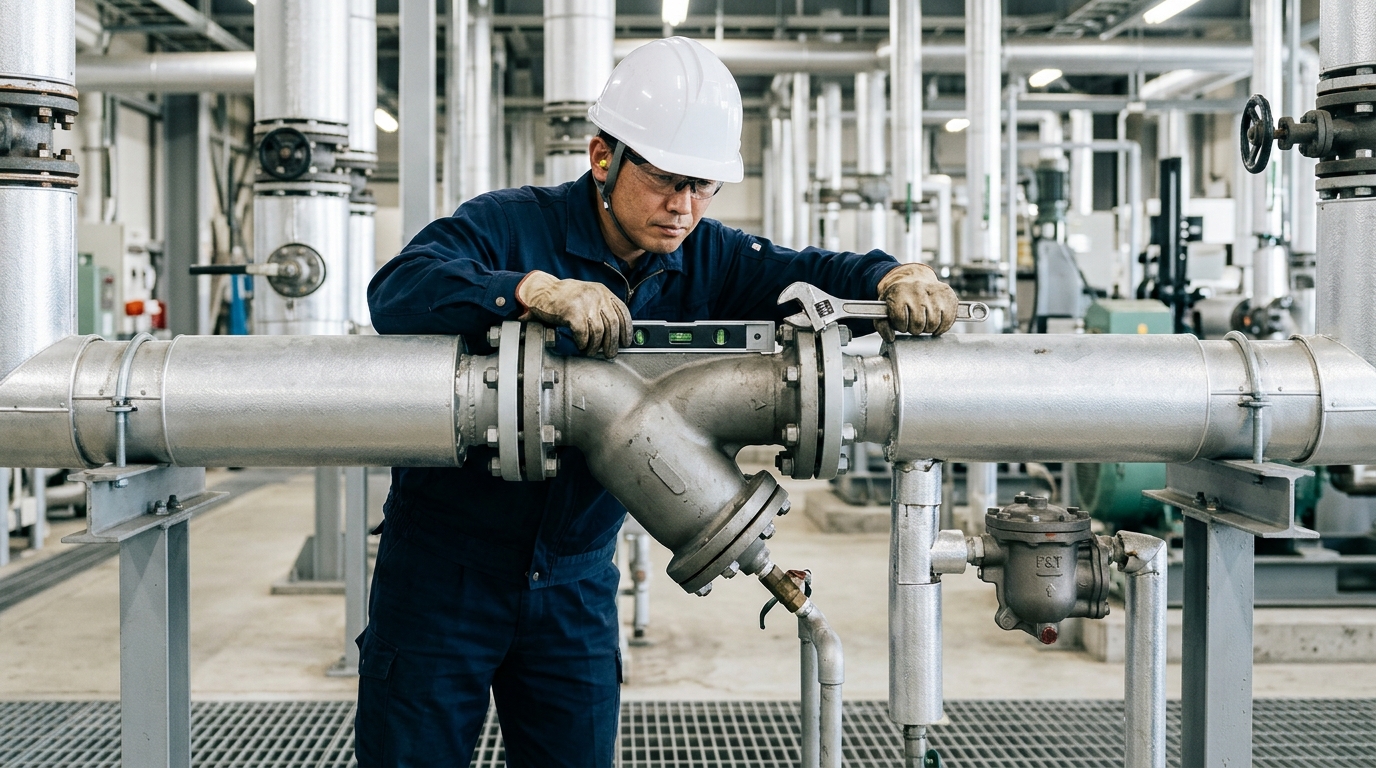
Installing a separator in a steam line separates out the condensate (water droplets) entrained in the steam, allowing higher-dryness steam to be delivered to equipment, which helps reduce uneven heating and product defects. Dryness fraction is an indicator that expresses the ratio between the “gaseous steam” and the “liquid water droplets” contained in steam; the fewer the droplets and the drier the steam, the closer the value approaches 1.0. A separator is a device for keeping this dryness fraction high at the inlet of the equipment. As one of the factors that influence heating stability and heat exchange efficiency, separators are adopted in many steam installations.
Key Points of This Article
- A separator separates condensate from steam and supplies high-dryness steam to equipment
- Steam with a low dryness fraction tends to be a contributing cause of reduced heat exchange efficiency and uneven heating
- Installation location, bore size, and the combination with a trap all affect the results
How a Separator Contributes to Quality Improvement
The Influence of Dryness Fraction and Condensate in Steam
In steam piping, part of the steam can revert to water droplets (condensate) due to condensation from heat loss, load fluctuations, and similar factors. Steam containing a large amount of condensate has a lower dryness fraction, and even at the same pressure the amount of latent heat actually transferred tends to diminish.
Effects that condensate in steam has on heating include the formation of a water film on the heat transfer surface that impedes heat transfer, and time-varying fluctuation in the amount of condensate flowing into equipment that makes heating difficult to stabilize. As a result, phenomena such as partial variation in the temperature of the heated object or delayed warm-up can occur. Because uneven heating involves multiple factors—not only the state of the steam but also the heat transfer design of the equipment and operating conditions—it is appropriate to regard the management of the dryness fraction as one important factor among them.
A separator abruptly changes the direction of the steam flow inside it and uses the difference in inertia to separate the heavier water droplets from the main steam flow. The separated condensate is collected at the bottom and discharged out of the system through a steam trap. This makes it easier to secure high-dryness steam at the equipment inlet.
Approach to Installation Location and Combination
To obtain the effect of a separator, it is common to install it on the upstream side and as close as possible to the equipment where the dryness fraction is to be raised. If it is placed too far from the equipment, condensate can form again in the piping after separation, lowering the dryness fraction.
The condensate separated by the separator must also be discharged reliably. Many designs provide, at the bottom, a space to temporarily collect the condensate and a section to receive scale and debris, and an appropriate steam trap is connected here. If discharge is delayed, the accumulated condensate is carried back over to the steam side, and the moisture that was so carefully separated ends up flowing into the equipment. For this reason, it is desirable to plan the installation to include the selection and maintenance of the trap.
Points to Note
It is a prerequisite that a separator be selected appropriately for the bore size and pressure conditions. An oversized or undersized selection affects pressure loss and separation performance. In systems where the intrusion of air (non-condensable gas) is an issue, separate measures such as air venting may be required, and a separator alone does not resolve every quality issue. It is important to make a comprehensive judgment based on the actual operating pressure, flow rate, and load fluctuations.
Frequently Asked Questions
Q1. What does dryness fraction refer to?
A1. It is an indicator that expresses the mass ratio between the gaseous steam and the liquid water droplets contained in steam. The fewer the droplets, the closer the value approaches 1.0. The drier the steam, the more stable the heating that can be expected.
Q2. What is the difference between a separator and a steam trap?
A2. A separator is a device that separates water droplets from steam within the flow. A trap is a valve that discharges accumulated condensate out of the system. The two serve different roles and are generally used in combination.
Q3. Where should it be installed?
A3. The basic principle is to install it on the upstream side of the equipment where the dryness fraction is to be raised, as close to it as possible. If it is far away, condensate can form again in the piping after separation, and the effect may diminish.
Q4. Will installation always eliminate uneven heating?
A4. It cannot be stated unconditionally. Uneven heating involves multiple factors such as heat transfer design and operating conditions. Improving the dryness fraction is one effective measure, but verification across the entire system is necessary.
Q5. How is the bore size determined?
A5. It is selected based on the operating pressure, flow rate, allowable pressure loss, and similar factors. Simply matching it to the pipe size can result in an oversized or undersized selection, so it is advisable to organize the conditions and make a judgment.
Q6. Are there points to watch out for in maintenance?
A6. It is important to confirm the operation of the trap that discharges the separated condensate. If discharge is delayed, the accumulated moisture returns to the steam side, which can lead to a decline in the dryness fraction. Periodic inspection is a good guideline.
Summary
A separator separates the condensate in steam and supplies high-dryness steam to equipment, supporting stable heating and the maintenance of heat exchange efficiency. To fully draw out its effect, it is essential to examine the installation location, bore size, and combination with a steam trap in accordance with the operating conditions.
If you have concerns such as “we want to isolate the cause of uneven heating or temperature variation,” “we cannot judge how high the dryness fraction should be raised at the equipment inlet,” “we do not know the appropriate bore size or type for our operating pressure and flow rate,” or “we want to select an equivalent product for an existing separator,” please make use of Yoshitake’s technical and selection consultation services. We will help you select a suitable model while organizing your operating conditions.