
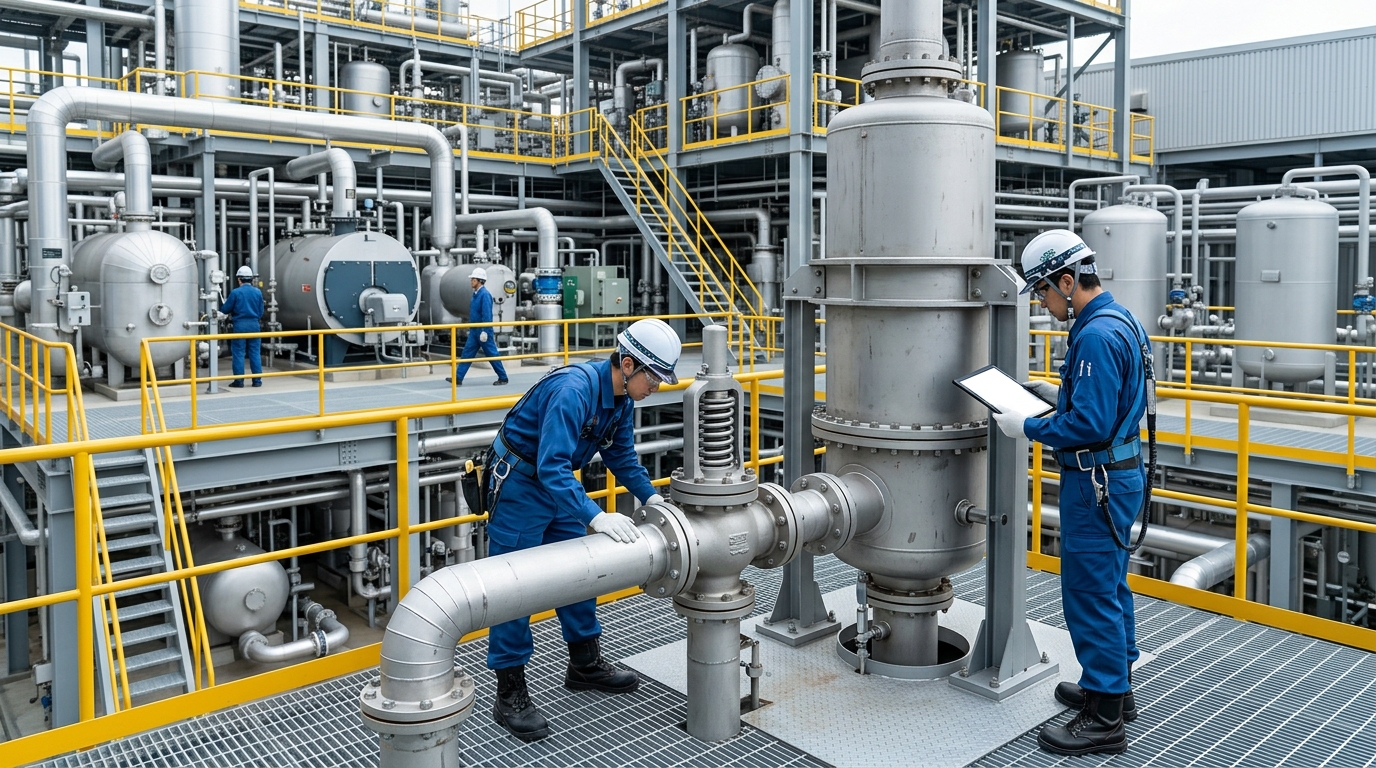
When a safety valve operates and discharges steam or gas into the atmosphere, an extremely high level of noise is generated at the outlet. A silencer (muffler) is a component fitted to the discharge end of the piping in order to reduce this blowdown noise. Its effect lies in expanding, straightening, and absorbing the fluid so as to attenuate the sound energy, and when conditions are favorable a reduction on the order of ten-plus dB(A) can generally be expected. However, because the amount of reduction varies with flow rate, pressure, frequency, and installation conditions, it cannot be stated uniformly that “the level will always drop by a certain number of dB.” This article organizes the mechanism by which noise arises, the way to think about a silencer’s effect, and the criteria for making a selection.
Key points of this article
- A silencer is a component that attenuates the noise of the high-speed jet generated during a safety valve’s blowdown by means of expansion, straightening, and sound absorption
- The amount of reduction varies with conditions such as flow rate, pressure, frequency, and path length, so it is reasonable to treat it as a rough guide
- In selection, confirm “target fluid, discharge quantity, inlet pressure, discharge direction, and the influence of back pressure” as a set
Safety valve blowdown noise and the effect of a silencer
The mechanism by which noise is generated
When a safety valve opens, the steam or gas throttled within the valve passes through the outlet piping and is discharged into the atmosphere at high speed. The main reason the sound pressure level becomes high at this time is the intense shearing and turbulence between the atmosphere and the high-speed jet generated near the outlet. The jet noise tends to increase as the flow velocity approaches the sonic range, and it can generally be organized that the larger the discharge quantity and the higher the inlet pressure, the greater the noise tends to be.
Noise cannot be narrowed down to a single cause; it arises from a combination of multiple factors, including the turbulence of the jet itself, uneven flow within the piping, and the shape of the discharge end. Because the frequency characteristics also change depending on the fluid conditions, the effectiveness of countermeasures is not uniform either.
The mechanism by which a silencer delivers its effect
A silencer is a component fitted to the discharge end to attenuate sound energy. Its main actions can be organized into the following three.
The first is expansion. By widening the flow-path cross section internally to let the fluid expand once, the jet velocity is reduced, which softens the shearing that occurs as the fluid exits into the atmosphere. The second is straightening. Internal perforated plates and flow-straightening structures smooth out unevenness and turbulence in the flow, suppressing the abrupt pressure fluctuations during discharge. The third is sound absorption. By passing the flow through sound-absorbing material or a resonant structure, sound in specific frequency bands is absorbed and attenuated. Through the combination of these, the sound pressure level at the discharge end is lowered.
The effect is condition-dependent: the low-frequency side is difficult to reduce with sound-absorbing material alone, whereas the high-frequency jet noise tends to respond to expansion and straightening. For this reason, it is important that the structure suits the assumed fluid conditions.
Criteria to confirm at the time of selection
When selecting a silencer, first grasp the fluid conditions rather than the acoustic figures alone. Specifically, confirm the target fluid (steam, air, or other gas), the nominal diameter and discharge quantity of the safety valve, the inlet pressure, and the discharge direction (upward or horizontal). The larger the discharge quantity and pressure, the larger the required silencer capacity and bore tend to be.
Next, confirm the influence of back pressure. Adding a component at the discharge end produces some degree of flow resistance, which can become a back pressure that affects the operation of the safety valve. Because a safety valve may be unable to deliver its rated discharge capacity when the back pressure becomes excessive, it is advisable to also examine whether the silencer’s flow resistance stays within the allowable range.
On the installation side, it is reassuring to also confirm the height and orientation of the discharge end, the support strength (whether it can withstand the reaction force during blowdown), the handling of drain and rainwater, and weather resistance for outdoor use.
Frequently asked questions
Q1. How much does a silencer reduce noise?
A1. It depends on the conditions, but a reduction on the order of ten-plus dB(A) is generally taken as a rough guide. The actual amount of reduction varies with flow rate, pressure, frequency, and installation.
Q2. Will the same silencer fit any safety valve?
A2. No. It must be selected to match the nominal diameter, discharge quantity, and connection shape. A mismatch can cause insufficient effect or excessive back pressure.
Q3. Does fitting a silencer affect the performance of the safety valve?
A3. A back pressure arises from the flow resistance. Because an excessive level can affect the discharge capacity, a selection that stays within the allowable back pressure is a prerequisite.
Q4. Does the selection method differ between steam use and air use?
A4. The conditions change with the target fluid. For steam, drain handling is a point of consideration; for air and gas, flow rate and pressure are the main points, and the approach to structure and capacity differs.
Q5. Are there points to watch for outdoor installation?
A5. Confirm rainwater ingress, drain removal, support strength, and the weather resistance of the sound-absorbing material. Also consider the orientation of the discharge end and consideration for the surroundings.
Q6. Can it be retrofitted to an existing safety valve?
A6. If the bore and shape of the discharge end match, a retrofit can also be considered. Because confirmation of the discharge quantity and allowable back pressure is required, please organize the conditions and consult us.
Summary
A silencer is a component that attenuates the noise of the high-speed jet generated during a safety valve’s blowdown by means of expansion, straightening, and sound absorption. Because the effect varies with conditions, treat the figures as a rough guide and confirm the target fluid, discharge quantity, inlet pressure, discharge direction, and allowable back pressure as a set; doing so leads to a selection free of failure.
If you have concerns such as “we know the discharge quantity but cannot judge how far the noise will drop,” “we want to confirm that the back pressure when a silencer is fitted will not affect the safety valve’s performance,” or “we want to select an equivalent product with a bore and shape that suits an existing safety valve,” please make use of Yoshitake’s technical and selection consultation. We will ask about your fluid and installation conditions and propose an appropriate way to select a silencer.