
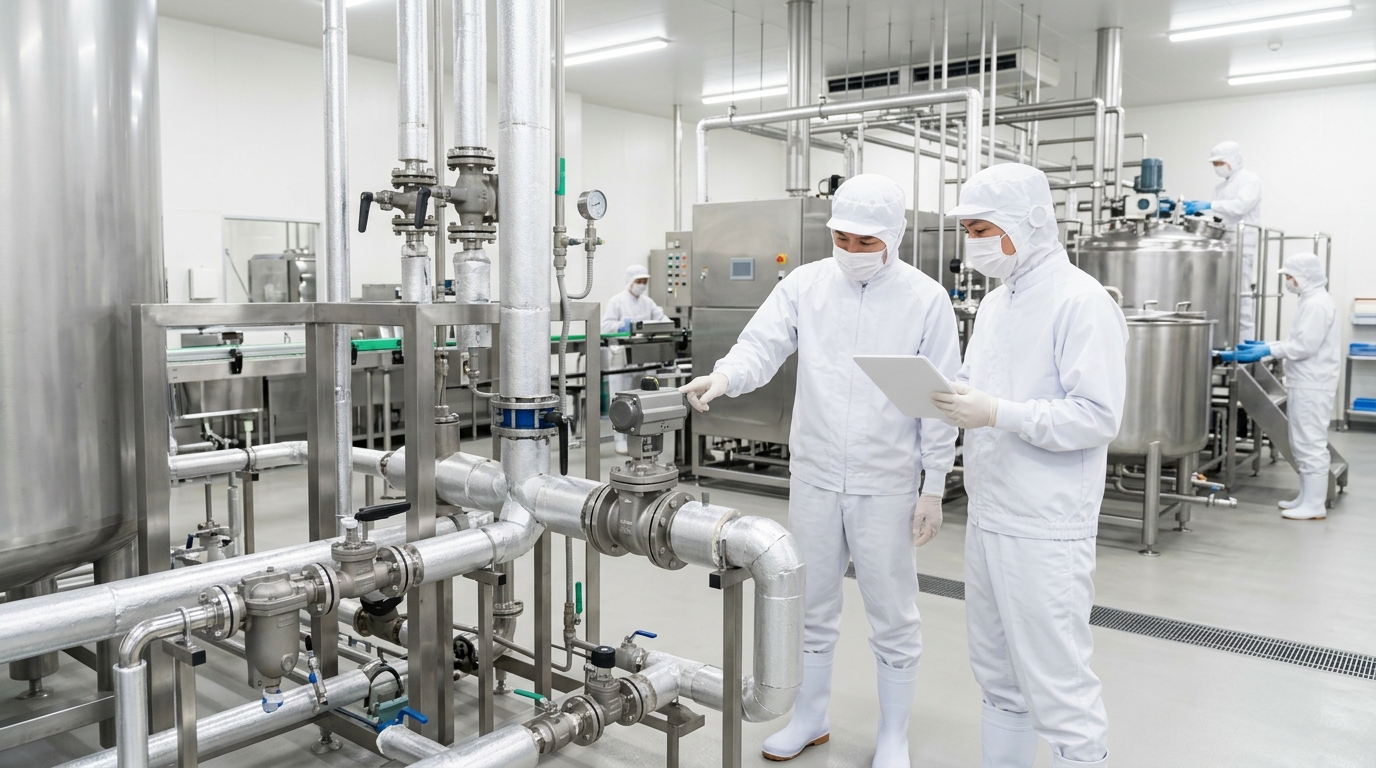
What the sites that achieved both energy savings and quality improvements through valve installation on steam lines have in common comes down to a single point: they took steam that had been delivered at its generated pressure and redesigned the system to reduce and stably control it to the pressure each piece of equipment actually required. Even without any special equipment upgrades, there are many cases where simply optimizing a line that had been operating at excessive and unstable pressure led to lower steam consumption and reduced heating unevenness. Here, we organize the installation patterns commonly seen in practice into conditional “models of success.” Because the results vary with pressure, flow rate, and operation, please treat all of them as rough guides.
Key points of this article
- Most energy savings start from “lowering excessive pressure to the required pressure”; there is no single magic valve.
- Quality improvement tends to come from uniform heating temperature achieved through “pressure stabilization,” and it is often obtained at the same time as energy savings.
- The sites that achieved results tend to understand, before installation, not only the maximum flow rate but also the minimum flow rate and the fluctuation of inlet pressure.
“Pressure optimization” as the common starting point of installation cases
When steam is sent to each piece of equipment at high pressure, still at its generated pressure, the equipment receives more heat than necessary, and steam consumption and heat dissipation tend to increase. A common pattern in installation cases is to place a pressure reducing valve at a key point in this piping and lower the pressure to what each piece of equipment requires. It is generally reported that by adjusting excessive pressure to an appropriate pressure, the use of surplus steam can be curbed.
The point is not the act of “lowering” itself, but that the pressure was set by working backward from the application to determine what the equipment requires. Because the required pressure differs by application, such as heating, sterilization, or drying, checking the specifications and operation of each piece of equipment first becomes the starting point for an installation that delivers results.
Quality improvement tends to arise from “pressure stabilization”
In cases where quality improvement was obtained together with energy savings, pressure stabilization is often the key. When the inlet pressure fluctuates, the steam temperature also swings, which can lead to variation in heating temperature and heating unevenness. The idea is that by keeping the secondary-side pressure constant with a pressure reducing valve, the heating conditions stabilize, contributing to improved finish quality and yield.
That said, the effect is also influenced by the magnitude of load fluctuation and the characteristics of the equipment. On a line where pressure tends to rise at low load, selecting the valve with an eye to controllability even in the minimum flow range serves as a useful guide.
What to nail down before installation to reproduce the results
The reason results differ even when the same valve is installed lies largely in the accuracy of the condition assessment done beforehand. The sites that went well tend to identify not only the maximum flow rate, but also the minimum flow rate that changes between startup and steady state, and the fluctuation range of inlet pressure. This is because matching the valve directly to the pipe size leads to oversizing, which can weaken responsiveness in the minimum flow range or make control unstable.
Evaluate through post-installation operation and maintenance as well
To sustain the installation benefits, it is essential to also curb leakage from connections and glands and heat dissipation from insufficient insulation. These are modest but tend to produce results, and checking them during periodic inspections makes it easier to maintain the energy-saving effect over the long term. Installation is not a one-time job; treating it on the premise that conditions will be reviewed as operation changes improves accuracy.
Frequently asked questions
Q1. Specifically, how much energy can be saved by installing a pressure reducing valve?
A1. Because the effect varies greatly with pressure conditions, flow rate, and operation, we cannot present a uniform figure. Please think of it as a rough guide: lowering excessive pressure to the required pressure tends to lead to reduced steam consumption and heat dissipation.
Q2. Can energy savings and quality improvement be obtained at the same time?
A2. Pressure stabilization tends to lead to more uniform heating conditions, and cases where energy savings and quality improvement are obtained at the same time are generally seen. However, there are differences due to load fluctuation and equipment characteristics.
Q3. Do results require a large-scale equipment upgrade?
A3. Not necessarily. There are cases where improvement resulted simply from optimizing a line that had been operating at excessive and unstable pressure. You can start by considering a review of the current pressure settings.
Q4. Is a case study helpful even if my conditions differ from it?
A4. The thinking behind installation (working backward to the required pressure, stabilizing pressure, and selecting based on actual flow rate) can be applied in common. Please use the order of judgment as a reference rather than the figures themselves.
Q5. In what cases are results hard to achieve?
A5. When the minimum flow rate is extremely small or the inlet pressure fluctuates widely, matching only the bore size while the conditions remain insufficiently understood may fail to deliver the expected controllability.
Q6. Can I aim for equivalent results by replacing an existing valve?
A6. Rather than selecting an equivalent product by model number alone, check whether the flow rate, pressure, and operation have changed between the time of the original installation and now. If operation has changed, reviewing the conditions at the time of replacement improves accuracy.
Summary
What the sites that achieved steam energy savings and quality improvement have in common comes down to a single point: they took steam that had been delivered at its generated pressure and redesigned the system to reduce and stably control it to the pressure each piece of equipment required. Energy savings tend to arise from optimizing excessive pressure, and quality improvement from stabilizing pressure, and the two are often obtained at the same time. In every case, starting from a rough guide and translating it into your own actual flow rate, pressure, and operation is what determines reproducibility.
If you have concerns such as “I know the pipe size but cannot judge whether the bore is appropriate,” “I understand the maximum flow rate but the minimum flow rate is unknown,” or “I want to select an equivalent to an existing valve but the operation has changed,” please organize your conditions and make use of Yoshitake’s technical and selection consultation. Based on the application, required pressure, and flow conditions, we will work with you to consider a valve selection that leads to energy savings and quality improvement.