
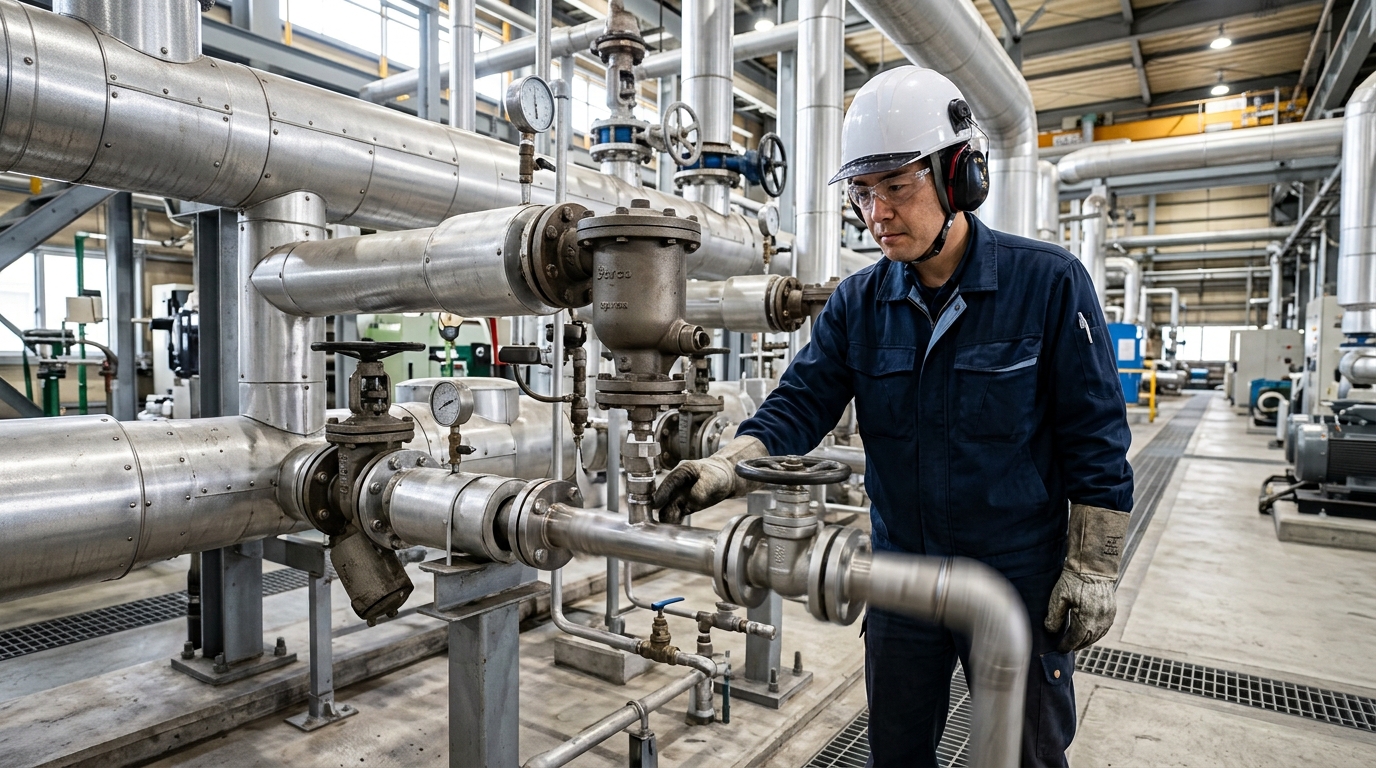
To stop the severe vibration and noise in steam piping—so-called water hammer—two fundamentals must be addressed: reliably discharging the condensate (drain) that accumulates inside the piping, and avoiding sudden valve operation and abrupt changes in flow velocity. Water hammer does not arise from a single cause; it occurs when factors such as condensate retention, sudden valve opening and closing, and rapid changes in flow velocity act in combination. Countermeasures, therefore, are most realistically advanced from both sides: condensate discharge (proper placement of steam traps and adequate slope) and operation (gradual warm-up and controlled valve operation). This article organizes the main mechanisms behind the vibration and noise that occur in steam piping, along with specific countermeasures that can be taken in the field.
Key points of this article
- Water hammer occurs not only when condensate is pushed along by steam, but also from multiple factors such as sudden valve operation and abrupt changes in flow velocity.
- The pillars of countermeasures are reliable condensate discharge (slope, steam traps, air venting) together with gradual warm-up and controlled valve operation.
- There is no single cure-all; it is important to identify the contributing factors for each piping system and combine measures accordingly.
Main mechanisms by which water hammer occurs
Vibration and noise in steam piping arise from several phenomena, singly or in combination. The representative ones are outlined below.
Water hammer caused by retained condensate (drain)
In piping that is shut down or insufficiently warmed up, the steam cools and condensate (drain) forms and collects at the bottom of the pipe. When steam then flows in, the accumulated condensate is pushed out and travels at high speed, striking bends, valves, and points of obstruction to produce shock and noise. In addition, when high-temperature steam contacts condensate and the steam condenses abruptly, surrounding water rushes into the resulting void all at once, and a strong shock pressure (water hammer caused by steam condensation) can occur. If a violent sound is produced immediately after start-up (during warm-up), retained condensate is the suspected cause.
Water hammer caused by sudden valve operation and abrupt changes in flow velocity
When the velocity of the fluid flowing through the piping changes suddenly, the kinetic energy is converted into pressure fluctuation, and pressure waves travel back and forth through the pipe, producing vibration and noise. Actions such as abruptly closing a valve, abruptly opening a valve, or a sudden pump stop tend to be the trigger, and this can occur regardless of whether condensate is present. The same applies not only to steam systems but also to liquid piping; the higher the flow velocity relative to the bore, the greater the shock tends to be.
Mixed gas-liquid flow and unstable flow
In a two-phase flow state where steam and condensate flow together, the flow may pulsate and vibration may continue. This tends to occur when conditions overlap—such as condensate not being sufficiently separated and discharged, or an improper slope that prevents the water from draining away.
Specific measures to stop vibration and noise
Because there are multiple contributing factors, countermeasures also combine several approaches. First identify which factor is dominant in your own system, and then consider the following items.
Discharge condensate reliably
- Provide a downward slope in the direction of steam flow (generally, as a rough guide, on the order of 1/100 to 1/250) so that condensate flows readily.
- Install a reservoir to catch condensate (a drain pocket) and a steam trap at low points such as before long horizontal runs or risers, and at pipe ends. If a drain pocket is too small in bore or depth, it cannot collect all the condensate and becomes a cause of retention, so secure a size that matches the amount of condensate to be collected.
- Select a steam trap of a type and capacity suited to the load and pressure conditions. Insufficient capacity or malfunction leaves the large volume of condensate generated during warm-up incompletely discharged, leading to retention.
- Provide air venting (an air vent) as needed to release the air that accumulates in the piping at start-up.
Practice gradual warm-up and controlled valve operation
- At start-up, rather than fully opening the main valve at once, warm up (warming-up) slowly with a small amount of steam before transitioning to normal operation; this makes it easier to suppress water hammer caused by the large volume of condensate generated in the initial phase.
- Do not open or close valves abruptly; operate them gradually. In systems where sudden shut-off is unavoidable, adopting a valve that closes slowly or equipment that mitigates pressure fluctuation is also an option.
- Stabilizing pressure and flow rate with a device such as a pressure reducing valve can, in some cases, be effective in suppressing abrupt changes in flow velocity.
Reviewing accessory equipment and layout
- A strainer or separator may be installed for the purpose of separating and removing condensate. A strainer’s main purpose is the removal of foreign matter, and changing its mounting orientation does not in itself resolve water hammer. Consider the installation orientation only to the extent that a horizontal orientation is recommended from the standpoint of avoiding condensate pooling; the fundamental countermeasures lie in condensate discharge and operation.
- Also inspect whether the piping route has dead ends or reverse slopes where water tends to collect, and whether loose support fittings are amplifying the vibration.
Note that all of the figures above are general rough guides; the actual appropriate values vary with conditions such as steam pressure, flow rate, piping length, and operating pattern.
Frequently asked questions
Q1. Is condensate the only cause of water hammer?
A1. No. Retention of condensate is one of the main causes, but water hammer also occurs from sudden valve operation and abrupt changes in flow velocity. Multiple factors often overlap, so identifying them for each system is necessary.
Q2. Will installing a steam trap stop it?
A2. A trap is effective for condensate discharge, but if its capacity or installation location is not appropriate, retention will remain. Reviewing it together with the slope and the size of the drain pocket is a prerequisite.
Q3. Why is the noise loud immediately after start-up?
A3. This is thought to be because condensate that accumulated during shutdown is pushed out when warm-up begins. It can be reduced by gradual warm-up and by securing a discharge route for start-up condensate.
Q4. Will simply operating the valve slowly fix it?
A4. Effectiveness can be expected against water hammer caused by valve operation, but if the cause is condensate retention, a separate discharge measure is required. We recommend first determining the contributing factor.
Q5. Will changing the strainer orientation resolve it?
A5. A strainer’s main purpose is the removal of foreign matter, and it is not something that changing the mounting orientation alone will resolve. Horizontal installation is recommended only to a certain extent; the fundamental measures lie in condensate discharge and operation.
Q6. How much slope does the piping need?
A6. Generally, a downward slope on the order of 1/100 to 1/250 in the direction of steam flow is taken as a rough guide, but it differs depending on conditions. A design that does not produce reverse slopes or water pooling is important.
Q7. Does installing a pressure reducing valve serve as a water hammer countermeasure?
A7. By stabilizing pressure and flow rate, it can, in some cases, suppress abrupt changes in flow velocity. However, it is not a standalone solution; please consider it in combination with condensate measures.
Summary and consultation
The severe vibration and noise in steam piping (water hammer) arise from multiple factors such as condensate retention, sudden valve operation, and abrupt changes in flow velocity. The fundamentals for stopping it are reliable condensate discharge through a downward slope, drain pockets, and steam traps, together with gradual warm-up and controlled valve operation. Because there is no single cure-all, the shortcut is to identify the dominant factor for each system and combine countermeasures accordingly.
If you have concerns such as “I can’t judge where to install a trap,” “I’m unsure whether the trap’s capacity is sufficient as things stand,” “I don’t know whether the pressure reducing valve bore is appropriate,” or “I want to select an equivalent for an existing valve,” please consult Yoshitake along with your piping conditions (steam pressure, flow rate, piping length, operating pattern, and so on). As a technical and selection consultation, we will help you choose equipment suited to your conditions.